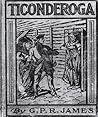
 Ticonderoga: A Story Of Early Frontier Life In The Mohawk Valley
by
George Payne Rainsford James
My rating:
5 of 5 stars
Despite some glaring flaws (which I will briefly discuss) I found this to be an excellent adventure novel or "romance" as they tended to call such books at the time. It is definitely in the tradition of Sir Walter Scott and the better books of Robert Louis Stevenson, though much harder to come by.
Set in upstate New York in the time of the French and Indian War, a short generation before the American Revolution, it is a story about war and love and the interaction of opposing European powers as well as opposing Native American confederacies. I have long had a sort of prejudice about stories from this time--supposing them dull and quaint--but I was wrong here, and have been proven wrong enough times now that I should retire that attitude for good. America at that time, especially on the frontier, was a very complex, very interesting place, and there is a lot of room for stories. This novel has a fast-moving plot with admirable and interesting characters, all mixed in with actual history in a way that I found very entertaining and even moving.
Yes, the novel suffers from the inevitable prejudices and blind spots of mid 19th Century men. The author clearly admires Native Americans and puts a lot of praise for them in his protagonists' mouths, but isn't shy about using words like "savage" to describe them. He shows a similar admiration for the Black characters in the story, slaves all, and makes several such characters accomplished in one way or another, but mostly forgets them, or treats their concerns as less significant than others', or makes them act somewhat childishly. He makes Edith and Otaitsa admirable and intelligent and courageous but still frames their femininity in terms of weakness or frailty. He shows decent tolerance for the beliefs of others, specifically regarding religious beliefs, but unashamedly promotes Christianity while being condescending or even argumentative about other faiths. In other words, he leans toward progressivism (for a man of his time) but is still accepting of every prejudice rampant at that time and gives those prejudices room to breathe. I recognize that much of the book--less than one might find in most writing at the time, but still significant--would require diverse readers to overlook a lot, ignoring things that might not have caused a murmur in 1850 but makes one grimace in 2021.
However, this is an oversimplification; the author shows a lot more nuance toward these characters than I can explain in a paragraph or two, and a case could be made that such moments and such speeches more nearly represent his true beliefs. Black Eagle, the Oneida sachem, is an excellent character, one whose principled stance and noble heart make him easy to love. His daughter, Otaitsa, and the young white woman, Edith, are both vital characters who take an active role in the novel, putting their skills and knowledge to use, having their own adventures within the context of the overall story. And several Black characters make key contributions to the plot through their knowledge, ingenuity, and perseverance. It is this more complete picture that helps make this novel not just palatable but exciting, engrossing, and a true pleasure to read.
IMO, always.
I enjoyed the author's language. The prose is descriptive and occasionally ornate, but still clear and energetic--nothing like the turgid language of James Fenimore Cooper (who I actually like) or even the brilliant but elaborate style of Sir Walter Scott (who I love). It is 19th Century writing, for sure, but feels more modern than other writing from the same era. And the author, as a historian who lived in the US for some time, does a good job with the actual historical setting.
There's a lot to enjoy here, and I was pleasantly surprised to like it so much. Unfortunately, It's difficult to find much of James' writing outside of gutenberg, but I need to find me some others, and I hope they hold up as well as this one does.
View all my reviews
 War Party by Louis L'Amour


