Showing posts with label Harold Lamb. Show all posts

Tuesday, December 20, 2022

A Fantastic Steppe Adventure

Kirdy: The Road Out of the WorldKirdy: The Road Out of the World by Harold Lamb
My rating: 5 of 5 stars

Set in 17th Century Russia, with Poles, Russians, Tartars, Turks, and representatives of many other ethnicities and communities, this is the story of a young Cossack given a mission to track down a traitor who successfully posed as the Tsar's son until he was forced to flee Moscow. Kirdy is the grandson of Khlit, a character who famously appears in many short stories from the age of pulp. At the beginning of this novel, Khlit is quite old, and when they learn that Otrepiev, the man who was supposedly the son of the tsar, the man currently oppressing the cossacks, was actually a fraud and a cossack himself, he sends his grandson to track him across the steppe and kill him.

That chase is the entirety of the novel, but the cool thing is that the story never flags. Kirdy is an honorable man, a tough man, unafraid and capable, and makes for a great hero. (It is no surprise to learn that Robert E. Howard, the creator of Conan and Solomon Kane, along with adventurers like El Borak, was influenced by Lamb's writing.) He encounters a beautiful, confident, tough Cossack woman named Nada, and they journey with a variety of other comrades, including his huge borzoi-wold hybrid, across the frozen land, chasing a man named Otrepiev through winter and through war. The great thing about Lamb is that he is a historian and makes his stories completely plausible, with accurate details about the land the people. It helps that he has obvious respect for the various inhabitants of central Asia and generally shows them in a favorable way, or at least fairly. (Some stereotypical characterization remains, but he was way ahead of most Westerners in the 1920s.)

This is a hard-driving action story with some romance (especially in the older sense of heroic or knightly adventure) and just a touch of fantasy feeling. The plot is a lot of fun, well paced and unforced, and is a pleasure to read. I think this was meant to be a novel for older boys, but technically that description includes me, so...

Recommended.

View all my reviews

Monday, June 6, 2022

Where Timur Emerges a Bit from the Shadows

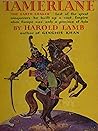
Tamerlane: The Earth ShakerTamerlane: The Earth Shaker by Harold Lamb
My rating: 4 of 5 stars

I had previously read a couple of his novels--Omar Khayyam and Nur Mahal--and thought this was another novel telling the fictionalized life of a historical figure. It isn't. It's actually a biography, and so has a very different feel. There are few scenes that feel intimate or genuine, since little of that survives in the historical sources, and it's a shame. I was disappointed.

Naturally, as a biography, the book is largely summarized narrative. Although it's well done, complete, concise, and as clear as such a complex story can be, and although it's much more compelling than a textbook or wiki article or other typical non-fiction source, it still isn't as engrossing as his novels. So: good--4 stars good--but not quite as fun as a novel might have been.

Oh well. It's all good.

I've learned to trust Harold Lamb's fairness and scholarship when approaching his books set in Asia and the Middle East. His attitude, as always, is surprisingly modern and inclusive for a white guy writing in the 1920s, writing as much as possible from the perspective of the people and cultures he's dealing with. This is clearest in the surprisingly even-handed way he treats Timur, a historical figure I'd always considered merely brutal without any positive qualities beyond making himself a successful conqueror. However, Lamb focuses just as much on Timur's personal bravery, quick thinking, economic programs, and relentless labor to build wealth and develop the lands of his empire as he does his bloody record. All those things are true about "Tamerlane."

In a note in the end matter, Lamb says:
"In this volume no attempt has been made, consciously, to ignore the cruel side of Timur's character, or the destruction he wrought. He has been presented to us so often in the past as an architect only of pyramids of skulls, and as a barbarian destroyer, that an effort must be made to realize what the man actually was."
A little later, he says:
"We find the European princes of his day little more inclined to mercy--the Black Prince made a shambles of Limoges, and Charles of Burgundy killed like a wolf among sheep at Dinant. At Agincourt the English killed French prisoners in order to be rid of them for the final phase of the battle; at Nicopolis, the English, German and French crusaders massacred the Serbian and Turkish prisoners before the battle. The massacres ordered by Timur differed only in being on a vaster scale."
Without excusing his brutality, a reputation he surely earned, we see it at least put it into the context of the time, allowing us to consider other details worth knowing.

This is entertaining non-fiction, and I learned a lot. The final 60 pages or so of notes and sources is also informative and worth reading. His section addressing the terms Tatar, Mongol, and Turk, along with some related words, is the clearest I've found on that confusing topic. (And it's almost 100 years old!) In fact, that may be his genius--making the history and lives and culture of distant people, remote in time, comprehensible to a western audience.

I'm confident there are superior histories written since this book came out, filled with newer scholarship, but I doubt any are as entertaining and instructive. Recommended.

View all my reviews

Sunday, February 6, 2022

Where the Princess Shoots Tigers and Kicks Ass

Nur MahalNur Mahal by Harold Lamb
My rating: 4 of 5 stars

A 1930s historical novel set in Mughal India, this book focuses on a Persian princess who became the power behind the throne. I enjoyed it and found it an exciting read. The author does a good job, especially for the time, of presenting a south Asian society in all its complexity, with leaders and populations from all over (present-day) India and Pakistan, Afghanistan, and Persia, along with the ruling Turco-Mongol descendants of Timur and his people.

Following Nur Mahal (or Noor Jahan, as she is also known), the Padishah's wife, we experience the events of the story mostly from the perspective of the harem. Normally, this would be very limiting, but she is special in the novel as well as real life. The princess pushed the boundaries to participate in the wider world. She was a rider and hunter, famously able to take down tigers, and she managed to emerge from the harem, contrary to custom, to assist her husband, advise him, and even take over much of the governing. This exposed her (and him) to censure on the one hand but grudging respect all the same, making her an early example of the kind of strong female character that has been much sought after in recent years in publishing.

In the novel, we see her as able and courageous, willing to take risks to promote her husband's interests and the interests of the empire, attracting and retaining able generals, putting down rebellions, and winning the hearts of the people. (One scene, where her husband has been taken prisoner while traveling with the court and she leads a charge across a river on her battle elephant is wonderful and entirely believable.) Her husband, though curious, intelligent, and physically able except for asthma, is still not an able leader, neither creative nor energetic, and she realizes she could have done so much more with someone like Mahabat Khan or another of those active and forceful men who eventually rebelled against him. His enemies recognize that he held the throne for as long as he did mainly through her efforts--all of which is, apparently, historical fact, though mostly suppressed in the histories of the time.

Harold Lamb is a surprising writer, coming as he does out of the early part of the 20th Century, in the way he demonstrates a vast understanding of the history of Central Asia and the way he (almost always) deals with the various religions and cultures in a sensitive and respectful way. There are a few sour notes, but the overall feeling is one of appreciation and respect.

So, 90 years after its publication, I'd say Nur Mahal (both book and princess) holds up. She makes an interesting and rather modern protagonist, impressive both for her will and her ability. And between the court intrigue and various wars, the action is fast-paced and entertaining. Just as important, the historical accuracy and the vibrant depiction of a multi-ethnic state is impressive, and for me an education. (According to Wikipedia, writers like Robert E. Howard, Gardner Fox, Ben Bova, and others were influenced by his writing. That makes perfect sense.)

Recommended for readers of historical fiction.

View all my reviews

Monday, August 2, 2021

Historical Action Romance

Omar KhayyamOmar Khayyam by Harold Lamb
My rating: 5 of 5 stars

Harold Lamb is not an obscure ancient writer; he wrote mostly between the world wars and was well received at the time, here and in the Middle East where many of his novels were set. But I had never heard of him and only discovered him by accident.

Now I read his writing with keen interest.

He is primarily a historian and translator, but he's one of those uncommon scholarly men who can write an engaging novel based on all the history he knows. His characters are complex, his language is a nice mix of direct and figurative, his story moves along quickly, and even though he wrote 80 or 90 years ago, there's little sign of chauvinism or intolerance. He knows his settings and is clearly sympathetic to his subjects.

I thought Khayyam was a poet, and he is, but as I learned here he really was a brilliant scientist and mathematician. (Those who don't know should google him.) His polymath achievements remind me of Galileo and Copernicus other such geniuses who saw beyond the limits of their culture and religion, glimpsing deep truths that they couldn't safely show the rest of the world. Or they paid for it if they did. The book made me curious about the real man behind the story, and then it made me a fan. A thousand years too late, perhaps, but a fan still.

The story told here is a fictionalized imagining of Khayyam's life, as the records are too few to really know enough about him, but it's great multicultural story of adventure and love and courage, with war and Assassins (capital intended) and kings and fortunes. One could change a few names and imagine it to be pure historical fiction about an imaginary character and enjoy it that way, but the broad strokes of the story are true and the reality impressive. Details and action are invented, but the man was real. And so was his poetry, apparently.

The author demonstrates a soft spot for iconoclasts and pot-stirrers, but he also shows sympathy for the common man and is sensitive to believers in a way that is surprisingly modern. Omar Khayyam might mock the blindness of faith; the author does not. With the perspective of the historian, he describes and demonstrates without offering judgment. That's how it felt to me, anyway.

Recommended for readers of history as well as those who favor romantic adventure stories. The historical notes at the end are helpful for those like me who are interested.

View all my reviews