Showing posts with label Li Shang-yin. Show all posts

Saturday, April 18, 2026

Where I Didn't Get It

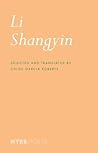
Li Shangyin (NYRB Poets)Li Shangyin by Li Shangyin
My rating: 3 of 5 stars

It was okay.

I generally really enjoy Chinese poetry, especially Tang-era poetry. I was psyched to get this book. But it's very hard to connect with.

A lot of Tang poetry is straightforward, at least on the surface, with concrete imagery and plain language, dealing with being separated from home, or enjoying wine and books, or working in one's garden, or visiting a neighbor, or saying goodbye at the river's edge. Generally comprehensible. And sometimes, often even, the poetry is filled with allusions that are completely unknown in the West, but are explained in extensive notes. (Red Pine does a really good job of this.) Both are absent here. Nothing is simple or readily comprehensible to a Western reader, and the many, many allusions are either left unexplained (most of the book) or are partly dealt with in endnotes (a few). So I struggled to understand or enjoy these poems.

I might succeed with a different collection and different translation and notes.

Like, look at these four lines (from a couplet in the original) and see if you get the author's intention:

Seablue, moonbeam,
Pearls hold tears.
Indigo fields, sun-warmth,
Jade begets smoke.


The book includes other translations of a few poems including this one, and one of those has two pages of notes for this 8-line poem. After working through that, I mostly understand it and can appreciate it some. Without it, I've got nothing but vibes, and I'm way off the mark on most of it.

My polite take on this book of poetry is that it is very challenging. I'm gonna look for a translation with more helps.

View all my reviews

Saturday, January 7, 2023

Where I Agree With the Author

Five T'ang PoetsFive T'ang Poets by Wang Wei
My rating: 5 of 5 stars

This is a very nice collection of Tang dynasty poetry.

I've read other similar books that I thought would make a good introduction to the era and the poets, but I think this may be the best of them. David Young, the translator, is himself a poet, which is not always the case, and I think it shows. Not only does he give the English versions a smoothness, an evenness of tone, that is often lacking, he does an excellent job in the introduction describing how he arrived at his translations, what sort of compromises he was making. I found myself in agreement with his approach both as he described it and as it was demonstrated in the poetry. A strictly faithful translation, transcribing the terse, elliptical language common in most poetry of the time, is almost incomprehensible in English; a highly Anglicized version (especially with rhyme--shudder) loses any hint of the original. I like the middle ground Young has found. In addition, he writes very useful introductions to each of the five poets, and they add to the pleasure of reading these.

Many of these poems are found in other collections, and when I look at some of them closely, I find that I like these better. They read more naturally and, to my mind, have greater impact. As a simple example, the first line in one poem is translated in another book as
You ask how long before I come. Still no date is set.

Young renders the line as
You ask when I'll be back--
I wish I knew!

The first sounds too much like a business letter to me; Young's version sounds--and looks--like poetry. The distinction is not always that stark, but that is the trend.

As to the literature itself, I am partial to Tang poetry. Much of it, especially the ones I understand, read like western Romantic poetry from the 19th century (which is a good thing, IMO). Natural settings and nature imagery; human emotion; an occasional interest in common folk; a focus on art and the creative process... all attributes that I have enjoyed in western poetry and work for me as a reader. It makes these poems, and this collection in particular, accessible.

Unrelated, but key to my reaction: the book, in many places, is annotated. It clearly came from a student taking notes in class, and it was fun to see what the conversation was. Reminded me of a very long time ago. I highly recommend a student-annotated copy if you can it. :)

Good stuff. Recommended.

View all my reviews