Showing posts with label comedic. Show all posts

Thursday, April 13, 2023

Where the Last Third Is the Best

April LadyApril Lady by Georgette Heyer
My rating: 4 of 5 stars

Halfway through the book, I liked this the least of any of the Georgette Heyer books I had read. It seemed rather silly, more like an I Love Lucy episode than a Regency novel. But past the middle it gets much better. By the end, I liked it much more and found it pretty satisfying.

In the first place, it's odd for a romance from any era, as the lovers in question are already married at the beginning. (No doubt there are many such books out there, and others might supply some titles; I would be surprised if it's a very high *percentage* of novels, however.) That's interesting and quirky, though. Nell loves her husband and Cardross loves his wife, but neither is sure of the other's regard. He thinks she very likely married him for his money and only pretends to care for him; she thinks he chose her just to look respectable while he continues his affair with another woman.

The surface conflict for Nell--the one I don't care for--is that she's spent too much money and owes many people around town. Her husband finds out and is angry but says he will pay for all of it and say nothing if she just gives him every bill at once. She believes she has done that, then discovers the next day that she has forgotten the biggest one, which is being called in, but she is too afraid to admit it to her husband and looks for some way out.

Hijinks ensue.

Her brother pretends to hold her up like a highwayman, but it doesn't work out like he hoped. She almost borrows money from a dangerous moneylender, but a friend stops her at the door. She considers pawning some jewels. Nothing is promising.

This storyline tangles with that of her young sister-in-law who is in love with a good guy who has no money. She wants to elope with him before he leaves the country for his work, so she needs money, too. Her disappearance makes it appear to Cardross that it is his wife--not his sister--who has stolen some family jewels and run away.

It comes together in a reasonable way, with some very sweet scenes that make up for the sitcom-like goofiness of the beginning. Everybody is a little wrong, everybody is a little right, everybody has to forgive everybody else. It's good.

The one thing I always like is how the author commits to making her characters so very different, at least in the dozen or so books I have read so far. She lets them have significant flaws without deciding they don't deserve happiness, which I think is very generous.

Recommended most for readers of the author.

View all my reviews

Saturday, July 25, 2020

Where I Deduce that the Title Is Ironic

Practical Demonkeeping (Pine Cove, #1)Practical Demonkeeping by Christopher Moore
My rating: 4 of 5 stars

This is a fun book, and I enjoyed it. Fast read. I started my Christopher Moore journey with his most recent books, which I loved, and so I wasn't sure how I'd feel about his first book. Well, not surprisingly, it isn't quite as satisfying as his later novels (IMO), but also not surprisingly, it's funny and witty and has a rough version of the author's later voice--so good, overall.

A demon is coming to Pine Cove, and we get to know quite a few of the odd folks in that town while they deal with the mayhem and disappearances. They're sort of modern-day versions of Dickens characters; more realistic, perhaps, but still eccentric and highly varied. Other novels take place in the same town, and that makes sense. He's invented a fully realized town of oddballs and might as well make use of them.

The demon and other supernatural elements of the novel give this a sort of fantasy feel, but it's always closer to a comedic novel than fantasy. (I like both, so... whatever; it works.) It reminds me of John Scalzi's Agent to the Stars, which is a SF book but has the same sensibility. Both are humorous sort-of action novels where the main characters are aware of unusual goings-on, but the rest of the world is ignorant, and in both the comedy comes largely out of interactions with the alien/demon. The tone is light, but the action still has consequences and stakes for the main characters.

I bet he coulda made it longer, but I'm glad he didn't. This was a pleasant read, funny and engaging, and it didn't outstay its welcome. What it did to is make me look forward to reading the other three books I have by Christopher Moore but haven't read yet. (Not to mention the new one out in hardcover. Anxious to get ahold of that one.)

Recommended for those who like their action with quirky characters and a nice touch of comedy.

Like me.


View all my reviews

Thursday, May 14, 2020

Where Jeeves Saves Bertie From Some Foolishness or Other

The World of Jeeves: (Jeeves & Wooster)The World of Jeeves: by P.G. Wodehouse
My rating: 4 of 5 stars

This is the first collection of short stories about Jeeves & Wooster. The stories were selected by the author in 1931 and published again in 1967, and the earliest of the stories would be over 100 years old now.

I enjoyed these well enough. There is (as many note) a sameness to the stories, a repeated pattern with plot and conflict, which is part of their charm in small doses and deadly in larger doses, but it's the language that amuses most in any case. Well, IMO. I'm sure others enjoy the almost slapstick nature of some of the exploits, but I liked the silly wordplay and dialogue.

I like Aunt Dahlia (the aunt he likes, and who likes him) telling him how helplessly foolish he is (ivory from the neck up--comments of that sort) while he refers to her as "aged relative." It's funny when he repeats some Shakespeare that Jeeves has quoted him without having a clue where it comes from. Bertie's frustrations and privileged view of life and intolerance for small inconveniences are amusing, in a way, especially when he complains and it sounds super petty but he makes a huge deal out of it in his posh, rather idiomatic way. "Dash it all!" and "Jeeves, this is a bit thick!" followed by a diatribe against children or country girls or dogs.

I suppose some of author's point is to skewer the pointlessly rich. Clearly, men like Bertie Wooster need something to fill their time, because the nonsense he could fill his days with was annoying--betting on everything one could imagine, plotting ridiculous practical jokes, constructing absurd lies and hoaxes to get out of difficulties, drinking and overeating like it was a part-time job--but we're still supposed to be sympathetic to him. And I am. He's not a bad sort, but I'd hate to hang out with him, or most of his friends. His uselessness is part of the humor, I guess.

Jeeves, of course, is the hero, though he's also judgmental and manipulative. I'm not sure how much of that the author intended us to overlook. It is comedy, after all. But almost every idea Jeeves has works out, like he's Sherlock Holmes to the spoiled leisure class. He's still funny, though he never jokes; his dry responses are probably the best part of the book.

Part of the reason to read this, for me, was to become somewhat familiar with a name I'd heard frequently over the years. That accomplished, I'm not sure there's enough fun in the stories to draw me back. I hear he has other characters that might please more, so maybe I'll think about trying one of them in the future. 50/50 that happens. Maybe 40/60.

I'll let you know.

Recommended, anyway, for those who haven't read Wodehouse before and maybe would enjoy comedic writing. One might check it out at the library, though, first time. If you like it, there's a ton more....

View all my reviews

Friday, May 1, 2020

It is not an easy matter to cut a tree down

The Mouse That Roared (The Mouse That Roared, #1)The Mouse That Roared by Leonard Wibberley
My rating: 4 of 5 stars

This is a quick book, light and pretty funny. At least on the surface. But it also has some weight hidden below the surface, more than I recall, and I like that.

I first read this when I was a kid, probably 12 or 13, and I wondered as I reread it now what made young me like it so much. No doubt I had seen the screwball movie just a little before and that colored how I read it, but as an older me I found it rather witty and rather funny but unlikely to appeal to a young person. It did, though; I read the sequels, too. Strange to not understand an earlier version of myself...

In places, the book is deceptively simple. The representations of America and the UK and the USSR that appear here are greatly oversimplified, as if this really were a children's book. Government systems are so streamlined that they appear nothing like the real world. The characters think and act and reason and plan in cartoonish ways. (Grand Fenwick declares war on the US so that they can lose and have the US help rebuild their economy. Checks out.)

But in the midst of silly comedic plotting are discussions and debates about the rights of innocents in a world where a few bad actors can kill us all. It makes the case that humans everywhere, even in small countries, deserve as much consideration as those humans who have atomic bombs:

"You do not know because you do not care about the little nations," Pierce said. "You think that the people who live in them are peculiar and quaint and behind the times and not really important. You forget that they are your fellow beings. You think of them as being a kind of substrata of the human race, of no importance because they have no weight to make felt."


All living things, the author suggests, deserve to live, to have their chance to grow:

"All things which have life seek to preserve it and because of this, one is always in doubt whether he has the right to destroy life when he cannot create it. When we fell a tree, my son and I, we know that we destroy not only the tree but also all its associations with the past, all the pleasures which it might give, if allowed to live, in the future. That is a great deal. It is not an easy matter to cut a tree down."


Well said. To me, that quote alone is good enough reason for the novel to continue to attract readers. That it might amuse is another.

Recommended.

View all my reviews

Monday, February 24, 2020

A Bawdy but Thoughtful Fool

FoolFool by Christopher Moore
My rating: 5 of 5 stars

Rude, irreverent, weird, and funny. Bawdy doesn't cover it--the mildest passages are bawdy. This is... ribald? Libidinous? Ooooh--salacious! No... Hmmmm....

Ah. Raunchy! That's it. In a good way.

Anyway, I thought it was entertaining and hilarious. I understand some readers might be put off. Such folks should check it out from the library, if they read it at all. I got it in hardcover. :)

I accidentally (long story) read the sequel first, and enjoyed it. Before I read this, I re-read King Lear, which it is largely based on, and that was a good idea. There are many threads in the original, and there are several additional threads here. I'll admit I lost track of what Pocket (the fool) was trying to do at all times, but I just rolled with it. Still fun.

A reimagining of old literature resonates with me, perhaps more than for others. I love seeing a fresh look on something that hasn't already been done a hundred times. (I'm looking at you, King Arthur.) This made King Lear relevant to me again, for the first time since 1979, so that's cool--and I enjoyed this romp (obligatory review word) through the old story.

Pocket is great character--almost entirely motivated by id, part loyal friend, part trickster, filled with ironic detachment, unafraid of annoying or enraging others and actually happy to do it (reminding me of, say, Hawkeye Pierce in M*A*S*H or Patrick Jane in the Mentalist)--and it works making the novel centered on him. He is not a minor character here, as in the play, but drives the action, affecting events in a surprising way.

And taunting, mocking, annoying, insulting, and frustrating everyone around him almost the whole time, with sex or inappropriately sexy talk on pretty much every page. Raunchy. That's the word.

Light tone; medium heavy themes; tragic events; it's a strange mix. But I like it.

Recommended.

View all my reviews

Wednesday, May 8, 2019

Where Old Guys Kick Ass

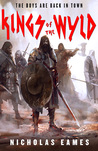
Kings of the Wyld (The Band, #1)Kings of the Wyld by Nicholas Eames
My rating: 5 of 5 stars

I love the rock-n-roll cover. That's what drew me in, originally. I only held off buying because my TBR pile, and the investment thereof, was unsustainably high. Then I learned the author lived in the college town in Canada where I spent two good years, and I hadta have it.

Glad I did. (I was gonna say "By turns blank and blank," the blanks being "funny" and "heroic," but Benjamin Dreyer blew that formulation out of the water. Dang.) This novel works on many levels, particularly as a straightforward action fantasy. Old fighter dudes come out of retirement to save the adult daughter of one of the guys. They face monsters and dragons and bad guys and hazards of all sorts, getting beat up and hurt and keeping on, all of it in a kick-ass, non-ironic, heroic fashion. In this way, it owes a lot to D&D and sword and sorcery and similar books that deal with that kind of action.

It's not light, though. There is actual drama, with a number of empathetic characters. I have no doubt that Clay adores his wife and would do anything for his daughter; Matrick genuinely, deeply cares about Moog, who is still grieving a lost love; Gabriel is gambling everything to try to save his daughter. You want to see them succeed. These characters are people we care about.

But it's also funny, and it works as a comic adventure. Because the characters read as real people, not caricatures (a type of fantasy humor that doesn't work for me) the laughs come from the interactions, mostly, though there is also excellent banter. (The humor is more Deadwood than Friends--if you get me. "That's so Al!" and "Oh, Johnny!" becomes "That's so Ganelon!" and "Oh, Moog!") The laughs season what could otherwise be a pretty grim story (but, you know, in a good way), moving it along, keeping it fun, and the emotional contrast makes for a satisfying read.

The coolest thing about the novel is its central conceit, which is that bands of fighters in that world are stand-ins for rock bands in our world. They are beloved and indulged celebrities, living lives of excess while riding high and even after the fame evaporates. Young bands come up, earning praise for destroying rampaging monsters, and replace the old guys who are no long idolized. Managers direct their careers, steal their money, and earn the resentment of the bands they do it to. Kids emulate them, dreaming of someday living the same life. It's funny, but it's clever and it works, giving the story a quirky resonance.

Well plotted, nicely paced, funny and dramatic by turns (damn! I did it anyway), with wonderfully salty language, it shows an author with a deft touch and lots of creativity, and it is a great pleasure to read.

Recommended.

View all my reviews

Monday, May 6, 2019

Who Doesn't Fall in Love with Agatha H?

Agatha H and the Airship City (Girl Genius Novels, #1)Agatha H and the Airship City by Phil Foglio
My rating: 5 of 5 stars

This book is a lot of fun, and I enjoyed every page. A steampunk novel (clockwork, really, I suppose) with a comic-pulp-action sensibility and a hint of mystery and romance, it has a plot that just rolls along. There is so much inventiveness here that I wonder if the authors ever run out of ideas.

Agatha H is a clever girl, a "madboy" wannabe, in a retro-futuristic Europe where geniuses called sparks invent contraptions and creatures of all types, using them to forge empires. When she is captured by Klaus Wulfenbach, tyrant and inventor, and dragged to his immense airship, she begins to show signs of true genius that even she didn't know she was capable of. Most of the action takes place on the airship, with a big cast of characters. Agatha herself is a great character--interesting, sympathetic, flawed, fun--and I definitely want to read more stories about her.

In fact, characters come at the reader at a Dickens-like pace at times, but most of them are so distinct (Dickens-like there, too) that you can generally keep them straight, though I'll admit I wasn't 100% here.

For inventiveness, which I value, I have to give this book an A+. The creativity in this novel is so pronounced that I almost imagine events and objects in the novel in kaleidoscopic colors. (The Jägers are my favorites. Constructed soldiers serving Wulfenbach, they are both comic and impressive, capable of both witty, sarcastic banter and amazing physical feats.) Stylistically, I'm sure this novel won't work for everyone, but I can't see any way steampunk fans don't love this. For such folks, I give this a big recommendation.

View all my reviews

Friday, April 19, 2019

Comedic supernatural mystery. Is that a thing?

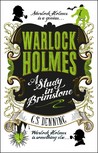
A Study in Brimstone (Warlock Holmes, #1)A Study in Brimstone by G.S. Denning
My rating: 4 of 5 stars

I like the premise of this novel. I like most iterations of the Holmes character, anyway, and I'm also a fantasy reader, so it's a natural fit.

I had some misgivings, though. For one, it seemed like Holmes was unsympathetic--at first. I changed my mind later, and enjoyed the role, and started to care about him, but I'm still a little unsure if it really works. (I'm 4/5 sure. 80% sure.)

I am also a little ambivalent about the way it is organized into a series of lightly connected short stories. The overall arc continues through the book, to a degree, but there are several discrete stories here. I kept waiting for characters to return to events from a previous story--such as Groggson's difficult love affair--but I guess when one story's done it's done. Unless book two shows me something else.

Also, slight spoiler--it ends with a cliffhanger. Sort of. I'm opposed to cliffhangers in general; I prefer a book to be self-contained. However, the missing resolution doesn't detract too much for me. Overall, it's a quick read and actually quite fun throughout, and I'm content to look up the next book and keep the story going.

The parodying of Sherlock tropes and titles and plot lines is well done and clever. It reminds me of Pride and Prejudice and Zombies (PPZ) and a few others in that vein in the way it combines classic stories with the supernatural, but the tone here is both lighter and more believable. I think that is because Watson is an ordinary person who is not used to vampires and warlocks and trolls any more than we are IRL, and he helps us navigate the extraordinary events. (I liked PPZ, but I prefer the way Watson keeps us grounded.) It's also pretty funny, which I do not usually look for in fantasy, but I liked it here.

In sum--I did have a rather uneven response to the book, especially in the beginning, but I enjoyed it more and more as I went on. It's fun and fast and clever enough that I will go find the next one, and I recommend the series to anyone intrigued by the premise the way I was.

View all my reviews

Sunday, April 29, 2018

Alexia Tarabotti doesn't care what you think. A review of "Soulless"

Soulless (Parasol Protectorate, #1)Soulless by Gail Carriger
My rating: 4 of 5 stars

I am totally over vampire stories and werewolf stories--but the premise of this book intrigued me, so I got it. I'm glad I took a look, because it's a fresh approach to the genre (even bearing in mind that I'm reading it 9 years after its first publication). It took me halfway through to get a fix on the author's tone, but once I did I enjoyed it very much.

Speaking of tone, here's my take on that: this is a (mostly) light-hearted, witty book, almost as much a romance as it is an action novel, and it is as charming and as comedic as it can be with genuine bloody monsters about. And dirigibles.

Alexia is a fun heroine, a rule-breaker with a great deal of confidence and unrelenting stubbornness, which is what is needed for a female MC in an alternate-Victorian setting. I like that this is an action story, and she is not simply watching the action (as is found in some novels of this type). She is engaged, and her action is integral to the plot. She has a mystery to solve that she investigates on her own rather than waiting for others to act, and she makes progress using her intelligence and nerve. She prefers comfort and propriety, to a degree, but doesn't back down when things become uncomfortable or unpleasant. Even when the action becomes more than a lady of the period can deal with--even a plucky woman with a strong will--and other characters come to the fore, she still engages and makes a significant contribution. She's not window-dressing; she's driving the action.

Plus, it's a witty book. I seldom laugh out loud when I read, but I actually did several times. Like at this point:

"Mrs. Loontwill fainted.

"Alexia thought it the best, most sensible thing her mama had done in a very long while."

The naughty bits were also written with a good amount of humor. I thought it a good balance for the romance.

Partway through, before I had gotten properly dialed in, I had thought I would finish the book but not get the sequels. I've changed my mind, obviously--now I'm eager to find the rest. It looks like Alexia has a lot of interesting, exciting stories to live, and I'm looking forward to reading them.

View all my reviews