Showing posts with label love poetry. Show all posts

Tuesday, April 8, 2025

Where It's Another Banger

One Hundred More Poems from the Chinese : Love and the Turning YearOne Hundred More Poems from the Chinese : Love and the Turning Year by Kenneth Rexroth
My rating: 5 of 5 stars

This is a very nice collection of ancient Chinese poetry, published in 1970. The great majority of Chinese poetry in translation has come out since then (I'm sure I'm right but I have zero proof for that statement) but I think you could stack this up against almost any volume that has come out in the last 50 years and it would compare very favorably.

I'm not making any claims about the accuracy of the translations (though I suspect it's alright), or whether these selections are a decently representative sampling of (mostly) Tang and Song poetry, or about the "importance" of any of the poets found here. (There are many highly regarded poets here, like Wang Wei and Tu Fu and others, but there are also a bunch I'd never heard of before--which is cool, actually.) And, in fact, as far as representation is concerned, female poets might be overrepresented here--which I applaud. So is love poetry. But the point is: this is not a textbook or a primer. It's a lovely collection of genuine poetry.

I found it an enjoyable read, and had to limit myself to just a handful of poems a day to make it last. The author chose poetry that's particularly accessible for Western readers, with themes that resonate with many of us, and I think it really works. Here's part of "I Return to the Place I Was Born," by T'ao Yuan Ming:

From my youth up I never liked the city.
I never forgot the mountains where I was born.
The world caught me and harnessed me
And drove me through dust, thirty years away from home...
The farm is only ten acres.
The farm house has eight or nine rooms...
When you come through the gate into the court
You will find no dust or mess.
Peace and quiet live in every room.
I am content to stay here the rest of my life.
At last I have found myself.


I totally understand what he's talking about. I feel just the same. And it's from about 1600 years ago.

That poem is found in other collections, but many of the poems here are not in anything else I've run on to. It has sent me on a search for collections of some of the poets in here, and some of them exist, but are rare (and stupid expensive). Still, I hope it'll hook me up with a few new poets and their works.

Like the previous volume, this is highly recommended, and makes a good starting point for anyone casually interested in Chinese poetry.

View all my reviews

Saturday, December 3, 2022

Where I Like It Best in Moderation

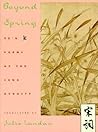
Beyond Spring: Tz'u Poems of the Sung DynastyBeyond Spring: Tz'u Poems of the Sung Dynasty by Julie Landau
My rating: 4 of 5 stars

This is a very nice collection of t'zu poetry from Sung Dynasty China (about 1000 years ago).

T'zu poetry is lyric poetry, meaning these could be (though usually weren't) sung. They originated as songs performed by prostitutes in the singing houses, and over time scholars and bureaucrats (same folks, actually) started to write their own lyrics. They fitted the words to one of about 800 melodies, sometimes as a sort of word game, but later more seriously. It took time before they become respectable, eventually losing their disreputable connection to prostitution and becoming the pastime of many people throughout China, at varying levels of society. This collection is filled with the scholarly type.

The t'zu poems acquired fairly rigid norms, with early lyrics establishing the topics and language that should be used. The intro gives a primer on the most common allusions and imagery, and after reading half the poems here, you will have seen the same themes and same allusions over and over. I'll admit, it loses it's punch eventually... It reminded me of popular American music and the songs about broken hearts and sad breakups, which you can still enjoy even though they are terribly overdone. Here, the most common style is where the poet is either speaking in his own voice or that of his wife, talking about their grief at parting, which apparently was usually done in the spring of the year. (Chinese bureaucrats were shuffled every three years, and it seems that families sometimes moved with them to new cities but often stayed put and just didn't see them for years on end.)

Typically, they part at the water's edge, where they would break off a small willow branch in farewell before he gets on a boat. (One line in a poem says, " The willow strands I've broken, end to end, would reach a thousand feet.") She (his wife or lover) will climb a tower in the evening and lean on the railing, watching for a ship that doesn't come, or he will climb a tower and gaze off toward home. Often, she will see geese or swallows, symbols of communication, and lament the lack of letters. He will wonder why he chased fame and power all these years, and drink himself to sleep.

From a poem by Liu Yung:
I cannot bear to climb the high tower, look out
Gaze longingly toward home--dim and distant
But to stop my thoughts from going back is hard
I wonder at my path in recent years--
Why have I lingered, miserable
Aware that in her room she has looked up--
How many times--and thought she saw my boat on the horizon?
And never known that I lean here
Congealed with sorrow?

I probably exaggerate the similarity of one poem to another; the breadth of topics and language is greater than I'm suggesting here. There is lots of room for expression in this poetry, and I found it sweet and very human. But what is even more significant is the depth of feeling conveyed in this format. Despite the norms and conventions of the genre, a reader (okay, it's me) can feel the true emotion which the poet is describing and likely truly feeling himself. (Almost all of them were men, but not all.) They were alone a lot, working all day and drinking all night, barely knowing what happened with their own families.

As an example, here's a lovely poem by the same author as above.

Yi lin ling <--the melody this lyric could be sung to
Chilled by the cicadas' dirge
We reach the post station at evening
Just after a sudden shower--
The banquet toasts at the gate seemed endless--
Here, where we long to linger, the boat impels you to be off
You take my hands--I see your tears through mine
Words, futile now, catch in my throat
I think of your going on and on--a thousand li of mist and wave--
How dense the evening clouds, how wide the Ch'u sky!

To love and part--what age old anguish
How can I bear clear autumn's desolation too
Not knowing where you'll wake from wine tonight?
The willows along the bank
The breeze at dawn, a fading moon--
Without you, the passing year--
Moments, scenery--all wasted
Were they to rouse a thousand subtle feelings
Who'd understand?

By the end of this collection, I had become full of these poems; I'd had enough. Though not as restrictive, say, as Japanese tanka (and haiku), and not as mannered, they do seem less spontaneous when taking in too many at a time. It gets harder to enter in the meaning when you say, "oh, the waves on the river again," and you become aware of the construction of the poetry at the expense of the meaning. So--moderation, I guess. Let the poetry breathe.

I liked it. I'll come back to these again, and I'll sample them.

One last interesting fact--the women who originated the songs weren't Han Chinese. They were steppe women, according to the translator, bringing their style of song to the dominant culture. I think that's cool.

View all my reviews