Showing posts with label Chinese poetry. Show all posts

Friday, November 21, 2025

Where Burton Watson Schools Us

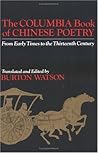
The Columbia Book of Chinese PoetryThe Columbia Book of Chinese Poetry by Burton Watson
My rating: 5 of 5 stars

This is a very nice collection of Chinese poetry, filled with wonderful literature from many time periods, but it is also a useful survey for students or others new to these works.

Much of the literature here is available in other collections, especially the poetry from the biggest Tang writers, but a lot of it was still new to me. And the introduction, chapter openings, and back matter were very useful, even for bits I'd read elsewhere. Burton Watson does an excellent job of explaining and teaching those of us in the West who are unfamiliar with the references and common symbols and the like or are still working out the differences between the various poetic forms. It's hard (but not impossible) to appreciate poetry in translation if you don't have some of these additional helps, and I appreciate how well Burton Watson supported us.

I still prefer books that are collections of works all by a single author--for the same reason that I prefer the original albums to "best of" albums, which are nice but lacking something--so I don't have quite the same feeling when I read collections like this, with examples from so many different authors. It feels somewhat artificial in a way I can't entirely defend. But it obviously has its uses, and this is a very good example of that type of collection. In addition to presenting some very fine poetry and educating me on it, a benefit of books like this one is tipping me off to "new" poets (from 1000 years ago or 800 years ago!) that may have whole books of just their work done by some helpful translator that I can now go look for. I have a few such names that I intend to follow up on.

In general, I love Chinese poetry for it's themes and simple clarity--so much is about loving the land, admiring a beautiful landscape, drinking wine with a neighbor, growing vegetables on a small plot, looking out over a river for a sail you recognize, and other romantic topics--and there's a bunch of that here. I'm aware that there can be many important messages buried in such simple-looking lines, which the editor sometimes clues us into, but even without that it's possible to love much of this literature. My favorites? Wang Wei, Li Po, and Tu Fu, out of the Tang era (who are so popular it is kind like saying you like Shakespeare, but it's true), and Su Tung-p'o, from the later Sung era. However, I'm now on the hunt for books focused on Lu Yu, Mei Yao-ch'en, and a few others. That alone makes it worth looking into this collection.

Wish me luck finding them.

New readers especially should take a look at this collection. Recommended.

View all my reviews

Wednesday, April 23, 2025

Where Li Qingzhao Misses Her Husband

Double Radiance: Poetry and Prose of Li QingzhaoDouble Radiance: Poetry and Prose of Li Qingzhao by Li Qingzhao
My rating: 4 of 5 stars

This is an elegant collection of a fraction of Li Qingzhao's poetry--most of which is lost. There are not too many famous female poets from the Tang or Song, and it's pretty hard to find English language collections of Chinese poetry by women, so I was happy to locate this one.

Though I liked it and give it 4 stars, it didn't work for me at first. I warmed up to it as I read, however, as I began to glimpse the real person and real emotion behind the precision language. Poetry like this is pretty but doesn't reach me:
Perhaps creation was stirred by inspiration
to instruct the clear bright moon
in gently rendering the earth's translucence.
So let us sip green-ants wine in cups of gold,
and let us not delay intoxication
with a flower whose beauty is far beyond compare.

But when she talks about loss, I can start to feel it:
Yellow dusk covers the yard.
Disconsolate, I sleep off the wine,
my spirit choked with sorrow.
Enduring the deep night alone,
moonbeam on our empty bed,
I listen to the rhythmic washing
of clothes on a laundry stone,
the little sounds of crickets,
and endless dripping water.

In some of the poetry, the language choices of the translator threw me off. An elevated diction is probably indicated, but too much effulgence or quotidian or antipathy made me stumble. "Fresh dew cleanses aquatic flowers" sounds so clinical. And yet, the language felt warmer and more intimate the longer I read. Either the language became more natural or I just adjusted, because I felt like I was starting to hear, finally, the poet's voice.

A lot of the emotion expressed by the poet in these verses is certainly genuine. She and her husband were famously in love, and you can hear that connection in many of the poems here. As is described in her own epilogue (from a collection of her husband's poetry) she and her husband were well matched, both loving history and poetry and collecting books and artifacts. They spent most of his salary on their collections, living simply on what remained. They were happy until the war came, when they had to flee an invasion from the north, leaving much behind. Then her husband was sent to a new appointment and died on the way. (She arrived just before he died.) Over time, everything else from their collection was lost in the war, stolen or burned, and she lived sadly without him and without everything they had gathered as a couple. The grief in the later poems, where she is aging without her love and showing signs of depression, is heart-wrenching.

...Alone at the table before cups of wine,
I brood over endless sorrows
flowing from sea to sky, the horizon.
How can I live without you?
The summer rose has withered,
so I rely on pear blossoms for solace.
We loved one another through the years:
Fresh perfume drenched my sleeves:
we drank the tea of fiery passion,
witnessed pageants of horses, festivals
where lightweight riverboats raced.
Fearless in the face of violent storms,
we raised our wine to crushed petals.
Now I wonder
why those days have fled.
I await your return.

At only about 60 pages, this is a slim collection. It's nice, though, and well worth looking at, and I'll probably be returning to it later. I would like to find a few more supports for the allusions, so I'm gonna be looking for more by this poet, other collections, if it's out there.

Recommended.

View all my reviews

Tuesday, April 8, 2025

Where It's Another Banger

One Hundred More Poems from the Chinese : Love and the Turning YearOne Hundred More Poems from the Chinese : Love and the Turning Year by Kenneth Rexroth
My rating: 5 of 5 stars

This is a very nice collection of ancient Chinese poetry, published in 1970. The great majority of Chinese poetry in translation has come out since then (I'm sure I'm right but I have zero proof for that statement) but I think you could stack this up against almost any volume that has come out in the last 50 years and it would compare very favorably.

I'm not making any claims about the accuracy of the translations (though I suspect it's alright), or whether these selections are a decently representative sampling of (mostly) Tang and Song poetry, or about the "importance" of any of the poets found here. (There are many highly regarded poets here, like Wang Wei and Tu Fu and others, but there are also a bunch I'd never heard of before--which is cool, actually.) And, in fact, as far as representation is concerned, female poets might be overrepresented here--which I applaud. So is love poetry. But the point is: this is not a textbook or a primer. It's a lovely collection of genuine poetry.

I found it an enjoyable read, and had to limit myself to just a handful of poems a day to make it last. The author chose poetry that's particularly accessible for Western readers, with themes that resonate with many of us, and I think it really works. Here's part of "I Return to the Place I Was Born," by T'ao Yuan Ming:

From my youth up I never liked the city.
I never forgot the mountains where I was born.
The world caught me and harnessed me
And drove me through dust, thirty years away from home...
The farm is only ten acres.
The farm house has eight or nine rooms...
When you come through the gate into the court
You will find no dust or mess.
Peace and quiet live in every room.
I am content to stay here the rest of my life.
At last I have found myself.


I totally understand what he's talking about. I feel just the same. And it's from about 1600 years ago.

That poem is found in other collections, but many of the poems here are not in anything else I've run on to. It has sent me on a search for collections of some of the poets in here, and some of them exist, but are rare (and stupid expensive). Still, I hope it'll hook me up with a few new poets and their works.

Like the previous volume, this is highly recommended, and makes a good starting point for anyone casually interested in Chinese poetry.

View all my reviews

Monday, March 24, 2025

Where I Find Some Great New (to me) Poets

One Hundred Poems from the ChineseOne Hundred Poems from the Chinese by Kenneth Rexroth
My rating: 5 of 5 stars

This is a very nice collection, nicely translated and annotated. I enjoyed it a lot.

Tu Fu, with more than thirty poems in this collection, gets more coverage than any of the other poets, but with only two exceptions we get a good number of examples from every poet here. I like it that way, getting five or ten or more poems from the same poet. This gives the reader a chance to form an opinion of them, get a better idea of what they're like, and maybe follow up by finding collections devoted to each one. (That's what I intend to do, anyway.) Some collections like this have lots of poets with only one or two poems each, and I find that less interesting than the way it is here.

The topics and themes of the selections are pretty universal and generally comprehensible to someone not deeply familiar with culture-bound ideas. You don't need to know much about Chinese culture 1000 years ago to make sense of them or enjoy them. There are some helpful notes at the back (which I realized too late) but they aren't essential. I like it that way--just poetry up front, with background information at the back of the book. It's a nicer esthetic, IMO.

I liked the translations, and for probably half of them I liked the formatting as well. I had just an occasional "I wouldn't have done it that way" thought about how to arrange the lines on the page, but it wasn't enough to take me out of the poetry. In general, I found this a pleasure to read, and I think most readers will feel the same.

Recommended. I already hunted up the second volume, and I'm looking forward to it.

View all my reviews

Saturday, March 8, 2025

Where I've Thrown in the Towel

The Late Poems of Wang An-ShihThe Late Poems of Wang An-Shih by Wang An-Shih
My rating: 3 of 5 stars

I like Wang An-shih.

I just can't enjoy this translation. This is the fifth book I've read by this translator, and I never like his style. The second and third books I read of his were sort of accidents--I didn't notice when I ordered them who did the translations. The last two--this and one other--I was trying to work my way through my issues with the way he put Chinese poetry into English. I've really failed.

That's a lot of attempts. Either I'm an idiot or a remarkably good sport, because I should have learned well before this. To be fair to me, I've tried other things I didn't like way more times than this. (Beer. I'm talking about beer. I want to like it but I just don't. Other people like it a lot and I think I should too. Did I enjoy the last glass of beer I had? No. Not at all. Will I try beer again someday? Almost certainly. Will I learn anything? Probably not.)

Here are two poems and translations that I liked a lot.

Gazing North

Hair whiter still, I ache to see those long-ago northlands,
but keep to this refuge: goosefoot staff, windblown trees.

Pity the new moon: all that bright beauty, and for whom?
It's dusk. Countless mountains face each other in sorrow.

------------------------------------

Written on a Wall at Half-Mountain Monastery

When I wander, heaven starts raining,
and when I stop, rain sets out for home.

How could rain be my own wandering?
Meeting here was that carefree and easy.


Tone; style; content; mood. I love it.

Here's one that doesn't work for me.

Anchored on Abandon River

Creaking oars quicken. River sun
sinks into azure distances. There's

stillness in my wandering. Tides
drift east and west, day and night.


If you prefer that latter, or if the difference tripping me up isn't immediately obvious and off-putting, you'll love the collection. Unironically. Go for it.

Mine tastes like beer.

View all my reviews

Tuesday, February 11, 2025

Where I Got Hung Up On the Translation

Mountain Home: The Wilderness Poetry of Ancient ChinaMountain Home: The Wilderness Poetry of Ancient China by David Hinton
My rating: 3 of 5 stars

[Some great poetry here. Skip down to the dashes if you want to know how I feel about the original writers rather than my experience with this collection in particular.]

Lots of people love this translator. I just don't. I keep trying, but I can't get past his style.

The poetry in here, or at least a good bit of it, is familiar to me from other collections, other translators. Poetry I responded to positively elsewhere doesn't work for me. To be fair, he's doing exactly what he means to do, and other readers completely approve, but I don't like it.

The biggest difficulty for me is how he rearranges the original end-stopped phrasing and makes it break over lines and even between the unrhymed couplets. The break has no connection to meaning. It's entirely visual. In fact, the poems look like he's trying to right-justify everything. Why? Poetry that's supposed to breathe between lines instead rumbles on to the next line and the next verse. Once I become aware of the translator behind the poetry, I can't unsee it, and I can't focus on the poems. I pause at the end of the line and discover the thought continues below, and that little interruption takes me out of the poetry and back into my head. It feels like he's standing between us instead of bringing the reader and the poet together.

Did you ever watch a TV show or go to a movie where the music was too loud and the dialogue was buried in the mix? And it distracts you and it bugs you and frustrates you, taking you out of the show? That's me with this translation.

Other people seem to like it. Lots of 5 star ratings. I'm the outlier. If numbers mean anything, he's going about this the right way, and I can be safely ignored. But if you're like me and get distracted by stuff, be aware.

---------------------------------------------

As far as the original poets--I love these guys. I already have collections by many of them and find them not just esthetically pleasing by somehow deeply emotionally satisfying. Talking about escaping the day-to-day grind of the city to hike mountain trails and lose yourself in nature, traveling down rivers, visiting remote monasteries, reading your books on the farm, just letting life happen, really appeals to me. I may not be making sense of all the philosophical nuances, no doubt missing a lot of the chan doctrine (which is nicely summed up in the brief chapter introductions), but even without every layer of deep meaning, these poets and their work is probably my favorite.

Several of these poets, though, were new to me, so I'm gonna look for other books with more of their poetry. But hopefully I'll find someone whose translation ethos and style match my preferences.

View all my reviews

Thursday, December 12, 2024

Where We Hear Temple Bells on the Mountain

Crossing the Yellow River : Three Hundred Poems from the Chinese (New American Translations: 13)Crossing the Yellow River : Three Hundred Poems from the Chinese by Sam Hamill
My rating: 5 of 5 stars

A very nice collection in very readable translation.

The subtitle for this book is "Three Hundred Poems from the Chinese," and it's mostly a survey of poetry from earliest examples (first century BC, or thereabouts) to nearly modern, as late as the 15th or 16th century, and includes dozens of poets. Nevertheless, about half the book is devoted to just three Tang era poets: Li Po, Wang Wei, and Tu Fu. But they dominate the history of Chinese poetry, so it's warranted.

Many of these poems are available in other collections made by other translators, and though I probably favor other versions of some of these, I enjoyed the translation overall. The meaning is as clear as can be while still looking and sounding like poetry. Though I've lately come around on poetry books with notes (Red Pine does a really nice job of this) I like the way that these poems are presented without intrusions. Perhaps we give up a little comprehension, like when I'm asking myself if the oriole here is just a bird or if the poet is making some comment on ministers of state--and there's something like that in almost every poem, with cranes and geese and the river of stars and towers overlooking rivers and other recurring images--but you can let other collections do the full explication of symbols and really dig in to the allusions. This one's just for the reader and the text, and there's a clean simplicity to that which I enjoy.

In any case, Chinese poetry usually does such a nice job with imagery, readers can enjoy the language without troubling themselves over every layer of meaning. Here's a poem by Yen Shu simply titled "Song":

An old song with new words,
a cup of clear wine--

last year's weather haunts
old towers and pavilions.

The sun sinks below the world.
Will it ever return again?

Nothing can be done
to delay the flowers' falling.

When the swallows come
like old friends returning,

I pace this fragrant
narrow garden path alone.


I don't know how many layers are actually in that poem, but even a mediocre reader can work through a couple of them, and they're wonderful.

A very nice job overall. I recommend the reader not skip the translator's excellent introduction, either. It's not just useful but interesting on its own and well worth the few minutes spent reading it.

I expect I'll come back to this book in the future, dig a bit deeper. Maybe look into more books translated by the same translator.

View all my reviews

Tuesday, March 12, 2024

Where We Live on the Mountain with the Poet

The Mountain Poems of StonehouseThe Mountain Poems of Stonehouse by Red Pine
My rating: 5 of 5 stars

I would say I enjoyed reading these poems about 4/5, but Red Pine does such a nice job of annotating and translating into nicely poetic language I have to give it all the stars.

Stonehouse was a Buddhist monk in 14th century China. He did the hard-core training and monastery thing as a younger man, but he lived most of his adult life up on one of two mountains with similar names. His poetry reflects a deep concern for religion more than anything else, and that's interesting to a point for a non-believer like me, but what I really like are his descriptions of life on the mountain. He does that well, though it's a secondary theme for him. "True emptiness is like a translucent sea/ where the faintest movement makes foam/ as soon as we have a body/ we worry about food and clothes" is the type of sentiment he expresses most often, talking about the kinds of things non-practitioners probably don't fully understand. That's cool, but I like this more:

Lunch in my mountain kitchen
there's a shimmering spring water sauce
a well-cooked stew of preserved bamboo
a fragrant pot of hard-grain rice
blue-cap mushrooms fried in oil
purple-bud ginger vinaigrette
none of them heavenly dishes
but why should I cater to gods


He talks a lot about planting fields ("I plant winter melon then aubergine/ I wear myself out staying alive") and carrying firewood down the mountain to sell and tending to fruit trees ("The peach tree I planted outside my door/ has flowered in spring twenty times") and other ways he has supported himself over the years. It sounds like a pretty difficult existence. But he still enjoys the beauty of the place he's chosen:

I hiked staff in hand beyond the pines
and found myself on an emerald peak
a flock of cranes were chasing a hawk
tree shadows darkened the streams
thorns made wild fruit hard to pick
their scent made herbs easy to find
thin smoke veiled the sinking sun
red leaves shaded half the cliff


That's some fantastic imagery. That's 5 stars just for the one poem.

There is a romantic feel to much of the poetry, though more than a little sadness and loneliness attached to his long separation from society. I can admire what he has accomplished along with his commitment even while I wish no religion had ever conceived of the notion of sacrificing so much to achieve something that I (as a skeptic) don't think very likely. I can applaud simplicity such as we find in much of this collection even while I wish it hadn't been necessary to go to the point of asceticism. But I'm many centuries too late to give advice to a man who would have only smiled at me and ignored everything I said even if I had been there to say it... People at least remember Stonehouse, something that can be said of very few people after their death, especially hundreds of years later.

Between romanticism and nature imagery on the one hand and religious thought and instruction on the other, this collection leans toward religion, which is not my most favorite, but there's enough of a mix that there's still lots to like for those in either camp. Well worth looking at.

View all my reviews

Sunday, February 18, 2024

Where Red Pine Gives Us As Much Tao Yuanming As We Can Get

Choosing to Be Simple: Collected Poems of Tao YuanmingChoosing to Be Simple: Collected Poems of Tao Yuanming by Tao Yuanming
My rating: 4 of 5 stars

A very nice collection of poems by an important 5th century Chinese writer, with an excellent translation. Easy 4 stars.

Not too long ago, I read another translator's version of Tao Yuanming's poetry, and I found the same thing I did here--the verses (as rendered in English) are a pleasure to read, and the poet is an interesting person, but I never quite make a deep connection with the work. That's on me, perhaps, but my whole reason for searching through the works of so many unknown (to me) poets is to find those that really resonate. It's an Easter egg hunt, looking for treasures hidden around the world, and this one is a near miss. There's a lot to like here, and much of it worked, so I still rank it as quite good and worthy of recommending to others, but I won't lie--I was hoping for a bit more.

When I saw that Red Pine was coming out with his version, I had to have it, and though the other edition is fine, I definitely prefer this one overall. He offers so much support for the English-speaking reader, so much biographical and literary help, that I feel like we're getting as close to the original as is possible for someone on another continent living 1600 years after the fact. We'll never get the full context, of course, nor will we be able to appreciate the subtle use of language and interplay of sound, but with the various helps we get a lot of the intended meaning, along with the sense of the figurative language and description. That's still a lot, making this an excellent source for both study and pleasure.

The only thing lacking for me were the poems I wanted to collect for myself, poetry that says something to me personally. Most of his poetry is specifically autobiographical, and while I share many beliefs and attitudes with the poet--he wants to read poetry and drink wine [I prefer coffee, but okay] and live in the country and have picnics and avoid entanglements with outside world--there were only two or three poems that spoke deeply to me. I was hoping for more. In other words, this set of poetry wasn't really about me; it was about him. That's cool. It doesn't all have to be about me. :)

So yes, I liked it; the 4/5 includes the poetry, the translation, the detailed notes, and the beautiful edition, and I'm happy to endorse and recommend the book. And while I may not love the verses in the deeply personal way I was hoping, I can still say I have a great deal of appreciation for it.

View all my reviews

Monday, November 20, 2023

The Best Translator for the Best Tang and Sung Poetry

Poems of the Masters: China's Classic Anthology of T'ang and Sung Dynasty Verse (Mandarin Chinese and English Edition)Poems of the Masters: China's Classic Anthology of T'ang and Sung Dynasty Verse by Red Pine
My rating: 5 of 5 stars

This is an amazing book and highly recommended.

Usually, I score based on the ridiculously subjective assessment of how fun was it to read? On that scale, I'll admit, this was about 3.5. But it's so well presented and so well broken down for the reader, I have to give it all the points.

This is a collection of 224 poems from Tang and Sung China, first collected in the 13th century and amended a bit afterwards. Part of what's interesting is seeing what contemporary readers (or readers who were at least several hundred years closer to their creation than we are) considered the most important poetry of those times. I'll admit, it's not what I would have chosen. But the original collectors would have taken into account the appropriateness of rhyme and meter and other effects of language that don't survive in translation, and of course I care nothing for that since I don't read Chinese. I prefer poetry with a lot of comprehensible imagery and easily accessed human emotion that one can still connect with. And there is some of that for sure.

But what there is plenty of is support for the English reader. Red Pine is (in my narrow, unsophisticated but unerring opinion) the absolute best at translating the poetry and supplying commentary making the poetry accessible. The fact that this poetry needs so much support is what makes it not my favorite, but having decided to read it, I can say that this is undoubtedly the best English version to get into it. Red Pine gives amazing biographical details, explicates oblique references to poetry we simply don't know, places the poetry in a specific historical context, and supplies all kinds of cultural knowledge that makes the poems make sense. It's a lot.

Ideally, I prefer to read poetry in books with nothing but the poems. You know? Just the words, just the lines. It's so much prettier to look at and more esthetic to experience. But that wouldn't work here at all, so the half-page or so of explanation for each poem is the next best thing.

There are lots of poems by familiar poets like Wang Wei or Tu Fu or Li Bai, but there are many, many more by poets I'd never heard of. Some of them, hopefully, will lead me to collections of their own.

Anyway, lots to enjoy and chew on here. Highly recommended for those making a study of Chinese poetry. Modestly recommended for casual readers like me.

View all my reviews

Thursday, August 3, 2023

Where I Belabor the Point

The Selected Poems of T'ao Ch'ienThe Selected Poems of T'ao Ch'ien by Tao Qian
My rating: 3 of 5 stars

It appears that most other people really liked this. I didn't.

It's not the poet--I think I might like him. And it's not exactly the translation. That seems okay.

It's the format. Drove me crazy. I couldn't read it in this form without having my understanding disturbed every second line by the way it was presented on the page. Maybe it doesn't affect other people like it does me. I really wonder.

Let me ask you a question as an aside: when you read something written in italics, like maybe a letter or something inside a novel, does it sound different in your head than the rest of the text does? It sounds different to me, like a different voice is reading, usually higher and a little sing-songy, and it has a negative impact on my comprehension. I can't seem to change that. If it goes on too long, I sometimes have to reread to get the parts I missed the first time through. It's like a radio slightly off the station that takes extra concentration to hear.

Other formatting differences have a similar effect on me. For example, in this book, the poetry is written with seemingly random line breaks, gathered in pairs lines as if he's translating a poem written in couplets. I already don't prefer poetic lines to wrap around to the next line, though I've made me peace with that... But to have the line break across separated lines made me nuts. Like this:

At this distant, bramble-woven gate, my
wanderings come to rest, the world and I

let each other go. Not a soul in sight.
At dusk, who knows my gate sat closed

all day? This year-end wind bitter cold,
falling snow a thick, day long shroud...


I can't read those lines, especially across the gaps, *without* a pause in my brain, a change in tone, a stumble, and it made me go back time and again to reread it as it was meant. Trying to read across those gaps as if they weren't there was like trying to read while being bounced in the back of a car.

Anyway, with effort, I read and enjoyed the poetry some. Maybe 3 stars worth. But I'm not exaggerating the effect the format had on my reading, the way it disturbed the flow for me, and I only wonder how everybody else can read it fine. The issue was front and center for me every time I opened the book. (I still would ask--what purpose did the breaks serve? I don't think it was the end of the original lines, and it doesn't seem to align with meaning. Meter? I tried to impose a rhythm on it, maybe tetrameters or something, but I couldn't make that work. So I dunno.)

If everything I wrote here sounds nuts, you'll probably enjoy this translation fine. But I see that Red Pine has a translation of this poet coming out later this year. I'm gonna try that one.

View all my reviews

Tuesday, July 18, 2023

Scholar, Poet, and Servant of the People

In Such Hard Times: The Poetry of Wei Ying-wuIn Such Hard Times: The Poetry of Wei Ying-wu by Wei Ying-wu
My rating: 5 of 5 stars

First of all, this collection of poems is translated by Red Pine, who always does a great job.

Second, Wei Ying-wu writes some deeply affecting poetry that still works in English more than 1000 years later.

So--pretty awesome.

Most of this poetry is 2, 4, or 8 lines of 5 characters, though there are some 7-character lines and other less common formats. And most of the poems are either biographical or part of correspondence, so they reference actual people, places, and events in the poet's life. All pretty standard. What that means to a reader in English is that (as I prefer) we don't get the rhymes found in the original or any real sense of the feel of the language, and we might struggle to identify and understand references that have no meaning to a modern reader, but we do experience the ideas and feeling in these poems, and the translator has done an amazing job of providing context and background information and illuminating allusions that would otherwise remain opaque. We might lose the music, but we get the meaning, and most importantly we experience the humanity.

The poet lived through troubled times--thus the title--including the An Lushan rebellion (and continued troubles afterwards) which created so much chaos and disruption for the country. As a scholar and an official, with a career including many government jobs in many cities, Wei saw how the people lived and suffered all over the empire. "My pitiful fellow officials," he implores, "think of the hardships of those below us." He is referring to peasants who work all day long and can barely pay their taxes, and how families have to provide a worker each year to labor for free on giant projects: "The disaster of war has worn us all down/ there's no vacation from corvée [forced work] and taxes/ the downtrodden masses need help." While trying to enjoy personal downtime, relaxing at a lake, he says, "farmers this month are busy/ living in comfort I think of them toiling/ and wonder how they deal with the heat."

In "Jade Diggers Ballad," he writes:

The government drafts a common man
tells him to dig for Lan River jade
over the ridge, nights away from home,
he sleeps in thickets of thorns in the rain
his wife returns from taking him food
and sobs just south of their home.


In a poem about inspecting flooding along the Ching River, he writes, in part:

I could see the traces of disaster
perfectly good crops in the river...
once-happy homes in ruins...
whole hillsides were washed away...
meanwhile you gentlemen at court
gossip and laugh and think about parties.


It pains him that there is so much that they can't do to help, and even when there is something that might be done, they aren't allowed. One of his jobs was overlooking the corvée, which meant he had to make sure every family did its part in supplying labor for the government, and he was painfully aware of the difficulty of that sacrifice, giving up a good worker when they were most needed at home.

Many of his poems are about visiting with monks or spending time in monasteries, and he often laments not being able to retire to a life of contemplation. He always intends to, but can never quite walk away. "I love to follow trails to monastic retreats," he writes, "to an orchard of fruit trees after a rain.../ where green shade nurtures quiet days.../ my official duties have kept me so busy/ my footsteps have come here too seldom." Other poets and other officials walked away sooner, living more of their own life, but Wei kept taking new positions in the government, trying to do what he could for the people. He remains humble, claiming to be "inept," but you sense he feels like he is doing at least some good. When he's almost blind he finally retires and teaches farmers' children how to read, but by then most of his friends are gone and almost no one comes to visit him. Still, his last known poem is about a visit from a friend in that last year of his life:

You came with New Year's greetings
walking here alone in the bitter cold...
after starting a fire deep in my stove
and closing the door to my empty room
we shared a gourd full of wine
and didn't speak of all the things that went wrong.


Raise a glass to Wei Ying-wu. He really fucking tried.

View all my reviews

Friday, March 31, 2023

Where Chia Tao Hits All My Favorite Notes

When I Find You Again, It Will Be in Mountains: The Selected Poems of Chia TaoWhen I Find You Again, It Will Be in Mountains: The Selected Poems of Chia Tao by Mike O'Connor
My rating: 5 of 5 stars

When I imagine classical Chinese poetry, especially Tang era poetry, especially with a hint (or more than a hint) of mystical religion, this is exactly what I have in mind. I may have to check to be sure, but this may be my new favorite volume of poetry. So much to love here.

Chia Tao was originally a Buddhist monk, an adherent of Chan Buddhism (which we would call zen), and though he stayed in contact with other monks his whole life, he dedicated his life to poetry. His religion was a huge part of his writings, including not just beliefs but people and places--the monks, the monasteries, the mountain retreats, and so on. The poetry is filled with trails, waterfalls, trees, and the distant sound of stone chimes, leading him toward remote monasteries. There's a lot of romance in these descriptions, and I'm here for it.

This is a nice example:
Sent to a Hua Mountain Monk

From afar,
I know your white-rock hermitage,
hidden in a haze
of evergreen trees.

When the moon sets,
it's mind-watching time;
clouds arise
in your closed eyes.

Just before dawn, temple bells
sound from neighboring peaks;
waterfalls hang thousands of feet
in emptiness.

Moss and lichen
cover the cliff face;
a narrow, indistinct path
leads to you.


There's a Wordsworth/Tintern Abbey feel to this, and I love it.

The translation is beautiful. While in some places the original elliptical phrasing is preserved (no verb, no article type of language) it is very readable and clear to an English language brain, and there's not a rhyme to be seen. (Rhyming poetry in translation is unbearable to me. A harmless prejudice, I hope.) Where it's helpful, the translator has provided notes in the back, so the reader can have the assistance without marring the look of the poetry, and I give him full marks for that choice, as well.

A lot of the poetry is contemplative and tranquil, and I adore it. But there's also a lot of emotion brilliantly captured.

Mourning the Death of Chan Master Po-Yen

Fresh moss covers
the stone bed;
how many springtimes
was it the Master's?

His profile in meditation
has been sketched;
but the body of the meditator
has been burned.

Snow in the pines
has closed the pagoda courtyard;
dust settles in the lock
on the sutra library.

I chide myself
for these two tears—
a man who hasn't grasped
the empty nature of all things.

That's very sweet. Lovely.

Highly recommended for readers of Tang poetry, or poetry more generally. Beautiful poetry nicely rendered in English, it bears many re-readings.

View all my reviews

Wednesday, February 8, 2023

Where It Didn't Please Me at All

Cloud Gate Song: The Verse of Tang Poet Zhang JiCloud Gate Song: The Verse of Tang Poet Zhang Ji by Jonathan Chaves
My rating: 2 of 5 stars

I usually enjoy Tang poetry; its topics and themes and vibe in general I find very compelling, and I usually find lots to relate to. And I usually like the translator, who is responsible for two other books that I really enjoyed.

I didn't like this one at all.

No, I amend that--I liked some of the shorter poems at the end of the collection. But the longer ones up front I actually kind of hated. Some is the author, whose poetry is mostly not interesting to me, but the rest is all on the translator. I mean, he did it with malice aforethought.

He made it rhyme. Ugh. No.

To be fair, he made a compelling case for it in the introduction, and I kinda thought he was gonna win me over. He doesn't usually try to make it rhyme, but he wanted the reader to come nearer the original experience than is possible with the usual translations. So I gave him a chance. For me, it's still a no. Too many rhymes are awkward, with inverted grammar, like rhyming "broken" with "the words inscribed effaced, so of the date there is no token," or "aback" with "and so I learn how illness does attack," and "pestles in mortars endlessly do smack." It isn't just that I don't care for it; when I read it, my inner narrator starts getting into a sing-songy style and I literally don't know what I'm reading. I re-read so many poems here, some multiple times, and that rhythm and rhyme pulled me back in like a poem in a Hallmark card.

Obviously, others may feel different about it. They might enjoy it. Me, I found myself getting mad. La d-da d-da d-da, la d-da d-de... I shoulda DNF'ed. But it got better, some. I liked the poems more when the translator (who, again, I normally really like) used slant rhymes and other approximations so that it didn't force my brain into a nursery rhyme gallop. (That's why this gets 2 stars. It was gonna be my first ever 1-star review, but I liked some of the short poems at the end.)

Because I prefer to be encouraging I'd like to direct anyone who gets this far to please check out "Pilgrim of the Clouds," and "Heaven My Blanket, Earth My Pillow," to see Ming and Sung poetry (respectively) beautifully translated by Jonathan Chaves. And if you have no hangups about poetry rhyming in English translation, have at this one.

I may investigate Zhang Ji to see if I like his poetry after all. (Not sure if there are other translations. Hafta google.) Right now I can't tell.

View all my reviews

Thursday, November 3, 2022

Where I Recognized Something of Myself

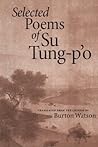
Selected Poems of Su Tung-p'oSelected Poems of Su Tung-p'o by Su Tung-p'o
My rating: 5 of 5 stars

This is an excellent collection of poetry. I found a lot to enjoy and a lot to personally connect to here.

First of all, I have a strong preference for mostly poetry in books of poetry--I rant elsewhere about making poetry books look too much like textbooks--and this has the perfect (for me) proportions: a useful introduction; many uninterrupted pages of poetry; and, where helpful, notes and explanations, especially biographical, placing the poetry in the context of the poet's life. But not too too much of that. Very sensibly, the poetry is organized in chronological order, which I find helpful.

Second, I find myself liking the poet himself, agreeing with a lot of his worldview and attitude, which makes it easier to connect with his art. He cares about his work in government, wanting to help the people he serves, caring enough that he dares to speak his mind too freely. He values family and friends, he accepts the ups and downs of changing fortune, he loves the natural world, he likes entertaining and having good conversation, and he enjoys a quiet retreat, even if he's living in poverty. His patience and dignity in the face of imperial disapproval and exile (a topic about which I don't quite understand everything) is inspiring, actually. I guess he practiced Zen long enough to get quite good at it... ;)

Third--or maybe I should have made it first--his poetry (and the very readable translation of it) is much to my taste, in subject matter, complexity, sense of humor, emotional content, length, and theme. Not that it's easy in every way; these still are 1000 years old, filled with references that fly by me unless there's a note with it. But still, reading these, one can hear the voice of another human, a man who thinks like I do in a surprising number of ways, who worries about the same things. When he grieves for a young wife gone ten years, you get it.

I realized near the end of the book (and verified by looking up old interviews) that this poet was the inspiration for a character in Guy Gavriel Kay's River of Stars, a fantasy set in a kind-of Sung Dynasty. I liked the character, and the connection made me like the poetry even more. It magnified for me the sense of bittersweet longing and regret that pervades his writing, especially in the last years, because that's the primary emotion in the novel.

And I happened to read the translation Kay favored, so... that's cool.

I suppose I don't need to recommend this book. A much finer writer (and, no doubt, reader) than me already did. But I'll cosign.

View all my reviews

Wednesday, October 5, 2022

Where I Agreed With the Translator

Poems of the Late T'angPoems of the Late T'ang by A.C. Graham
My rating: 4 of 5 stars

This is a very readable and enjoyable collection of poetry from the late Tang dynasty.

These translations have a number of moving parts. Always, there is an introduction, with the translator's take on his job; there are the poems themselves, in English; and there are the notes for specific poems along the way. All are done well here, IMO, though the poems that I least enjoyed are among the most celebrated--so that's a bummer.

A. C. Graham does an outstanding job of showing, in some detail, with specific examples, the manner in which these elliptical and allusive Chinese poems are translated into English, illustrating the difficulties in attempting to convey as much of the literal meaning, connotations, rhythm, rhyme, and other elements as possible without harming the other aspects of the poetry. The tradeoffs are obvious--forcing the poems to rhyme in the target language adversely affects the word choice, while focusing on exact meaning not only makes rhyme impossible but makes it more difficult to employ anything near the original rhythm: "As these lines illustrate," the translator tells us in the introduction, "the ideal of perfect literalness is soon betrayed by concessions to idiomatic smoothness, rhythm, and immediate intelligibility." He describes the balance he attempted to achieve between the varying demands of the original, and I find I agree with his determination.

I also approve of his within-text notes, which are mostly spare, though he troubles himself to fully annotate a few poems. (These are the ones I liked least, some poetry that is so densely packed with hints and allusions and metaphors and culture-bound idiom that it is utterly opaque to the reader without the notes and not very interesting with it.) In general, I found the occasional notes useful and not too disruptive to the reading. Other similar volumes are so packed with notes and helpful intrusions that it dries the poetry out to the texture of a stiff old textbook, a fate I feel he has avoided.

Some of the poetry here, like much of Tang poetry that I've encountered before, is direct and clear and comprehensible, filled with concrete imagery, universal experience, and relatively natural language. (The stuff I like.) Much of it, however, is more mannered, more difficult, based more on poetic models emerging from a mature tradition. These poems, according to the notes, are some of the most admired in the canon, at least among Chinese readers, but they are the least successful in translation. Understanding them even a little is more of an academic exercise (not a bad thing, all in all) than an aesthetic one. But, IMO, there are enough of the former that I still have an overall appreciation for the book.

Recommended most for students of Tang poetry or those who've already pored over the most common collections. There is a lot to enjoy here, and a great deal to work through if one is interested.

View all my reviews

Friday, September 16, 2022

Where the Poetry Gets Stepped on

Li Po and Tu Fu: PoemsLi Po and Tu Fu: Poems by Li Bai
My rating: 3 of 5 stars

Gotta admit--I didn't love it. This book is mostly introduction and annotations--probably less than 30% is poetry. And the poetry was the whole reason I got it.

Sure, the annotations, the lengthy explications, and the careful interpretation of unfamiliar idioms and allusions were useful, in a way. This is a primer in reading the poetry of these two men. For those studying their poetry, I would happily recommend this volume.

For the rest of us just wanting to read poetry and get lost in it, this one will annoy. Sure, I guess I could try re-reading it now, skipping all the extra text. I think I might do that, honestly, and see if I enjoy the translations more. Reading it as written feels more like listening to music on NPR, where you have a 3 minute song and then 10 minutes of discussion. Those proportions are all out of whack.

Ironically, the subtitle of this collection is simply "Poems," as if that's all you'll find here. I wish.

My purpose for reading poetry is to locate those poems or passages I connect with somehow. It's like hunting for easter eggs for me. I keep track of the ones I really liked and eventually copy them into a journal. In some collections, I find reason to genuinely connect with and return to a quarter or more of the poems. This collection: two. Just two. I don't know if it was all the notes on every side being a distraction or if the translations were not quite working for me or if the selection was skewed toward technically interesting poetry rather than human and accessible, but I didn't dig it.

And I wanted to.

Oh yeah. The translator frequently referred to Mao, kinda positively. I think maybe four times. The first time was forgivably odd, but each additional reference doubled and redoubled my disapproval. It soured the experience, honestly.

I'll put it aside and look at it again another day. Today I'm starting a different book. Here's to better luck!

View all my reviews

Monday, August 15, 2022

Where I'm More than Usually Grumpy

The Selected Poems of Li PoThe Selected Poems of Li Po by Li Bai
My rating: 2 of 5 stars

The more I read this, the more it bugged me.

I usually like Li Po, having read his poetry in a couple different collections, but I really didn't like the translation in this one. It just didn't work for me. The rhythm came to grate on me, and I liked it less every page I turned. I hate-read the last 20 pages.

(I seldom give a negative or harsh review, but I feel free saying this because so many people like this translation, and the guy has won translation awards. He'll be fine. I can be a random data point way over on the edge that everyone can just ignore...)

Thing is, I was really looking forward to this. Thought I was gonna love it. But it's all translated in a terse, elliptical, sentence-fragment way. It's stingy with verbs and connecting words like articles and prepositions. It was a stylistic choice; I think it's meant to more nearly resemble the original Chinese than is often the case, and for other readers I guess it paid off. But I found it hard to read and hard to connect to. I'd get stuck on top-heavy sentences, looking for the verb that sometimes never showed up, and I'd have to re-read and re-parse every line. It wasn't intuitive or simple, and the struggle took me out of the poetry.

Like this. Take a look. These are lovely images, but the translation is so angular, so sharp:

Heaven temple, Shui-hsi Monastery:
east wall lit beneath cloud brocade,
sounds of a clear stream tumbling past,
green bamboo harboring tower rooms.

I'm totally ready to dig this, but it feels like a poem made of dry sticks tied with a string.

Another poem begins this way:
War last year at the Sang-kan's headwaters;
war this year on the roads at T'sung River.

And another:
Thoughts of you unending
here in Ch'ang-an,
crickets where the well mirrors year-end golds cry out
autumn, and under a thin frost, mats look cold, ice-cold.

I mean, at least there's a verb there at the end, finally. I was pretty psyched. But it's dense, and that crickets line seems to have no beginning or end, just a lot of middle...

Anyway. Whatever. I'm sure it's my bad. Everybody else thinks it's awesome.

I've found another collection with a different translator. Fingers crossed.

View all my reviews

Monday, August 1, 2022

Where Yang Wan-li Speaks Across the Years

Heaven My Blanket, Earth My Pillow: Poems from Sung Dynasty China by Yang Wan-LiHeaven My Blanket, Earth My Pillow: Poems from Sung Dynasty China by Yang Wan-Li by Yang Wan-Li
My rating: 5 of 5 stars

This is a very readable and enjoyable collection of Sung Dynasty poems by Yan Wan-li.

Most of the poetry included here is autobiographical and intimate--the poet is visiting a monastery, or is traveling by boat to a new post, or is playing with his children, or is visiting historical sites, or is getting sick and depressed and can't sleep. We find lots of the natural imagery common to Chinese poetry in any era--rivers and lakes and mountains mostly, along with everything around the edges of those things:
Today there is no wind on the Yangtze;
the water is calm and green
with no waves or ripples.
All around the boat
light floats in the air
over a thousand acres of smooth, lustrous jade.

However, only a few exclude the poet from the scene, and his voice is present even in those. "I sit watching the sun set over the lake," one begins. Another: "I see a fly/ warming himself on the windowsill." A third: "I stand by the stream waiting for the moon to rise." He's not writing about places and vistas; he's writing about himself experiencing those things.

He returns west after a posting that didn't work out, and he feels like the land knew he'd be back: "I guess I never fooled the milestones;/ they reprimand me for ever going east." Yang Wan-li is self-consciously part of the setting he is describing, and his feelings in that moment are frequently as important as any other element of the poetry's composition.

In his later years, his health really brings him down, and he speaks openly about depression. In "Rising From a Nap at Noon," he writes: "Just as I'm feeling most depressed... a breeze blows through the northern door," bringing the scent of orchids, and "this old man feels refreshed." At other times, though, even nature can't cure him. He can't sleep, or doesn't have the energy to read anymore, and he feels like he's standing outside of time. In a poem about late spring, he writes, "the scene is beautiful, but I'm feeling bad;/ everyone else is happy; I alone am depressed." And again, elsewhere: "I am ill" he says, "and spring looks like autumn to my sick eyes."

The most striking lines, for me, were these, where he remarks on the lonely feeling of depression on a sleepless night:
My pain cries to heaven,
but heaven does not know.
Or heaven does know, but does not care.

Ouch. And I get it.

The lines may be from the Sung Dynasty, but they are full of sense, direct and accessible, even now, 800 years later. There's a real person writing these words, and that connection is what makes the art so powerful.

Recommended. It's a slim volume of about 100 mostly short poems, but also includes an introduction with useful background information and context.

View all my reviews

Wednesday, June 1, 2022

Where I Found Lots to Like

Zen PoemsZen Poems by Peter Harris
My rating: 3 of 5 stars

Some of the poets in this collection are ones that have caught my eye before, so I picked it up and read it in bits in pieces over time. I have no more than a passing interest in things zen, and so, not surprisingly, it wasn't entirely up my alley, but I found a lot that was both interesting and meaningful to me. Those are the poems I happily added to my hand-copied collection.

I don't respond to everything here; not all of it is for me is a better way to phrase it, I suppose. But I found lots to like. I especially enjoy the nature poems--thick forests, mountain paths, rushing streams, and distant temple bells--but I'm almost as fond of the recluse poems--old scholars living in a hut, reading their books of poetry (hmmm...) and tending their gardens (hmmm... again) and drinking wine. (So close! Are there any coffee poems?)

Here's an example of the nature vibe by the poet Hanshan (or "Cold Mountain") with a touch of the recluse in it:

Clambering up the Cold Mountain path,
The Cold Mountain trail goes on and on:
The long gorge choked with scree and boulders,
The wide creek, the mist-blurred grass.
The moss is slippery, though there's been no rain
The pine sings, but there's no wind.
Who can leap the world's ties
And sit with me among the white clouds?

Nice. :)

The other benefit of a collection like this is finding a few more names to track down elsewhere. This book led me to at least half a dozen authors I'll enjoy finding somewhere else. So it's small, and even though I don't love everything it still packs a pretty good punch.

View all my reviews