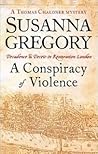
 A Conspiracy of Violence by Susanna Gregory
My rating: 3 of 5 stars
I did not enjoy this book. I should have DNF'ed when I first considered it. But for ~waves hands~ reasons I'll give this a passable three.
My problem with this novel? The plot is buried under boring details, random clues adding up to nothing, names of characters that matter but never enter into the story, and just too many distractions that aren't even entertaining let alone informative. Probably half of the novel is just the main character, alone or in dialogue, trying to fit cryptic clues into some kind of meaning, wondering if it proves this or shows that, trying to decide which of a dozen people might have done a thing, who among those dozen knew about the little factoid at the time, who knows now, who is on the wrong track about it... It's exhausting. A spreadsheet wouldn't help.
Here--literally a random page, the first one I turned to:
Who had sent the Lord Chancellor a missive containing that particular phrase, and what did it mean? Or had it been intended for someone else, and the Earl had intercepted it? And why had Clarke converted the same words to cipher and hidden them in his secret pocket? Were the Earl and Clarke associated with John Hewson, who had ordered Chaloner to praise God's one son as he lay dying, or was that coincidence?
Half the book is like that. And almost everything he does know comes directly from other characters who either volunteer the information or discuss it while he's accidentally almost right beside them. Everyone knows more than him, including knowing everything he's doing. His skills are nonexistent.
Oh, yeah, he can decipher messages. That's it.
But most annoying is the fact that Chaloner is the worst hero I've ever seen. He's supposed to be a veteran spy and investigator, and yet he's mistaken and on the wrong track almost the whole book so much that it feels like he's brand new at all of this. Besides that, he almost screws up every. single. time. that someone is trying to stop him or chase him off or pump him for information or kill him. It's horrible. He's inept, incompetent, foolish, and lucky to survive this book, let alone a whole series of them. In the last big scene, he bumbles unprepared into danger, where he is captured. Given a lucky chance, he shoots a gun, and misses. He gets shot at, and should have died, but she misses. He tries to escape during the chaos of a fire, but a woman grabs him and is choking him out, and he needs help to escape her. Then he gets trapped under a man's body with fire creeping toward the gunpowder and would have died except someone pulls him out. He achieves nothing. A bungler.
Not to mention the fact that he's wrong about everybody in that room, who should be trusted and who should not, who is on which side, who is behind everything--meaning he's discovered almost nothing in 480/500 pages. In fact, we get to the epilogue and find out he's still wrong about what supposedly happened and who did it.
He's this incompetent all the time. FFS. How is he the hero?
There is some good research behind the setting and setup of the book. 17th Century London is well described. I like a few things. Just enough interest to push myself to finish--which means (by my own personal policy) I give it a 3. I kept hoping it would pick up and he would become an impressive spy, because it feels like the kind of book I love. But I never want to read another book with him as the main character.
Unless it's a comedy. In the movie, he'd be played by a young Don Knotts. Or maybe Jim Carrey.
View all my reviews


No comments:
Post a Comment