Showing posts with label Clifford Simak. Show all posts

Sunday, April 4, 2021

The Reviews Are Split. And I'm of Two Minds.

Special DeliveranceSpecial Deliverance by Clifford D. Simak
My rating: 4 of 5 stars

I love Clifford Simak, but on reread I didn't love this novel. Hmm.

I really didn't remember what it was about, and as I reread it very little struck a chord. I enjoy his style, his language, his themes, so I always like it, but I have to admit that I was kinda bored this time. (Still, I can't bring myself to give it less than a 4. That would be insulting.)

Too little happens. The conflict to start out is amazing--several humans from different versions of earth are plopped on a planet (another version of earth?) and sent out walking, where they encounter inexplicable buildings and beings. The premise is sort of like a scaled-down Riverworld, which is cool, but most of the book feels like aimless wandering. It was a mystery without clues, a game without rules. It reads fast, as always, so it's easy to fly through it, but it's not very filling, to mix my metaphors. :)

I actually like the end. The very very end. But TBH--this could have been an episode of Star Trek or something. A tight 60 minutes. TNG did have a story kind of like this--but the Simak novel came first.

Anyway, still a pleasure for the Simak fans. For the non-fans, don't start them with this one. Send them over to City or Werewolf Principle or Time is The Simplest thing.

View all my reviews

Sunday, March 14, 2021

A Very Human Mechanical Man

The Mechanical (The Alchemy Wars, #1)The Mechanical by Ian Tregillis
My rating: 5 of 5 stars

This is a great book, and a really cool start to a series.

Set in a parallel world where the Netherlands developed clockwork technology tied to alchemy and overran the world with their robot "Clakkers," a world where France is reduced to its holdings in the New World and other countries bow to the Hague, the story is mostly about a rogue Clakker who is accidentally freed from the geas that control him. He tries to survive in a world where free Clakkers are the highest priority of the Dutch government, wishing only to be left alone. At the same time, Berenice, the spymaster of France, is trying to learn all she can about the mechanical devices to have some way to defeat her enemies and empower her nation. She is a dangerous, brilliant woman, and engaging enough to have been the only POV character.

The world-building is wonderful--what we need to understand is supplied, but in bits throughout, never in obtrusive ways. The main characters and their stories, especially, are centered; the setting matters a great deal, an adds to the richness of the story, but never takes over.

I love Jax as a protagonist. The reader has sympathy for his situation, for the plight of all Clakkers, and even though he's a mechanical man he has a unique voice. Like robots in the works of Clifford Simak, Jax is a gentle soul, a kind soul, and is clearly his own person. I am rooting for him to succeed at every moment.

The series takes a breath at the end of the novel, but it's not the end in any way. I have the second book on its way and look forward to the next installment. And I already own the third--a gift that sent me on this journey in the first place. I'll be glad to get started on that soon enough.

Anyway, obviously, I recommend the novel. Fast action, great characters, a nice mix of tones, and believable stakes. Whew. Good stuff.

View all my reviews

Thursday, March 11, 2021

Still Great After All These Years

Time Is the Simplest ThingTime Is the Simplest Thing by Clifford D. Simak
My rating: 5 of 5 stars

This is one of my favorite Simak novels, one of the handful I first read back in the 70s.

In some ways, this novel, like so many of his books, is simple. There is no hard science here; the setting is not deeply explored; there are not many characters; the plot is not complicated. But in other ways, it is deep; the ideas are universal and meaningful, and the characters tend toward the philosophical, with long conversations about the future of humanity and the like. They discuss at length the situation with paranormal humans, how they are useful, even essential, to human history, but are at the same time despised and feared and even hunted.

The parallels between the "parries" and marginalized groups in our real world is no accident, nor is it simply an allegory. Instead, it is an application of the rules of intolerance, rooted in racism and witch-burning hysteria. This is how demagogues would use fear of telepaths to take power and control society. The question is--could they weather the attack?

Simak's approach doesn't sit well with everyone. He keeps his focus tight and intimate. We don't see the big cities or the news shows, and we don't know what's going on around the world. those things are barely hinted at. What we see is just the main character and the handful of people around him. You hardly know if there is still a New York City in this place (there is); you can't tell if there is TV (though there is something like it mentioned); you almost wonder if there is traffic on the highways (we can only guess). He doesn't care about that. Unlike modern fat books, he doesn't give us multiple POVs with layers of world-building.

Instead, it's a quiet book. A man on a canoe, trying to reach safety before it's too late. A single man, trying to escape a powerful corporation. Trying to survive, and maybe save some folks in the bargain.

It's still a favorite. Still 5 stars after all these years.

Not the thing if you want hard science in your SF. Just the thing, though, if you think road trips and grass and hills and woods and rivers belong in science fiction. And maybe witches.

View all my reviews

Friday, February 19, 2021

Encountering an Old Love

The Werewolf PrincipleThe Werewolf Principle by Clifford D. Simak
My rating: 5 of 5 stars

This was a re-read after 40+ years. And I still am in love with this novel, along with almost everything Simak wrote.

He has a way of creating non-humans and monsters and every kind of exotic character and making them human in the best ways. Here, as in so many novels, he grounds the story in a wilderness setting. Even though there is advanced science, there is also a simple life that the characters are striving for and embracing, and there's a sense of peace there that's hard to find in science fiction.

Quick pace; streamlined plot; small cast of characters; lots of conversation and rumination and quiet visiting; big ideas. It still works for me. There's a bit of melancholy in re-reading a book from one's teen years, but there's a joy, too. I've got about 20 more I've only read once--time to dip back into them.

Recommended. :)

View all my reviews

Sunday, February 7, 2021

Mostly Fanboy Stuff

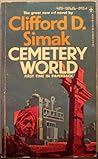
Cemetery WorldCemetery World by Clifford D. Simak


This was not only one of the first Simak books I ever read, it was one of the first science fiction books I ever read. It was Clifford Simak who made me think I liked science fiction, and he remains my favorite ever writer. (Tied with a couple others, tbh. But he was my first favorite, so... tie goes to him.)

It's been about 45 years since I first read it, and I only vaguely recalled what it was all about. I had lost the plot entirely. The truth is, I don't love the plot as much as I did back then. I think Clifford Simak may not have known exactly where he was going when he started writing. But that doesn't diminish my good opinion. I'm even more aware than I was then how I love his style, his tone, his sense of place, his way of putting huge things in perspective. There's something calming in reading his writing; I feel like everything's gonna be okay and I should go sit on the porch and pet my dog.

Some of that was conscious on his part, I'm pretty sure. Often referred to as a writer of pastoral SF, or even as THE pastoralist of science fiction, Simak often (not always) used rural settings for his stories, whether on earth in the present or future or another earth-like planet. Cabins in the woods or small towns in Wisconsin, Minnesota, Ohio, or other such places appealed to a kid growing up in rural Michigan. Guys go for walks in the woods with their dogs and have long chats with ghosts or robots or goblins while smoking a pipe or having a drink. Sometimes they have gadgets, and sometimes they have axes for splitting wood to keep the cabin warm.

Cemetery world is a perfect example. Fletcher Carson returns to earth (something like 10,000 years in the future) to see how things are. Much of the planet is given over to the sprawling cemetery catering to those humans throughout the galaxy who want to be interred in the soil of earth. The rest of the planet is making a slow recovery from the devastation of war. Most of the novel, he and the other characters are meeting the remnants of humanity who live in a wilderness that looks a lot like an early, unspoiled earth. They cross rivers and mountains while unraveling a mystery about the place, all the while philosophizing about life and time and all the big ideas that Simak likes to return to. (Me too.)

There's something about the main characters camping along a stream, cooking food over a fire, that humanizes and puts into perspective the giant SF ideas. Space opera can be very cold; Simak's stories and settings tend to be warm. Dangerous, of course, but still more human lasers in space.

It was nice to revisit. Scrupulous honesty demands I give this novel four stars (to mean "You'll probably like it this **** much) but the sentimental part of me gives it 10.

Whenever people ask "Who would you meet if you could talk to anyone from the past?" I answer Clifford Simak. He's the man.

View all my reviews

Tuesday, September 15, 2020

Where the robots ponder heaven

Project PopeProject Pope by Clifford D. Simak
My rating: 5 of 5 stars

On this re-read of a book I first enjoyed 30+ years ago, I have to say that I liked it again, but maybe for different reasons.

Clifford Simak does a great job of bringing his science fiction down to the personal level, to ground level. Though this novel takes place on a planet far from earth, it still is set in a small town on the edge of the wilderness, like so many others. The characters chat around a fire or walk in the woods and they have a drink while they explore what's going on around them. It's a different feel and a different pace from most SF.

I think my initial reads of Simak's novels, this one included, were generally just following the plot and looking for the answers to the riddles and mysteries. That's still fun the second time through, but it's the atmosphere he creates that I enjoy most now. Genteel robots discussing faith and the possibility of Heaven with the main character in an unhurried, friendly way, just feels like a future that isn't terrifying. It's human.

Some reviewers feel different about the novel. I get it. The plot is pretty jagged, and despite their warmth, his characters are never fully realized. I like it, though. I think we find a kind of conversation here, one that he started with his readers a dozen books before this one, a conversation that continues through all of his books, and it's one that matters to me. He shows us a ghost and asks us if we can consider it a person; he does the same with a primitive man from the distant past; then with intelligent animals; then aliens; then with a disembodied mind; and frequently, here and elsewhere, robots and computers. Are they like us? If no, why not? If they can visit with us and ponder the universe, aren't they the same as us?

It's pretty clear what Simak thought about that. And it helped form my opinion as well.

View all my reviews

Thursday, August 27, 2020

Where I Re-Read an Old Favorite

The Goblin ReservationThe Goblin Reservation by Clifford D. Simak
My rating: 5 of 5 stars

This was one of the first SF books I ever read, and Simak became and has remained my favorite author since then. It was interesting and enlightening to re-read it some 45 years later.

First of all, I love his writing, love his characters, love the long philosophical discussions, love the contemplative tone, love the natural/rural/pastoral settings. That's all still true.

But--second--I *do* have a different take on the novel this time. Not only am I older, but times have changed, too. Here's what I see now:

•It's short! Maybe 70,000 words. And I like it. Anything under 100,000 words is my favorite. (I'll read and enjoy big fat fantasies, but even good ones get old after page 500 or 600...)
•Lots of cool ideas. Time travel and long-distance space travel are perfected; the MC returns home to find a copy of him returned first and was killed; fantasy creatures, like goblins, are discovered and brought to the university; one of the characters is a ghost; the possible love-interest has a saber-tooth; there's a crystal planet that predates the Big Bang; and bunches more.
•Related--many ideas are left as loose threads. Shakespeare is brought to the university from the past, and nothing of note happens with him. It's just a matter of some interest. Also, we're left wondering what will happen with the incredible knowledge stored at the crystal planet. The difficulties of time travel are ignored. And I'm left with questions about the little people...

But those unfired Chekhov's guns are beside the point. The plot makes sense, moves along briskly while still exploring some interesting ideas, and we get a meaningful conclusion. I still like it.

And somehow, the author has written the whole thing in a tone that makes me think that everything is gonna be alright in the end...

View all my reviews