Showing posts with label London. Show all posts

Thursday, July 2, 2026

Where Chaloner Is the Worst Possible Investigator. Ever.

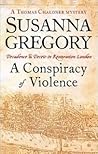
A Conspiracy of Violence (Thomas Chaloner, #1)A Conspiracy of Violence by Susanna Gregory
My rating: 3 of 5 stars

I did not enjoy this book. I should have DNF'ed when I first considered it. But for ~waves hands~ reasons I'll give this a passable three.

My problem with this novel? The plot is buried under boring details, random clues adding up to nothing, names of characters that matter but never enter into the story, and just too many distractions that aren't even entertaining let alone informative. Probably half of the novel is just the main character, alone or in dialogue, trying to fit cryptic clues into some kind of meaning, wondering if it proves this or shows that, trying to decide which of a dozen people might have done a thing, who among those dozen knew about the little factoid at the time, who knows now, who is on the wrong track about it... It's exhausting. A spreadsheet wouldn't help.

Here--literally a random page, the first one I turned to:
Who had sent the Lord Chancellor a missive containing that particular phrase, and what did it mean? Or had it been intended for someone else, and the Earl had intercepted it? And why had Clarke converted the same words to cipher and hidden them in his secret pocket? Were the Earl and Clarke associated with John Hewson, who had ordered Chaloner to praise God's one son as he lay dying, or was that coincidence?


Half the book is like that. And almost everything he does know comes directly from other characters who either volunteer the information or discuss it while he's accidentally almost right beside them. Everyone knows more than him, including knowing everything he's doing. His skills are nonexistent.

Oh, yeah, he can decipher messages. That's it.

But most annoying is the fact that Chaloner is the worst hero I've ever seen. He's supposed to be a veteran spy and investigator, and yet he's mistaken and on the wrong track almost the whole book so much that it feels like he's brand new at all of this. Besides that, he almost screws up every. single. time. that someone is trying to stop him or chase him off or pump him for information or kill him. It's horrible. He's inept, incompetent, foolish, and lucky to survive this book, let alone a whole series of them. In the last big scene, he bumbles unprepared into danger, where he is captured. Given a lucky chance, he shoots a gun, and misses. He gets shot at, and should have died, but she misses. He tries to escape during the chaos of a fire, but a woman grabs him and is choking him out, and he needs help to escape her. Then he gets trapped under a man's body with fire creeping toward the gunpowder and would have died except someone pulls him out. He achieves nothing. A bungler.

Not to mention the fact that he's wrong about everybody in that room, who should be trusted and who should not, who is on which side, who is behind everything--meaning he's discovered almost nothing in 480/500 pages. In fact, we get to the epilogue and find out he's still wrong about what supposedly happened and who did it.

He's this incompetent all the time. FFS. How is he the hero?

There is some good research behind the setting and setup of the book. 17th Century London is well described. I like a few things. Just enough interest to push myself to finish--which means (by my own personal policy) I give it a 3. I kept hoping it would pick up and he would become an impressive spy, because it feels like the kind of book I love. But I never want to read another book with him as the main character.

Unless it's a comedy. In the movie, he'd be played by a young Don Knotts. Or maybe Jim Carrey.

View all my reviews

Sunday, January 25, 2026

Where the Author Wowed Me

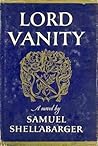
Lord VanityLord Vanity by Samuel Shellabarger
My rating: 5 of 5 stars

I bought this on kind of a fluke, and then I loved it. Start to finish. 5 stars.

Published in 1953, it falls in a dead spot historically for me. This isn't a book I would ever have read 40 years ago, or even looked at twice. As a child of the 60s, and becoming a reader in the 70s, I would choose new kids' books (like Charlie and the Chocolate factory) or new science fiction or fantasy (when I found out about those), and sometimes the odd book from another genre, like The Outsiders or something. Except for novels in school, I very rarely read books older than the early 60s. They didn't appeal. The Hobbit and the Lord of the Rings are exceptions, and I can't think of any others from childhood that broke through. And though I read in school, with *some* interest, Hemingway and Steinbeck and some other early 20th century stuff, I didn't like them enough to read for fun. (Still don't, actually.) And I honestly had no idea there would be any books from 1900-1950 that I would like. They were, to my mind, the ratty old books of another generation sitting on the shelves, all dusty and dry, meant to be passed over.

I wasn't surprised when I found I liked 19th century stuff, like Scott and Dumas and Austen, because I had no prejudice against those books. But I didn't think I'd ever want to read stuff from my parents' or older relatives' era. It's only lately that I've developed an interest in books from that time, an interest in hunting for things that I would like that I have never learned about before, or books I simply tuned out because they weren't for me.

All that is to say that I had no idea that this author existed, and I wouldn't care except that this was a really good book in a genre I really enjoy, an author that I should have been reading all my life. Many of the other titles sound great, and I don't want to count my chickens, but I suspect I'm gonna like a least a few of them.

Some spoilers: The story starts in Venice in the 1700s, with a talented young man trying to make his way in the world with just his wits and his talent. He is a musician and a writer and an actor, but he is also nobody special. His talents bring him to the attention of people who do matter, and he is sent off on a chaotic career. He falls in love with a dancer, a young unaffected woman that the reader is pretty much guaranteed to also fall in love with. He has setbacks--a time on the galleys as a convict, sent there on trumped-up charges--but he is redeemed and travels to England where he is recognized by his noble father, but his hopes for a future with the beautiful young dancer are destroyed by his father's wishes and his fear of falling once more into oblivion. He is a dandy; he is a soldier in Canada; he is a spy. He is an actor, and plays all his parts well.

And all of this is written about with tremendous skill. The love story is touching. The social life in Bath and then Paris, the dances and salons and card sharps and merciless lords and scheming ladies, is compelling. The battle scenes, telling the story of England's defeat of France at Quebec, is amazing, riveting. And the intrigue of Richard spying for England in Paris is very well done, almost too clever for me to follow. I loved the pacing and the layers and on-again-off-again love story. Terrific prose. Very satisfying ending.

It was such a great surprise to learn about this book, this author, this prejudice I had without even realizing it. A lot of new reading is possible that I didn't know about.

Highly recommended. I see other of his books have higher scores than this, and I have great hopes.

View all my reviews

Wednesday, October 15, 2025

Where Jane Saves Her Own Neck

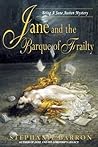
Jane and the Barque of Frailty (Jane Austen Mysteries, #9)Jane and the Barque of Frailty by Stephanie Barron
My rating: 5 of 5 stars

I'm still on my second time through the Jane Austen mysteries, and I'm only loving them more.

I wasn't a mystery reader until I got hooked on this series, and I'm only now getting kinda good at it. There's a bit of genre savvy required to read them right, and I didn't have it at first. It's not just knowing that the first person pointed at probably isn't the murderer, like in a police procedural, or getting good at guessing who the culprit really is before it's revealed. (I'm not necessarily all that good at the latter, anyway.) There's also the ability to pay attention well enough that you know who people are, how they're related to each other, what their motivations are, which things they both know and which things only one of them knows, and where individuals were at different times during the course of the story. That stuff's hard once you have more than a tiny handful of characters. But you can get better at it, even if you have a notoriously faulty memory. (Also me.)

Agatha Christie takes this to extremes in some of her mysteries, especially the ones where the murder, the murderer, and all the suspects are isolated--and all the isolated people are suspects--on the Orient Express or at a summer home or on a ship down the Nile and it's Poirot's job to establish the movements of everyone involved down to the minute. (I guess people refer to these as closed circle mysteries or locked room mysteries.) That's more puzzle than story to me, and not as much my thing (though I have loved a few Agatha Christie novels), but it really does concentrate those analytical elements that a lot of mystery readers love. (I wonder if a modern detective in that sort of novel would benefit from using a spreadsheet...)

It's not quite that intense in this mystery or the series, and that's good IMO, because this is a lot closer to the feel I like, that of a Jane Austen novel of manners, with visits and balls and conversations over tea. There are family subplots and a larger, biographical arc stretched across all the books in the series, that give it more interest to me. In this novel, we have a little scandal among great lords and ladies in London, with a Russian princess making a spectacle of herself because of her apparent love for Lord Castlereagh just hours before she's found dead near his front door. The story involves other kept women and prostitutes of various degrees--here charmingly referred to, at times, as a "Barque of Frailty," (hence the title)--in a way unlike actual Austen novels. But it's refreshing more than anything else. The real Jane gave us a narrow worldview, the type allowed in novels at the time, but Stephanie Barron lets us see a broader cross-section of Regency England, a bit more of real people, and it's like having a brain itch scratched. I like it.

Jane herself (the character) becomes a suspect when she and her SIL are given some jewels to sell for a friend that turn out to come from the murdered princess. It becomes even more important that she solve this crime than others, because it's her neck this time, and for plot reasons they don't tell anyone about it.

Beautifully written. Well researched. Lots of interesting characters. It's still 5 stars to me, and if I kept better track of the characters and their movements this time, well, I guess I'm still learning. Recommended.

View all my reviews

Saturday, October 30, 2021

Where the Story Just Gets Better

The Case of the Left-Handed Lady (Enola Holmes, #2)The Case of the Left-Handed Lady by Nancy Springer
My rating: 5 of 5 stars

This was a great pleasure to read.

I enjoyed the first book in the series, but this was a more engrossing, more satisfying read. It is meant for a middle grade audience, but like other well written MG books, it can be enjoyed by readers of any age. I like the character of Enola Holmes, her goals and interests and independence, and as far as the story is concerned I like the very real challenges she faces. Yes, she's brilliant and capable, but she's still a young teenager trying to make her way on her own in a big city while trying to locate her mother. She will do well on her own, as her mother keeps saying--but she still wants her mom.

It makes sense. And it works.

Enola uses various disguises to earn a living while she anonymously helps London's poor. And at the same time as she is trying to locate her mother, her brothers are trying to locate her. Lots of conflict. The search for the missing girl in the title is equal parts adventure and mystery, and it makes an effective centerpiece for the book while the larger arc moves along a tick.

The resolution is satisfying and the setup for sequels is ideal. I look forward to the next book, already waiting on the shelf.

Recommended for the original target audience as well as mystery readers of all ages. Anyone who likes fun things, really.

View all my reviews

Friday, May 17, 2019

Where I Tone Down the Raving for a Book I Liked Better than I Let On

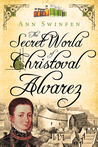
The Secret World of Christoval Alvarez (The Chronicles of Christoval Alvarez, #1)The Secret World of Christoval Alvarez by Ann Swinfen
My rating: 5 of 5 stars

I enjoyed this novel, and it succeeds on many levels. It is fun to read (my main criterion, actually), it deals with themes I care about, it has characters I enjoy knowing, and its well-rendered setting, besides lending the story additional realism, is an engaging source of information.

This is primarily an Elizabethan spy story with a young doctor drawn into the intrigue, which, come on, is good fun. The action is broken up by scenes of Christoval's life and work, which helps to ground the increasingly fantastic spy story. He has his own spoilery secrets which threaten to emerge, adding to the conflict and tension. As a character, Christoval is sympathetic and engaging, with a great backstory: his family is Jewish, from Portugal, forced to hide their religion and flee to England, and he has his own additional secrets. His skill as a doctor, a mathematician, and a musician is part of what makes his story fun--he gets to be awesome sometimes, which I love, watching him save lives and break codes. All within reason, though; He's still a teenager in a dangerous world, not a superhero, and the author does not forget that.

A number of interesting themes emerge through the course of the story. A central one is the place of religion in society. As one of the "hidden Jews," (referred to, uncomfortably, as Marranos, which is acknowledged as a slur but shows up in a casual way a number of times), Christoval is sympathetic to the Catholic conspirators who are forced to hide their religious beliefs in Protestant England. How can a citizen be blamed, he wants to know, for adhering to a religion that was once obligatory? Especially when it passed out of favor, then back in, then back out once more? His ambivalence about bringing such people to justice makes him more believable and sympathetic. Other themes are: wealth disparity (inevitably); the oppression of women; tradition's primacy over new knowledge; and the violence inherent in the system. ;) Happily, these are allowed to surface in a natural way, adding welcome depth to the novel.

The setting is nicely developed with convincing detail. I found it educational, and can only hope and assume the information is accurate. :) How would I know?

I am glad to recommend this novel to other readers. Such quibbles as I have are swamped by my approval, and I can say it was a pleasure to read. I recommend that I go look for sequels.

View all my reviews

Saturday, January 12, 2019

A Serious Review of a Fun Book

Rivers of London Vol. 1: Body WorkRivers of London Vol. 1: Body Work by Ben Aaronovitch
My rating: 5 of 5 stars

I've given up on as many graphic novels as I've finished. I can't say why they don't really work for me so much of the time. But I really liked this one.

I had just read the first novel in the series and liked the premise and characters, and I saw that there was a series of comics, and I had to check it out. I was happy to find the tone and style so close to the novel.

Peter Grant is a young London policeman who sort of stumbled into a specialty, which is solving all the weird cases. He works with an older man who is teaching him the secrets of the arcane as they follow clues. They also live in a cool old house in the only part of London I know from a single brief visit there, and drive a cool car, and have other awesome artifacts. From the first story, and continuing here, you find ghosts, river spirits, vampires, and every sort of oddity, but it's all rooted in the real streets of London.

The mix is what works so well, I think. We have a young man who leads a normal life interacting with magic and figures from folklore, and we have figures from folklore interacting with normal life (such as the beautiful river spirits who like to shop and go clubbing). In my words, looking back, it kinda sounds ridiculous, which is why it's good I'm not the author. It took a better writer to make it engaging and believable and fun and as much character-driven as plot-driven.

The inclusivity of the novels and this graphic novel--Peter is a black Londoner, and many of the characters, including the spirits, are also black or Muslim or Asian--is one of the aspects that makes it feel more modern and believable and, for me, enjoyable. It breaks out of the insular (pun intended), parochial, narrow view that makes reading some older English writing so claustrophobic. It's a shame that the author, Ben Aaronovitch, is not an own-voices writer for any of those communities--for which he can hardly be blamed, but there it is--but his is a robust, respectful multicultural London, and it is fun to read. In fact, I would suggest that that is his strength: rendering a modern, complex London. The city, with all its variety, its long history, its diverse cultural antecedents, its evolution and gradual, though incomplete, elimination of class and gender divides, its uneven post-colonial melding of immigrant peoples, can almost be viewed the main character here, and he definitely shows us that character from the inside, as someone who really knows it.

Recommended. The books, too.

View all my reviews