Showing posts with label politics. Show all posts

Saturday, July 8, 2023

Why You Should Read Something Else

Madam President (Charlotte Kramer, #3)Madam President by Nicolle Wallace
My rating: 2 of 5 stars

The author seems like such a nice person. Lemme just acknowledge that.

But this is such a very bad book. I can't believe how bad. (I would only give a 1-star if I found something hateful in the book. There isn't anything like that. It's just a bad book.)

And I don't want to give *all* the reasons, or explain in too much detail, but I have to give some justification. In summary: 1, there's so, so much info-dumping exposition, mostly explaining things we never need to know, sometimes for pages at a time, and it's all through the book; 2, the prose is so dull and unprofessional; and 3, literally nothing important happens in the plot.

It sounds like a thriller--multiple terrorist attacks on the same day; what will the president do?

But it's not a thriller, because the answer is that she works really, really hard on the mf speech set for the end of the day. Over many chapters. In fact, the actual plot is how the president's people struggle to control the message. It's not about rescuing the injured; it's not about tracking down leads to see who committed the crime; and it's not about the response to the terrorists. (Well, just barely, in the tacked-on "one year later" sort-of epilogue.) No, instead it's about the press corp and who's leaking to them and how the president's team works to keep the press happy and how her cabinet squabbles over communication tactics, trying to make the president look as engaged and presidential as possible throughout the day, especially in the speech. OMG.

All talk. All spin. All messaging. So crushingly dull.

Once in awhile I finish a book I should have DNF'ed. This was one of them. Seriously, the author is so sweet, I kept rooting for her to pull it together somehow as I half-read, half-skimmed the final 100 pages...

But nope.

Not recommended.

View all my reviews

Thursday, October 8, 2020

A Cool Steampunk Version of 1900's America

Boston Metaphysical Society: A Storm of SecretsBoston Metaphysical Society: A Storm of Secrets by Madeleine Holly-Rosing
My rating: 4 of 5 stars

This is a very cool world, one I enjoyed visiting. An alternate 19th Century US, with great industrialist families set up like nobility, and steampunk science as well as metaphysical abilities and dangerous spirits... very cool.

I like the main characters, too, and thought the writing was excellent, especially for what is basically an indie book. (Bought at Phoenix comicon--and signed by the author.) With a decent plot, a number of conflicts, and a cool premise, it earns a solid 4 stars from me. There are related comics or graphic novels and I bet they're a lot of fun.

I might have gone to five stars, but I have a problem with the plot. Actually, the ending. I didn't care for it. I guess I got the wrong idea about some things, and I won't give spoilers, but it didn't go the way I was sure it would, and that makes me not want to see the next book. (Is there a next book?) I dunno; I might get over that and give it a try. Maybe I can learn to trust again...

But not today.


View all my reviews

Wednesday, September 23, 2020

Where I Contemplate a More Hopeful World

The Mouse on the Moon (The Mouse That Roared, #2)The Mouse on the Moon by Leonard Wibberley
My rating: 4 of 5 stars

On rereading this book after about 40 years--I still liked it.

It's a slim book and a quick read; somewhat realistic and somewhat farcical; quite satirical and quite funny. Taken together, it's a winner.

This isn't biting satire, but whimsical, though it isn't less effective for that. It still forces the reader to think from the perspective of citizens of small nations and maybe reconsider (as an American) how much we walk on other people without considering their rights.

In some ways, the first novel and this sequel are both science fiction, imagining a world where a tiny nation develops some key new technology and uses it to leapfrog the superpowers in importance and genuine power. This science--a type of nuclear bomb in the first novel and a new type of nuclear power in the second--dismantles the power balance of the time (1960s).

It's a nice thought experiment, and the author uses it to tell a gentle satire on the politics of that time. It's also got a little comedy, a little romance, and international politics, making it easy to see why it was made into a movie.

So, good fun. I almost would give it all the stars except I don't want to oversell it. It's pleasant and amusing, and you would probably like it.

View all my reviews

Monday, October 7, 2019

Where I Find the Series Is Still on Solid Ground after Two Books

Imager's Challenge (Imager Portfolio, #2)Imager's Challenge by L.E. Modesitt Jr.
My rating: 4 of 5 stars

I enjoy books by this author, in general. He writes in a very glib way, with a rolling plot that just keeps moving. I especially like the characters (here and elsewhere) and like to see them figure things out and attack problems with the help of allies.

I don't love his long descriptions of the inconsequential (what Rhenn did on almost every day from the start of the book to the end, or the menu of almost every meal in the story) or strange dialog (random meetings turning into long paragraphs of conversation about politics or philosophy). It pads a story that would be plenty long, but that's how he likes it, so that's what you get. If you want the story, you get the quirks.

I like the story, so I'll take the quirks.

Rhenn is a good character. He's a young man with a lot of nerve and imaging skill and a strong ethical sense. He's navigating a world where you can count on some people and not others, which he's figuring out, and he makes unlikely friends because he is fair and reliable. I like his girlfriend, Seliora, and her family a lot, too. They are a business family and members of an ethnic minority, people somewhat oppressed by the majority, and while Seliora and the others are very loving, they also have a very tough mentality that I admire. From the start, they embrace Rhenn in a do-anything-for-you kind of way, which included fighting behind the scenes for him, and become central to the plot. This dynamic between Rhenn and her family is my favorite part of the book.

Imager's Challenge is the second book in the series. The more the world-building gets taken care of, which is a big part of the first two books, the more the action comes to the fore, which I find more fun to read. So after I see to a few other books waiting on my TBR pile, I'm eager to get to book 3 and seeing how Rhenn is doing.

Book and series--recommended.

View all my reviews

Sunday, June 16, 2019

Where I Like the Author but Didn't Enjoy the Book. Don't Rat Me Out

Rubicon: The Last Years of the Roman RepublicRubicon: The Last Years of the Roman Republic by Tom Holland
My rating: 3 of 5 stars

I didn't love it.

I can't speak to the scholarship. Tom Holland (still not Spider-man) seems to know a great deal on the topic. He says a lot of smart things. I just didn't like reading this very much. (And I have enjoyed other books by this author in the past, like Persian Fire.) I found it a slog. Still, I made myself finish, a few pages a day, over a long stretch. And here we are.

The story here is narrowly focused on the fortunes of individual politicians (a cast of thousands, actually, most of them with names starting with C, like Crassus, Catulus, Cethegus, Caesar, Cato, Catiline, Cicero, Clodia, Clodius, Curio, Caelius, Cinna, and others--and though I can't blame the author for this, it really was poor planning by History) and who's up today, who's down, who's making an alliance, who's double-crossing an ally, and so on. It may be real life, but as far as the the story goes, it reads like summary of a soap opera. I mean that in the "I can't follow this story" kind of way. The "I can't remember who Clodia was" kind of way. (As well as the "Weren't they enemies?" kind of way.)

For me to understand the story better, I needed to see a bigger picture, get more of a bird's-eye view of events and less of a nose-against-the-TV view. However, as always, YMMV.

And yet, despite all that, despite my bad attitude, I still learned a lot about Rome and its people and society. In fact, in terms of knowledge about Rome, I'm probably a lot closer now to where I should have been before I attempted the book.

I suspect those with greater background knowledge will enjoy reading this more than I did.

View all my reviews

Friday, May 17, 2019

Where I Tone Down the Raving for a Book I Liked Better than I Let On

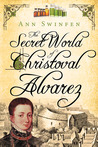
The Secret World of Christoval Alvarez (The Chronicles of Christoval Alvarez, #1)The Secret World of Christoval Alvarez by Ann Swinfen
My rating: 5 of 5 stars

I enjoyed this novel, and it succeeds on many levels. It is fun to read (my main criterion, actually), it deals with themes I care about, it has characters I enjoy knowing, and its well-rendered setting, besides lending the story additional realism, is an engaging source of information.

This is primarily an Elizabethan spy story with a young doctor drawn into the intrigue, which, come on, is good fun. The action is broken up by scenes of Christoval's life and work, which helps to ground the increasingly fantastic spy story. He has his own spoilery secrets which threaten to emerge, adding to the conflict and tension. As a character, Christoval is sympathetic and engaging, with a great backstory: his family is Jewish, from Portugal, forced to hide their religion and flee to England, and he has his own additional secrets. His skill as a doctor, a mathematician, and a musician is part of what makes his story fun--he gets to be awesome sometimes, which I love, watching him save lives and break codes. All within reason, though; He's still a teenager in a dangerous world, not a superhero, and the author does not forget that.

A number of interesting themes emerge through the course of the story. A central one is the place of religion in society. As one of the "hidden Jews," (referred to, uncomfortably, as Marranos, which is acknowledged as a slur but shows up in a casual way a number of times), Christoval is sympathetic to the Catholic conspirators who are forced to hide their religious beliefs in Protestant England. How can a citizen be blamed, he wants to know, for adhering to a religion that was once obligatory? Especially when it passed out of favor, then back in, then back out once more? His ambivalence about bringing such people to justice makes him more believable and sympathetic. Other themes are: wealth disparity (inevitably); the oppression of women; tradition's primacy over new knowledge; and the violence inherent in the system. ;) Happily, these are allowed to surface in a natural way, adding welcome depth to the novel.

The setting is nicely developed with convincing detail. I found it educational, and can only hope and assume the information is accurate. :) How would I know?

I am glad to recommend this novel to other readers. Such quibbles as I have are swamped by my approval, and I can say it was a pleasure to read. I recommend that I go look for sequels.

View all my reviews

Thursday, January 17, 2019

Just a book. Not a screed. Let's not fight. Geez.

Where We Go from Here: Two Years in the ResistanceWhere We Go from Here: Two Years in the Resistance by Bernie Sanders
My rating: 4 of 5 stars

I enjoyed reading this book, and not just because I like Bernie Sanders. I also like his breezy writing style, his cadence; it's impossible not to hear his voice when you read. In fact, that may be one of his gifts--sounding like himself!

Those who hate the man will no doubt hate the book, so I don't recommend this for those who get triggered. Supporters will probably react like me--this is good, though there's not a lot of new stuff here. I liked the way it comes across mostly as a journal, a real-time look at the resistance under Trump, and his speeches, reproduced here verbatim, are fine, but mostly repeat what we already know he stands for. It reads quick, though, and there are some details that come out about his interactions with other big names that are interesting.

I will say that those who despise him or mistrust his motivations or think he is self-aggrandizing rather than sincere, if they WERE to read it, would have to work really hard to still convince themselves he's not being entirely genuine. It's not just that the issues he supports are all those that help people and not corporations or the already-wealthy. In addition, he talks up other people who have a similar message, amplifying their voices.

He spends a lot of time talking about the public servants he supports who are doing the job, or public figures or candidates who represent the movement, people like Alexandria Ocasio-Cortez, Rashida Tlaib, Michael Moore, Linda Sarsour, Andrew Gillum, Raul Grijalva, Ben Jealous, Stacey Abrams, John Fetterman, Reverend Barber, and many others. The way he fights for the middle class and working class, and the way he supports others who do the same, looks suspiciously genuine. (I mean, seriously, it totally does.)

Others may disagree. I get it. Except I don't get it. Not really.

Anyway, this is a good read for those looking to be encouraged in the fight. Maybe a way to learn a few more names of like-minded politicians to support and watch out for, too. Those who should read this already know who they are.

View all my reviews