Showing posts with label Lord Byron. Show all posts

Friday, February 27, 2026

Where Jane Stares Down Byron

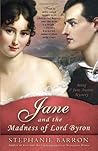
Jane and the Madness of Lord Byron (Jane Austen Mysteries, #10)Jane and the Madness of Lord Byron by Stephanie Barron
My rating: 5 of 5 stars

I still agree with 15-years-ago me--this is a very good book. 5 stars.

In this one, Jane and her recently-widowed brother are visiting Brighton for a little cheering up time, and on the way they rescue a young woman who is tied up in a coach, being taking north. Turns out, she's being abducted by Lord Byron. (This is fiction, though anything was possible with Byron.) When she's restored to her family, we learn that her dad's a jerk, blaming the poor kid for the actions of a pretty bad guy. This and that happens (visits and dances, that kind of thing), then the young woman is killed, drowned, and her body is discovered in Byron's bed.

You know that's gotta mean Byron didn't do it--but he really feels like the kind of guy who would. Various friends impose on Jane to help clear his name, despite her feelings about the guy. As always, Jane will search for the truth, whatever direction that takes her. Lots of bad guys to choose from here, including the Prince Regent and several people around him. Very salacious.

Caro Lamb is an important character in this one, the young woman who loved Byron to distraction, and she's wild, but super interesting. In fact, this whole novel is a bit wilder, a bit darker, a bit seamier, than earlier ones, even though all of them have had danger and bad guys and way more discussion of sex or sex crimes than you would ever find in Jane Austen's own novels. We are 200 years on, of course, so I think it's good. Realer. Rougher. Jane is undaunted, though even she is a little put off by Caro Lamb's "frankness" about bedroom topics.

Great plotting, great writing, wonderful characters. (I've still got a huge crush on our heroine. However, I fear she would call the literary version of me respectable and immediately forget me. Alas.) These novels are all fun to read, and this is one of my favorites.

Recommended. :)

View all my reviews

Friday, May 10, 2024

Where the Giaour Gets Revenge

The Giaour: A Fragment of a Turkish TaleThe Giaour: A Fragment of a Turkish Tale by Lord Byron
My rating: 4 of 5 stars

It's hard to find a nice, readable copy of this poem.

Kind of impossible.

The only things I could find were online versions--a terrible way to read poetry--and random collections, which in my opinion have more than the whiff of the classroom and are just about as sexy as a scribbled on circa-1970 middle school algebra textbook with the cover ripping off. It is its own thing; it deserves its own covers, rather than sharing them with unrelated works of every type.

So I had to copy and paste and format and print my own copy and sew it up and glue it between cardboard covers I wrapped in muslin that I dyed purple and let everything dry. It's pretty warped and wonky, but it's a book, about 50% mess, 50% cool.

Then I could read it.

I liked it, and I wished there was more of it. It tells an actual story in bits and pieces, out of order, and more context rather than less would have made it more easily comprehensible, but even as is I found it engaging and affecting. The Giaour is a man, a non-Muslim in (what I understand to be) Turkish-occupied Greece who falls in love with a beautiful woman in the harem of Hassan, a powerful man. The poem introduces us to beautiful Greece, then through the eyes of a fisherman we see the dangerous Giaour on horseback, on his way to killing Hassan. Then we have, out of order and from different POVs: Hassan's death at the hand of the Giaour; Leila dropped into the sea, drowned in a bag, by Hassan; Leila escaping the harem dressed as a Georgian page; the Giaour facing Hassan; and then the Giaour holed up in a monastery, living out the rest of his short life in a cell.

Nothing announces the shifts in time, forward and back, nor the change of POV, so it's a bit of a mystery. But there's a lot of power in his language, and I have always liked the rhythms that Byron gave his lines, even when I wasn't very interested in poetry in general. (Some people don't care for his "Destruction of Sennacherib," but I often used that in classrooms full of reluctant readers and it worked well. Especially with good narrators on youtube.)

A nice passage, in the Giaour's own words:

The cold in clime are cold in blood,
Their love can scarce deserve the name;
But mine was like the lava flood
That boils in Aetna's breast of flame.
I cannot prate in puling strain
of Ladye-love, and Beauty's chain:
If changing cheek , and scorching vein,
Lips taught to writhe, but not complain,
If bursting heart, and maddening brain,
And daring deed, and vengeful steel,
And all that I have felt, and feel,
Betoken love--that love was mine,
And shown by many a bitter sign.

The poem is dark and rhythmic and even a bit Gothic, with the suggestion that he might be cursed for his crimes to return as a vampire to destroy those he loves. Fortunately he loves no one...

It's not surprising to read that this inspired Poe to some degree. Poems like "Annabel Lee" or "The Raven," with their macabre and Gothic feel, their regular rhymes, and their powerful rhythms, seem like relatives to this one. There's a definite family resemblance.

This isn't a short poem, but at 1300 lines it's not terribly long, either. (It's about 60 short pages in my edition.) :) Definitely short enough and strange enough and cool enough that it should still be getting attention, IMO--and not just in dusty old textbooks.

Read if you like poetry with love and swords and danger and the ocean.

View all my reviews Where Byron

Wednesday, April 3, 2024

Where Lord Byron Is the Suspect

Riot Most Uncouth: A Lord Byron MysteryRiot Most Uncouth: A Lord Byron Mystery by Daniel Friedman
My rating: 5 of 5 stars

Wow. My 5-star rating is way over the average, which sits right at 3.

I'm shocked at that result. I thought this was a really great novel. (I see a bunch of disgruntled Byron stans gave this a 1. But the most common score was a 5. I get it now.)

At the beginning, I almost DNF'd the book. Lord Byron is the main character, and as most people know, he was kind of a jerk. Mad, bad, and dangerous to know. Probably worse than that. And here, he is portrayed as an absolute malignant narcissist--which he might or might not have been. The Byron in the novel is a horrible man whose only virtue (besides being a good writer, I suppose) is that he generally is honest about himself, not pretending, for example, when he's seducing a woman, that he will ever love her or take care of her or anything noble. Most of the time, there is no sign of virtue, though. He is an asshole and uses his status as a club to injure people that mostly don't deserve his cruelty.

I don't like books with characters I have no sympathy for. That's my biggest turnoff in reading and in movies. Somehow, though, he became, by degrees, more sympathetic to me, and I started to care about him. Then I got into the story. (A similar example: Al Swearengen, in Deadwood, is a dangerous, callous, homocidal prick, but he's also smart and funny and strangely compelling. I should hate to watch him, but I don't.) Anyway, I can't totally explain why I found Byron sympathetic after all, except I guess he's also really smart, and when he's horrible to bad people it is pretty fun.

This is a mystery novel, which is one of my favorite things, and it has all the usual bits: a crime, some suspects, the gathering of clues, additional crimes, danger for the MC, and so on, but it also seems bigger than that. In part, that's because we get a lot of flashback scenes with Byron's childhood, especially revolving around his father, and the story is framed as a much older Byron revisiting the story from his university days. In terms of time, the novel is wider than the mystery, but thematically it's wide, too, touching on mental health and family relationships and the privileges of nobility, and so on, and feels in some ways like a mini-biography. I thought it worked.

There is a satisfying conclusion to the story, and though the older Byron narrating the last chapter casts doubt on some of the exact details of the mystery's end, it feels like it doesn't really matter.

Yes, he's a terrible guy, so I totally understand those who couldn't keep reading. And the mystery is bloody and violent, so that might spoil it for others. But from a certain perspective, there's a lot to laugh at here, not to mention a wild mystery to solve, and I really enjoyed reading it.

View all my reviews

Tuesday, August 8, 2023

Where Rosalind Can't Please Everyone

And Dangerous to Know (Rosalind Thorne Mystery #3)And Dangerous to Know by Darcie Wilde
My rating: 5 of 5 stars

This is the third Rosalind Thorne mystery, and I think it's excellent.

I like Rosalind as a character--bright, decent, lots of gumption, but not a superhero. She has limits. So, believable. Her one-time betrothed is interesting and likable; the Bow Street runner she's bumped into a lot in her adventures is also very cool. She's got friends who write and friends in fancy houses, and not everybody's nice or sympathetic, but lots of them are. It's a great mix, and an excellent setup for mysteries.

This mystery is about an unnamed woman who died outside Lord Melbourne's house, and it's Rosalind's job to figure out what happened even while she's helping Lady Melbourne with missing letters that might be used to blackmail her. (Her husband is in parliament, and her son is destined to be Queen Victoria's prime minister. Her son's wife is Caroline Lamb, who had an affair with Lord Byron and wrote a book kinda about it. All that stuff is true and most of it is relevant to the story.)

Some historical mysteries (in my experience, which is slight to moderate) do a good job with the setting and historical details, and some do a good job telling an engaging mystery story, but relatively few get both right. Stephanie Barron's Jane Austen mysteries are amazing and succeed in both, and C. S. Harris's Sebastian St. Cyr mysteries are another, every title of which I recommend. The Rosalind Thorne series (as always, IMO) is the third that I know of that has great stories in a well-conceived historical setting.

(And all three write under pseudonyms. I wonder if that means something.)

Anyway, this is lots of fun, and I definitely recommend it. I mean, read them in order and all, but when you get a chance read this one...

View all my reviews