Showing posts with label poetry. Show all posts

Friday, August 7, 2026

Where He Should Have Risked It

Cyrano de BergeracCyrano de Bergerac by Edmond Rostand
My rating: 5 of 5 stars

Yes. It *is* that good. For real. 5 stars.

I first read this back in 10th grade. Mr. Vanciu (he was awesome) made us do book reports in world history class, and this was one of my choices. Even then, reading it on my own, going into it without a great deal of interest, I liked it. Almost fifty years further on, after enjoying a few different adaptations, I've finally come back to the original (in translation still, obviously), and found it entertaining and engrossing and thought-provoking and touching (and infuriating!) all at once. I'm a big fan of happy endings, but once in a while a really good story can have a sad ending (kinda sad; mostly sad) that still works for my brain and my psyche, and this is one of them.

The language is great. The plot is classic. And the love story is beautifully tragic. (You idiot! Take a risk! Speak to her!) But that's Cyrano. He's brilliant and brave and utterly, immovably stubborn. He loves the beautiful woman, but his appearance prevents him from taking a chance with Roxane. Instead, he puts all of his love and all of his poetry in letters that he sends under Christian's name. He's already handsome; with Cyrano's fine words, his compliments and deep thoughts, Roxane falls completely in love with the young soldier. But it was really the words that won her, not Christian's handsomeness. She has loved the man behind the letters the whole time without knowing it was Cyrano she loved; Cyrano didn't believe Roxane could truly love him until it was too late to matter.

Damn.

Anyway, the updated adaptations are fun, but this doesn't really need any updating. It's perfectly comprehensible as is, and the story does everything it needs to do for a modern audience to totally get it, IMO. Even just reading it, the play works. (I wonder if there's a novelization?) Yes, again, it's that good.

Highly recommended.

View all my reviews

Wednesday, December 11, 2024

Where Samson Does One Last Trick

Samson AgonistesSamson Agonistes by John Milton
My rating: 4 of 5 stars

I rather enjoy Milton, and Samson Agonistes is another work of his that I find interesting and engaging to read just for no reason at all. I am largely a genre fiction reader--fantasy, SF, mystery, pulp--and I'm not terribly patient with dry old poetry, but Milton, for some reason, is a pretty good fit. I'm trying to figure out why.

It's not like he's totally straightforward in his writing. There are so many obscure references and allusions that most of us could get pretty lost. But perhaps I'm fortunate in that I have enough of them in common with him (churchy childhood and all) that I get a lot of it, and the stuff I miss doesn't matter too much in terms of comprehension. Or enjoyment.

But these aren't stories that are hard to follow. IMO, the biggest hindrance to enjoyment of older literature is usually comprehension, and these are, of course, retellings of famous stories; that familiarity is a huge aid to comprehension. Paradise Lost and Paradise Regained are largely fictionalized, with a lot of added material, but the main contours of the story in Genesis are largely intact. This story, basically the last day in the life of Samson, the strongman from the Bible, hews a little closer to the original story, being much shorter, with fewer additional scenes or characters. And I think it works.

If you recall, Samson was an Israelite hero, defeating the Philistines in battle with his great strength. That was a gift from god, and it depended on him never cutting his hair. Delilah, his Philistine wife, eventually coaxed the secret out of him. She cut his hair, taking his strength away, and he was captured and blinded and made a slave. This poem (a Greek-style tragic play, actually) tells about his last day, when his father came to try to ransom him (invented detail), but he got dragged to the temple to perform feats of strength, which had largely returned to him. Then, when he gets the chance, he pushes the pillars down in the temple, burying huge numbers of Philistines and dying in the process.

Now, Milton likes to control women waaaay too much for me, spending a lot of time blaming them (and the men who don't control them) for being kicked out of Eden and for Samson being captured. But allowing for his Puritan attitudes a little bit, the story is generally entertaining and thought-provoking. This poem is just under 1800 lines, making it a little long for a single sitting, probably, but not too long to read in bits over several days. It's not meant to be performed like a regular play, but I like imagining how it could be realized as an animation or radio drama or some other thing...

Anyway, yeah, I liked it. Recommended for people who sometimes read epic poetry or adjacent literature.

View all my reviews

Tuesday, October 29, 2024

Where Satan and Jesus Take a Tour

Paradise RegainedParadise Regained by John Milton
My rating: 4 of 5 stars

Read as a story, as retelling of a myth, as poetry, this is pretty entertaining, and well done. I mean that as a reader separated in time from the author by about 350 years. Dipped into with a little curiosity and a dash of patience, I found this fun and pretty entertaining, even though I'm not the intended audience, and I think many other readers would have a similar response.

As a devotional experience, reading it as a hardcore Puritan might have done three centuries ago, it's probably pretty cool, but I don't think modern Christians can approach it the same way. They might still be charmed by the way Milton approaches matters of theology, even if they don't agree with his take. In any case, that's not my thing now, though I do like that he takes on ambiguities in the language and tries to explain them them for the reader, as he does in Paradise Lost. (In that book, for example, Milton spends some time on the ambiguous phrase "in that day you shall surely die," referring to the day they eat the forbidden fruit. Clearly they don't die that day, so he discusses it, trying to make sense of it. Here, Satan brings up the kingdom Jesus is to inherit, trying to understand what that means: "A kingdom they portend thee, but what kingdom, Real or allegoric, I discern not..." I like it that he anticipates what questions the reader has been wanting to have answered.)

This has received a lot less attention from the average reader over the years than Paradise Lost. It is a much shorter work with a narrower scope and smaller cast, and it's also less "visually" impressive. (There is no scene showing burning demons in hell, no construction of Pandemonium, no description of a war in Heaven, and it's a shame. Those were fun to picture.) It's not entirely lacking, mind you. This part deals only with Jesus getting baptized and then spending forty days fasting in the desert, but that canonically includes Satan tempting Jesus, showing him the great nations of the world and promising to make him king over it all, and those scenes are both awe-inspiring and entertaining. Satan sweeps him magically from one high spot to another, where Milton can describe the amazing scenes all around. It still requires the reader to use their imagination, but it's pretty effective:
With that (such power was given him then), he took
The Son of God up to a mountain high.
It was a mountain at whose verdant feet
A spacious plain outstretched in circuit wide
Lay pleasant; from his side two rivers flowed,
The one winding, the other straight, and left between
Fair champaign, with less rivers interveined,
Then meeting joined their tribute to the sea.
Fertil of corn the glebe, of oil, and wine;
With herds the pasture thronged, with flocks the hills;
Huge cities and high-towered, that well might seem
The seats of mightiest monarchs; and so large
The prospect was that here and there was room
For barren desert, fountainless and dry.

He follows this with a long recitation of the various cities and empires that he could see from that point, which is a chance for Milton to show his erudition:
Here thou behold’st
Assyria, and her empire’s ancient bounds,
Araxes and the Caspian lake; thence on
As far as Indus east, Euphrates west,
And oft beyond; to south the Persian bay,
And, inaccessible, the Arabian drouth:
Here, Nineveh, of length within her wall
Several days’ journey, built by Ninus old,
Of that first golden monarchy the seat,
And seat of Salmanassar, whose success
Israel in long captivity still mourns;
There Babylon, the wonder of all tongues,
As ancient, but rebuilt by him who twice
Judah and all thy father David’s house
Led captive, and Jerusalem laid waste,
Till Cyrus set them free; Persepolis,
His city, there thou seest, and Bactra there;
Ecbatana her structure vast there shews,
And Hecatompylos her hunderd gates;
There Susa by Choaspes, amber stream,
The drink of none but kings; of later fame,
Built by Emathian or by Parthian hands,
The great Seleucia, Nisibis, and there
Artaxata, Teredon, Ctesiphon,
Turning with easy eye, thou may’st behold.
All these the Parthian (now some ages past
By great Arsaces led, who founded first
That empire) under his dominion holds,
From the luxurious kings of Antioch won.

(Spoiler: Jesus says no thanks, we've got a plan already.)

But the huge canvas and the great detail, all delivered in elevated language, is mind-expanding and intellectually invigorating, whether the reader is religious or not. The fact that its only about 2000 lines--about 40 pages--is a plus, too, making it more manageable for uncommitted readers. Overall, it's more impressive and more entertaining than I expected.

I'd like to see this done as an animated feature, with dreamy watercolors. Seeing empires spread across the horizon could be really cool. I wonder if there's a BBC radio show or something we could use for the narration. Hmmm.

Recommended if you already like the series.

View all my reviews

Thursday, June 6, 2024

Where I Read One Too Many Translations of Beowulf

Beowulf: A New TranslationBeowulf: A New Translation by Unknown
My rating: 3 of 5 stars

This is the 1957 translation by David Wright.

It's fine.

I've read about 5 versions of Beowulf this year, and I found this one comprehensible but not very enjoyable. It reads like a rough draft, with awkward sentences that individually make sense but collectively sound off. I can't quite say why it hits me I like that, but I found it hard to read in a fluent way, especially compared to some other versions.

The Rosemary Sutcliff novelization, for example, isn't as faithful to the text, but it reads like a novel. The Seamus Heaney translation, which is a line by line verse rendering of the original poem, is much more aesthetically pleasing, though it comes at a slight cost of comprehension. And the "No Fear" version of Beowulf--actually two versions--has a very clear, made for students, prose translation of the text which might actually fit into the category of "long footnotes," because I don't think you'd want to read it on its own. It's too compact, leaving out too many details. It is useful, though. What surprised me was that the "original" version of Beowulf in that book, the one considered difficult the same way Shakespeare is difficult, is actually very nice IMO. It's prose, but with a nice poetic feel, with beautiful language, leaning toward the sound of the Heaney version.

Anyway, I gave all of those 5 stars. I was hoping this would be amazing in a different way, but it's neither beautifully poetic nor radiantly clear. It's not bad; it works. And the introductory essay is very good, as are the notes and appendices in the back. It's fine. It's just not as much favorite, ya know?

I read somewhere there are hundreds of translations of Beowulf into English. I think we're good now. Should be enough for a bit.

View all my reviews

Friday, May 10, 2024

Where the Giaour Gets Revenge

The Giaour: A Fragment of a Turkish TaleThe Giaour: A Fragment of a Turkish Tale by Lord Byron
My rating: 4 of 5 stars

It's hard to find a nice, readable copy of this poem.

Kind of impossible.

The only things I could find were online versions--a terrible way to read poetry--and random collections, which in my opinion have more than the whiff of the classroom and are just about as sexy as a scribbled on circa-1970 middle school algebra textbook with the cover ripping off. It is its own thing; it deserves its own covers, rather than sharing them with unrelated works of every type.

So I had to copy and paste and format and print my own copy and sew it up and glue it between cardboard covers I wrapped in muslin that I dyed purple and let everything dry. It's pretty warped and wonky, but it's a book, about 50% mess, 50% cool.

Then I could read it.

I liked it, and I wished there was more of it. It tells an actual story in bits and pieces, out of order, and more context rather than less would have made it more easily comprehensible, but even as is I found it engaging and affecting. The Giaour is a man, a non-Muslim in (what I understand to be) Turkish-occupied Greece who falls in love with a beautiful woman in the harem of Hassan, a powerful man. The poem introduces us to beautiful Greece, then through the eyes of a fisherman we see the dangerous Giaour on horseback, on his way to killing Hassan. Then we have, out of order and from different POVs: Hassan's death at the hand of the Giaour; Leila dropped into the sea, drowned in a bag, by Hassan; Leila escaping the harem dressed as a Georgian page; the Giaour facing Hassan; and then the Giaour holed up in a monastery, living out the rest of his short life in a cell.

Nothing announces the shifts in time, forward and back, nor the change of POV, so it's a bit of a mystery. But there's a lot of power in his language, and I have always liked the rhythms that Byron gave his lines, even when I wasn't very interested in poetry in general. (Some people don't care for his "Destruction of Sennacherib," but I often used that in classrooms full of reluctant readers and it worked well. Especially with good narrators on youtube.)

A nice passage, in the Giaour's own words:

The cold in clime are cold in blood,
Their love can scarce deserve the name;
But mine was like the lava flood
That boils in Aetna's breast of flame.
I cannot prate in puling strain
of Ladye-love, and Beauty's chain:
If changing cheek , and scorching vein,
Lips taught to writhe, but not complain,
If bursting heart, and maddening brain,
And daring deed, and vengeful steel,
And all that I have felt, and feel,
Betoken love--that love was mine,
And shown by many a bitter sign.

The poem is dark and rhythmic and even a bit Gothic, with the suggestion that he might be cursed for his crimes to return as a vampire to destroy those he loves. Fortunately he loves no one...

It's not surprising to read that this inspired Poe to some degree. Poems like "Annabel Lee" or "The Raven," with their macabre and Gothic feel, their regular rhymes, and their powerful rhythms, seem like relatives to this one. There's a definite family resemblance.

This isn't a short poem, but at 1300 lines it's not terribly long, either. (It's about 60 short pages in my edition.) :) Definitely short enough and strange enough and cool enough that it should still be getting attention, IMO--and not just in dusty old textbooks.

Read if you like poetry with love and swords and danger and the ocean.

View all my reviews Where Byron

Sunday, April 14, 2024

Where Beowulf Gets Modernized

No Fear BeowulfNo Fear Beowulf by Unknown
My rating: 5 of 5 stars

I generally enjoy and approve of the "No Fear Shakespeare" books, and though this one is not Shakespeare it's just as well done. If someone is reading Beowulf and needs resources, I would absolutely recommend this book.

Unlike the other books in the series, the "original" text here is actually a translation. I can't find who did it or when, but it's technically still modern English although it is archaic sounding. The original Anglo-Saxon is not presented here. This is what the older translation sounds like:

But here in Heorot a hand hath slain him
of wandering death-sprite. I wot not whither,
proud of the prey, her path she took,
fain of her fill. The feud she avenged
that yesternight, unyieldingly,
Grendel in grimmest grasp thou killedst,--
seeing how long these liegemen mine
he ruined and ravaged...


The (even more) modern version, the "no fear" part, is like this:

"A wandering demon has taken him, and who knows where she is now, eating his flesh. She has come to avenge Grendel..."

To be fair, the modern version cuts out quite a bit--it's always about half as long as the original. But I think it does all it needs to in order for a modern reader to clarify what's happening when the older version is a bit dense. Leaving out the poetic bits shortens it a lot.

Though it isn't the point of the book, I still really like the old version, or at least I do when I'm understanding it correctly. Its use of alliteration is very catchy ("proud of her prey, her path she took" and "Grendel in grimmest grasp," etc.) and does a lot of what the Anglo-Saxon original did. There are tons of versions of Beowulf, and the version here does it justice, IMO. If you want poetry, this is poetry. And if it's a comprehension aid you want, the modern translation part is perfectly adequate--which is all it needs to be.

Recommended, especially for students of the text.

View all my reviews

Wednesday, January 17, 2024

Where Petrarch Like Likes Laura

The Poetry of PetrarchThe Poetry of Petrarch by Francesco Petrarca
My rating: 3 of 5 stars

I am not attempting to be a poetry critic. I am a "reading for fun" critic. IMO, Petrarch's not that fun. A little. 3 stars.

I found some poems and lots of lines that are fantastic, well worth reading, and I have some good things to say overall. But in general, as a book for passing some quiet moments, this isn't that great. As alway, YMMV, but I don't think most modern readers would enjoy steadily reading through this book very much.

I'll give the translator all the credit in the world. This reads well in English; though it doesn't rhyme, and I don't think a lot of attention was given to rhythm (though some, clearly), this is still poetry, much of it still able to connect with a modern reader. It sounds good.

It's just that it's almost all--and famously so--aimed at the one particular beautiful woman that he fell in love with as a young man and only kinda knew, and it gets tiresome. There are only so many puns on her name (Laura, connected to laurel trees, and l' aura, a wind, and a similar word for gold) that can be used before you're tired of them; there are only so many references to the lights of her eyes or the path her feet have trod that you can take before you have had enough of those. The first 150 poems or so feel like he's playing, pretending to be sick with love, as if he'd randomly chosen her to be his muse for a display of courtly love in poetry. But the longer he goes on, especially the years after her death, the more it sounds like an unhealthy delusion, a life wasted on the unattainable woman he turned into a saint.

Just too much.

Still, some of it's pretty. Here's how he feels (#292) about being left alive after she had died:

...and still I live, which makes me sad and angry,
abandoned by the light I loved so much,
lost in a storm, on a dismasted ship.

So let my love song have an end here now;
the vein of my accustomed wit is dry,
and all my lyre can produce is sobs.


And this expression (#300) is excessive, but just within bounds, perhaps:

How much I envy you, you greedy earth,
who get to clasp the one who's taken from me...


His last poems, when he's feeling old and Laura has been dead a long time, are so sad and pathetic and overly religious I want to shake him. Find someone else! What are you doing? It feels like mania, not an homage. And the same figures of speech get reused over and over. Maybe the excess is the point. I dunno.

Overall--some great, long-admired, critically-acclaimed, beautiful poetry. Too much of a good thing, probably.

My recommendation if you want to enjoy these more than me: pick a poem at random, just one, and read it carefully. Enjoy it. Pull it apart if you like, or just let it roll over you. But stop there. Don't keep shoveling them in like eating sour patch kids, one after another, until your stomach hurts and your mouth is sore. Too much. One at a time. Wait a week or two and choose another one. Space it out.

Mildly recommended.

View all my reviews

Monday, October 16, 2023

Where Ovid Surprised Me

MetamorphosesMetamorphoses by Ovid
My rating: 4 of 5 stars

Here's another book I never intended to read, but I'm glad I did. And it's such a pretty edition--that cover is so nice.

I came across this at the thrift store. Impulse buy.

I found this surprisingly readable. By that I mean the original (Ovid's retelling of the stories) is quite entertaining and the translation is very clear and comprehensible. (There are also useful notes in the back which somehow I didn't notice until I was 3/4 of the way through. That was unfortunate--they're quite good.) Focusing on the source material, I'd say this is still pretty entertaining reading even in 2023. Interesting stories, interesting characters, lots of myths that one might know and might not...

Don't get me wrong--I HATE some of the stories. They're so unfair. Over and over again, one of the gods rapes a woman and then changes them into a bird or something, or one of the gods kills a dude for accidentally glimpsing them in the water or some other wholly unjust, criminal thing. I got so mad over and over when gods behaved very badly and humans paid the price, especially since nobody is saying "Hey, that's not right!" Ovid didn't. I only noticed one place where something like "the gods are not fair" is said, though I'll admit there might be more evidence of that if I scoured it from the beginning.

The cruelty and injustice can be hard to take, but it's a little easier if one reads it like an anthropologist, trying to understand the mind and the worldview of an ancient person living in a universe that is that cruel, that unfair, that capricious. I found myself wondering how we escaped that at all, and to what degree we have escaped such a horrific worldview. Reading it with that kind of mindset, at that remove, I found it more entertaining and less horrifying, more like a comic book or a superhero movie or a fantasy novel that is clearly not real.

And they're not all like that. Many of the stories are happy (or happyish) and don't require any special philosophy to enjoy. And the structure is very interesting. A lot of it is like 1001 nights, where stories get nested, and maybe one story gets forgotten for awhile and then we get back to it. (This edition does a good job of adding headers so that you can see what story you're in.) Though I won't lie--since I read this in small bites over many days, I often, even usually, forgot who was talking in each scene, who was telling the story. A more careful reader might want to keep notes in the margin or sketch a simple outline as they go, if it would help them keep things straight. But that's not entirely necessary. It's still good without such careful, critical reading.

Honestly, though, I'm thinking I might read back through this after enough time has passed to dig a little deeper into the stories and the themes. It feels like it would repay a second read.

Ovid's premise, of course, was to collect in one place and retell in a single narrative all of the most interesting stories from myth and legend that include changes--from human to animal or natural feature. It's kinda shocking how many such stories there are. So many rivers are made from the limbs of people or from the tears of someone; so many prominent rocks along the coast are the remnants of people; so many birds were originally people. That's just a common trope or motif in myth, I guess.

As literature, as I said above, this is quite readable, and I recommend it for all those who have seen it mentioned a thousand times here and there and kind of wondered about it. There's so much action, you'd be surprised how fast the pages turn. But get a recent translation like this one. Worth it.

View all my reviews

Friday, October 6, 2023

Red Pine and Cold Mountain FTW

The Collected Songs of Cold Mountain (Mandarin Chinese and English Edition)The Collected Songs of Cold Mountain by Hanshan
My rating: 5 of 5 stars

There is a great deal to recommend here.

If you like the poet Han-than ("Cold Mountain," named for the place where he hid himself away), or the translator Red Pine, or poetry based (mostly) on Buddhist thought, or poetry based (somewhat) on Taoist thought, you will almost certainly appreciate this book. It is a complete collection of Cold Mountain's poetry, with almost every single poem getting a paragraph of annotation. (For those who read Chinese, the original is included, on the facing page. Useful for some. For me, that's just nice art.) And I find Red Pine's translations, always, to be clear and comprehensible without glaring modernisms or strange archaisms. For this generation, IMO, speaking only as an ignorant reader, his translations can't be beat.

Here's a random selection:

Sitting alone I keep slipping away
far off with the cares of my heart
clouds wander by the mountainside
wind rushes out the valley
gibbons swing from the trees
birds call through the forest
time slips past my temples
yearend finds me old with regrets


You hear the poem in unadorned language, without gimmick. I like it.

As I am only academically interested in either Buddhism or Taoism, I'll admit I got my fill of those philosophies before I got to the end of the book. (Lots of verses like "The suffering of the Wheel is relentless/ back and forth stirring up the dust/ the ant patrol on its endless round/ the Six Paths are nothing but confusion...") I lean more towards the type of poem above, the ones that sound more like Wordsworth or something, with lots of nature imagery. But even without a deep interest, I was glad to learn quite a bit about religious thought during the Tang dynasty, just acquiring bits and pieces via the poetry and the notes.

Anyway, it was fine. No doubt others will find that aspect more to their taste.

The volume includes a few poems by two of Cold Mountain's associates. That's just the whipped cream on top.

Lots of people should be reading this. Maybe they are. Nobody has consulted me. But If you like any of the things mentioned above, this should be an easy choice.

View all my reviews

Saturday, August 26, 2023

Buddhist Monk Poets of China

The Clouds Should Know Me By Now: Buddhist Poet Monks of ChinaThe Clouds Should Know Me By Now: Buddhist Poet Monks of China by Red Pine
My rating: 4 of 5 stars

There are many layers to the poems in this book, more than I can appreciate with my current level of understanding, but even an examination only about two layers deep reveals a largely satisfying book. It's not entirely even, but I still found it mostly enjoyable.

Since these poems are written by buddhist monks, they naturally concern aspects of buddhist thought, and I have the most cursory understanding of such things. Simple phrases that I think I understand are explained in the notes to be significant in ways I wouldn't have thought. So that's the stuff I can't appreciate too much. It's like the grown-up jokes in the children's cartoons--just for those who understand.

What I love are the lines and poems about the wind in the trees and the clouds on the mountains, that kind of stuff. As monks, living mostly in mountain monasteries, they produce that sort of imagery a bunch. That's a level that works for me. And that imagery often corresponds to thoughts, dreams, reflections, and emotional states that also are perfectly comprehensible to anyone. That's my favorite.

Here's an example, from the poet Chia Tao, translated by Red Pine (one of the editors):

LATE IN THE DAY, GAZING OUT FROM A RIVER PAVILION

Water to the horizon
veils the base of clouds;
mountain mist
blurs the far village.

Returning to nest, birds
make tracks in the sand;
passing on the river, a boat
leaves no trace on the waves.

I gaze at the water
and know its gentle nature;
watch the mountains
until my spirit tires.

Though not yet ready
to leave off musing,
dusk falls,
and I return by horse.


It's not all lessons in zen. There is talk of war, loss, discouragement, and loneliness, but also joy and friendship and good times and drinking. These poets did their best to shake off the world, but all of them remain aware of it to one degree or another. These are normal people, recognizable in their emotional lives and hopes and dreams despite living, most of them, an ascetic life. There's plenty to connect to.

A number of different translators produced this work, and while they might all do a good job in their way, I receive them very differently. There are a few translators I don't much enjoy here, but there are others that I love. There are other books of poetry I enjoyed more (overall) than this one that I gave the same 4 stars to, but there's a short 5-star book inside this, and that influenced by ranking. :)

This is probably a better fit for those with a greater knowledge of and appreciation for buddhist teachings, but those who enjoy Tang Dynasty poetry--or later--will probably find their own 5-star selections from the book. So, this is recommended for those readers.

View all my reviews

Wednesday, April 19, 2023

Where We Find Beautiful Korean Poetry in Chinese

Among the Flowering Reeds: Classic Korean Poems Written in ChineseAmong the Flowering Reeds: Classic Korean Poems Written in Chinese by Kim Jong-Gil
My rating: 5 of 5 stars

These poems--mostly quatrains, though I'm not sure what rhyme schemes were used in the originals--are exactly what I think of when I imagine classical Chinese poetry. And they are, in fact, written in Chinese, though all come from learned Korean scholars. Many of the poets lived in China and served at court or in the civil service; others remained in Korea and served at court; and others, including some women writers, never achieved either. But all were highly educated in Chinese, because for most of the period covered here (roughly 800-1900 C.E.), all writing done at court in Korea was in Chinese.

The literary models they followed were also Chinese, though the topics and treatments are not quite the same. (Another collection like this was published as The Moonlit Pond: Korean Classical Poems in Chinese, translated by Sung-Il Lee. I really enjoyed that one as well.) In outward form, these seem very Chinese--most of the poems make use of nature imagery; most are written as if spoken to a friend or written in a letter; most contain a speaker who is talking about himself. A nice example is this poem by Yi Kok, who served without great distinction at court in China as well as in Korea (and gave the collection its title):

To a Friend

On a small boat, my lifelong wish unattained,
I return home, hair already white, laughing at myself.
Still I dream of service at the Emperor's court
and forget that I am now among the flowering reeds.


The mountains and northern snows show up in a lot of this poetry, as in this poem by Kwon Kap:
At the Old Capital

The moonlit snow, the color of a former dynasty,
the cold bell, sound of the old country.
I stand pensively on the southern lookout;
clouds rise at dawn above the castle ruins.


There aren't too many female poets represented here, but here is an example of a love poem from Yi Ok-bong:
To a Lover

How are you getting along these days, by lord?
The moon shines at my window and I am sad.
Had I left footprints where I went in my dreams,
the stone path to your gate would have turned to sand.

I love those last two lines. She's visited his home so often in dreams, the stone should be pulverized by now.

The translation works well, in my opinion. No effort has been made to rhyme in English--which I approve of--and the typically elliptical language has been smoothed out a bit for us in most places, though some lines are kept nearer the terse Chinese original, as in the line above: "The cold bell, sound of the old country." We are given articles but no verb, which is a fair accommodation for English-speaking brains. And if the language itself isn't inspired in every line of translation, it is at least good enough that it doesn't draw attention to itself. I enjoyed it.

I find this a very successful collection. Wonderful poetry, an accessible translation, and a nice assortment of poets. The only thing I would have like better is just more of it. Another 100 poems would be nice.

Recommended.

View all my reviews

Friday, March 31, 2023

Where Chia Tao Hits All My Favorite Notes

When I Find You Again, It Will Be in Mountains: The Selected Poems of Chia TaoWhen I Find You Again, It Will Be in Mountains: The Selected Poems of Chia Tao by Mike O'Connor
My rating: 5 of 5 stars

When I imagine classical Chinese poetry, especially Tang era poetry, especially with a hint (or more than a hint) of mystical religion, this is exactly what I have in mind. I may have to check to be sure, but this may be my new favorite volume of poetry. So much to love here.

Chia Tao was originally a Buddhist monk, an adherent of Chan Buddhism (which we would call zen), and though he stayed in contact with other monks his whole life, he dedicated his life to poetry. His religion was a huge part of his writings, including not just beliefs but people and places--the monks, the monasteries, the mountain retreats, and so on. The poetry is filled with trails, waterfalls, trees, and the distant sound of stone chimes, leading him toward remote monasteries. There's a lot of romance in these descriptions, and I'm here for it.

This is a nice example:
Sent to a Hua Mountain Monk

From afar,
I know your white-rock hermitage,
hidden in a haze
of evergreen trees.

When the moon sets,
it's mind-watching time;
clouds arise
in your closed eyes.

Just before dawn, temple bells
sound from neighboring peaks;
waterfalls hang thousands of feet
in emptiness.

Moss and lichen
cover the cliff face;
a narrow, indistinct path
leads to you.


There's a Wordsworth/Tintern Abbey feel to this, and I love it.

The translation is beautiful. While in some places the original elliptical phrasing is preserved (no verb, no article type of language) it is very readable and clear to an English language brain, and there's not a rhyme to be seen. (Rhyming poetry in translation is unbearable to me. A harmless prejudice, I hope.) Where it's helpful, the translator has provided notes in the back, so the reader can have the assistance without marring the look of the poetry, and I give him full marks for that choice, as well.

A lot of the poetry is contemplative and tranquil, and I adore it. But there's also a lot of emotion brilliantly captured.

Mourning the Death of Chan Master Po-Yen

Fresh moss covers
the stone bed;
how many springtimes
was it the Master's?

His profile in meditation
has been sketched;
but the body of the meditator
has been burned.

Snow in the pines
has closed the pagoda courtyard;
dust settles in the lock
on the sutra library.

I chide myself
for these two tears—
a man who hasn't grasped
the empty nature of all things.

That's very sweet. Lovely.

Highly recommended for readers of Tang poetry, or poetry more generally. Beautiful poetry nicely rendered in English, it bears many re-readings.

View all my reviews

Friday, February 17, 2023

Where There Is So Much Color

Poems of the Aztec PeoplesPoems of the Aztec Peoples by Edward Kissam
My rating: 4 of 5 stars

This book of poetry translated from Nahuatl (the language spoken by the Aztecs and others) is interesting and entertaining, but it's not (IMO) like other poetry you might read for pleasure. "Exotic" as a modifier has gotten a bad reputation, tending to indicate paternalism or condescension, but in the less judgmental way--meaning "outside my experience" or something like that--there's no denying that these verses feel exotic to a Western mind.

Some of it is the unfamiliar culture it comes out of, naturally, but no little part comes from the setting and the natural world that gave birth to it. We find references to jade, emeralds, turquoise, and obsidian; macaws, quetzals, herons, and hummingbirds; vanilla, corn, tobacco, and chocolate; jaguars, deer, and rattlesnakes; gongs, drums, and tortoise shells; and mountains, oceans, caverns, and canyons. Images are filled with weapons and references to war on the one hand and flowers, butterflies, rainbows, and feathers on the other. Add in the names of towns, gods, and kings that are little known to most of us, like Tenochtitlan, Anahuac, Nezahualpilli, Cacamatl, Ayocuan, Huitzilopochtli, and Xochitquetzal, you feel like you're looking in on a colorful, vibrant, exciting land which owes nothing to our own. These are people like us--but their world isn't like ours.

It is amazing and a bit disorienting. Beauty sits right alongside cruelty and ugliness, poetry and flowers right next to ritual bloodletting and human sacrifice.

I found it hard to read these poems as just poems, looking for the beauty in them, enjoying them as art. They are too culture-bound to let me sample them that way. This is poetry that makes sense in the context of its own world but is very hard to connect to ours. What I mean is that I don't see me here very much. But there are striking lines and images that are still fantastic, and they're all over these pages:

Blue birds, black birds, come
where the tree of blossoms grows--
its precious clustered leaves!
Come dark birds, blue birds,
and you, green quetzal!
You come from Nonohualco,
the land by the water,
precious birds of Ipalnemoani.
You are his creatures. Come!

Here, in the house of moss,
spread like a flower
is the head-dress of the blue bird.
He came to contemplate the dawn.
All your birds are waking.
The gold tzinitzcan preens,
the red quechua, the blue bird
who screams the dawn.
Their morning
wakens you.


And here is the beginning of a love song:

I am scattering
different kinds of flowers.

Here I come to give you songs
to make your head spin, flowers,
as I smile at you.

I come from where the water
gushes out of the earth.
I've come to offer you songs,

flowers to make your head spin.
Oh, another kind of flower
and you know it in your heart.

I came to bring them to you,
I carry them to your house,
on my back,

uprooted flowers,
I'm bent double with the weight of them
for you.


Flowers, the translators tell us, sometimes refer to sacrifice and blood, often refer to poetry and language, and just about as often refer just to flowers. But it might be all of them at once.

Beauty and blood.

There's a lot to love here, but it's a little hard to enter in the poetry in a personal way. So I'll just stand as close as I can and peek over, taking in all the color.

View all my reviews

Wednesday, February 8, 2023

Where It Didn't Please Me at All

Cloud Gate Song: The Verse of Tang Poet Zhang JiCloud Gate Song: The Verse of Tang Poet Zhang Ji by Jonathan Chaves
My rating: 2 of 5 stars

I usually enjoy Tang poetry; its topics and themes and vibe in general I find very compelling, and I usually find lots to relate to. And I usually like the translator, who is responsible for two other books that I really enjoyed.

I didn't like this one at all.

No, I amend that--I liked some of the shorter poems at the end of the collection. But the longer ones up front I actually kind of hated. Some is the author, whose poetry is mostly not interesting to me, but the rest is all on the translator. I mean, he did it with malice aforethought.

He made it rhyme. Ugh. No.

To be fair, he made a compelling case for it in the introduction, and I kinda thought he was gonna win me over. He doesn't usually try to make it rhyme, but he wanted the reader to come nearer the original experience than is possible with the usual translations. So I gave him a chance. For me, it's still a no. Too many rhymes are awkward, with inverted grammar, like rhyming "broken" with "the words inscribed effaced, so of the date there is no token," or "aback" with "and so I learn how illness does attack," and "pestles in mortars endlessly do smack." It isn't just that I don't care for it; when I read it, my inner narrator starts getting into a sing-songy style and I literally don't know what I'm reading. I re-read so many poems here, some multiple times, and that rhythm and rhyme pulled me back in like a poem in a Hallmark card.

Obviously, others may feel different about it. They might enjoy it. Me, I found myself getting mad. La d-da d-da d-da, la d-da d-de... I shoulda DNF'ed. But it got better, some. I liked the poems more when the translator (who, again, I normally really like) used slant rhymes and other approximations so that it didn't force my brain into a nursery rhyme gallop. (That's why this gets 2 stars. It was gonna be my first ever 1-star review, but I liked some of the short poems at the end.)

Because I prefer to be encouraging I'd like to direct anyone who gets this far to please check out "Pilgrim of the Clouds," and "Heaven My Blanket, Earth My Pillow," to see Ming and Sung poetry (respectively) beautifully translated by Jonathan Chaves. And if you have no hangups about poetry rhyming in English translation, have at this one.

I may investigate Zhang Ji to see if I like his poetry after all. (Not sure if there are other translations. Hafta google.) Right now I can't tell.

View all my reviews

Monday, January 16, 2023

Where I Wanted More

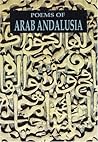
Poems of Arab AndalusiaPoems of Arab Andalusia by Cola Franzen
My rating: 5 of 5 stars

This is a very accessible collection of poetry that gives the reader entry into an exciting time and place that one could hardly reach otherwise. Originally written in Arabic and collected about 800 years ago in Andalusia, which is now in Spain but was then under Moorish control (and had been about 500 years at that point), it includes poems written centuries before that. There is such a mixture of cultures and peoples coming together in that period in that area--Christians, Jews, Muslims; Arabs, Berbers, Goths; speakers of Arabic, Spanish, all of their variants, as well as other languages--and such a melding of their various histories that I find it amazingly rich. This poetry reflects much of that, which is what attracted me in the first place. But there's more.

For one, it's a beautiful translation. It's odd, though; the translator worked with the Spanish version of these originally Arabic works. As is so often the case, necessarily, the formal rules of meter and rhyme that shaped the originals is not represented in the English version. I'm okay with that. In fact, I prefer it. Without imposing those constraints, the language and meaning and imagery and (many of the) figures of speech come through clearly, and it's those elements I most admire in poetry.

Here is a line spoken by a lover:
We were two secrets
held by the heart of darkness
until the tongue of dawn
threatened to denounce us

It is perfectly comprehensible to a modern mind, and we are empathetic to the speaker, feeling the sharp emotions of a stolen night of love and the approach of its inevitable end. And yet it seems fresh, the product of a unique mind expressing himself in his own way, preserving those thoughts in writing. This is the collection in a nutshell.

Also, the richness of the culture behind the poetry attracts me, and I want to know more. The joining or mixing of separate cultures is seen in so many verses where, for example, blonde-haired women are mentioned, or the bells of Christians are heard, and then the same Muslim speaker might then reference fountains or camels or gems or flowers or other details that sound distinctly Middle Eastern or Asian to a Westerner. Another connection is between the people and the land. It shouldn't be surprising--but it kinda is--to hear a Muslim Arabic speaker describing the land of Spain and how much he loves it:
Valley of Almería!
God grant that I never see
myself deprived of you!
...And you, friend, here beside me,
enjoy this time, for there are delights
in this paradise not to be found
in the eternal one.

Of course, his ancestors had been in that land many generations at that point, so there really is nothing strange in that except for the realities of the present that we mistake for eternal truth. But it is these striking combinations that make the poetry so special to me--finding familiar human emotions and familiar human thought clothed in unfamiliar images and terms. There is something both unifying and refreshing in that combination.

Additionally, and quite separate from the translation and my interests in the time and place, I feel these poems stand on their own simply as art. These works are universal in the best way and can be appreciated simply as human expression. This short poem is a nice example:
The wind does the delicate work
of a goldsmith
crimping water into mesh
for a coat of mail.

Then comes the rain
and rivets the pieces together
with little nails.

Although we find a lot of military imagery in these poems, those verses could come from any place and any time. The fact that it came from Abu l-Qasim al-Manishi in 12th century Seville is an interesting detail that does not need to affect the value of the art in any way. IMO, he could have been writing in any age and it would have the same impact and the same meaning.

Recommended. My only complaint is that it is a small volume, less than 100 pages. I would have liked twice as much.

View all my reviews

Saturday, January 7, 2023

Where I Agree With the Author

Five T'ang PoetsFive T'ang Poets by Wang Wei
My rating: 5 of 5 stars

This is a very nice collection of Tang dynasty poetry.

I've read other similar books that I thought would make a good introduction to the era and the poets, but I think this may be the best of them. David Young, the translator, is himself a poet, which is not always the case, and I think it shows. Not only does he give the English versions a smoothness, an evenness of tone, that is often lacking, he does an excellent job in the introduction describing how he arrived at his translations, what sort of compromises he was making. I found myself in agreement with his approach both as he described it and as it was demonstrated in the poetry. A strictly faithful translation, transcribing the terse, elliptical language common in most poetry of the time, is almost incomprehensible in English; a highly Anglicized version (especially with rhyme--shudder) loses any hint of the original. I like the middle ground Young has found. In addition, he writes very useful introductions to each of the five poets, and they add to the pleasure of reading these.

Many of these poems are found in other collections, and when I look at some of them closely, I find that I like these better. They read more naturally and, to my mind, have greater impact. As a simple example, the first line in one poem is translated in another book as
You ask how long before I come. Still no date is set.

Young renders the line as
You ask when I'll be back--
I wish I knew!

The first sounds too much like a business letter to me; Young's version sounds--and looks--like poetry. The distinction is not always that stark, but that is the trend.

As to the literature itself, I am partial to Tang poetry. Much of it, especially the ones I understand, read like western Romantic poetry from the 19th century (which is a good thing, IMO). Natural settings and nature imagery; human emotion; an occasional interest in common folk; a focus on art and the creative process... all attributes that I have enjoyed in western poetry and work for me as a reader. It makes these poems, and this collection in particular, accessible.

Unrelated, but key to my reaction: the book, in many places, is annotated. It clearly came from a student taking notes in class, and it was fun to see what the conversation was. Reminded me of a very long time ago. I highly recommend a student-annotated copy if you can it. :)

Good stuff. Recommended.

View all my reviews

Friday, December 23, 2022

Where We Meet Another Famous Tang Poet

PoemsPoems by Wang Wei
My rating: 4 of 5 stars

Wang Wei was another of the Tang dynasty's beloved poets, along with Li Bai and Du Fu. Like other poets, he became a court official, holding a number of posts throughout the country, though it is his country retreat that he most loved. His poetry is filled with nature imagery and bits of personal information--including friends and postings, mostly, with little mention of family other than his brother--but it all feels personal, in a way. Like so many poets of the time, he typically wrote in his own voice; the thoughts are his real thoughts and the feelings presented are his feelings. (Mostly.) There is a small mention (in this volume, at least) of the tragedy of his wife's death when he was only 30, though it is only in the notes that this is made explicit, and it seems odd to me, a modern reader from the US, thousands of miles away and 1200 years later, that he might so directly express sadness at being parted from a friend but suppress and barely mention any feelings he had about a more personal grief. It feels backwards to me. But I suspect that says more about culture and norms, about which topics are deemed appropriate for literature and which aren't, than it says about personality and his true feelings.

This volume is small but contains a good chunk of his known poetry. The foreword and notes are useful, clarifying a lot of the opaque references, and the translation is very readable. As far as the poetry itself, I found I liked most of it but felt drawn to and connected to just a little. My reactions were more like, "Nice, interesting, well done," and only sometimes like, "Oh, right, I get that!" But maybe I'll try a bit in another anthology to see if I can't run onto more of the second type.

Anyway, a nice collection. A lot of readers of poetry might enjoy this.

View all my reviews

Saturday, December 3, 2022

Where I Like It Best in Moderation

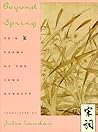
Beyond Spring: Tz'u Poems of the Sung DynastyBeyond Spring: Tz'u Poems of the Sung Dynasty by Julie Landau
My rating: 4 of 5 stars

This is a very nice collection of t'zu poetry from Sung Dynasty China (about 1000 years ago).

T'zu poetry is lyric poetry, meaning these could be (though usually weren't) sung. They originated as songs performed by prostitutes in the singing houses, and over time scholars and bureaucrats (same folks, actually) started to write their own lyrics. They fitted the words to one of about 800 melodies, sometimes as a sort of word game, but later more seriously. It took time before they become respectable, eventually losing their disreputable connection to prostitution and becoming the pastime of many people throughout China, at varying levels of society. This collection is filled with the scholarly type.

The t'zu poems acquired fairly rigid norms, with early lyrics establishing the topics and language that should be used. The intro gives a primer on the most common allusions and imagery, and after reading half the poems here, you will have seen the same themes and same allusions over and over. I'll admit, it loses it's punch eventually... It reminded me of popular American music and the songs about broken hearts and sad breakups, which you can still enjoy even though they are terribly overdone. Here, the most common style is where the poet is either speaking in his own voice or that of his wife, talking about their grief at parting, which apparently was usually done in the spring of the year. (Chinese bureaucrats were shuffled every three years, and it seems that families sometimes moved with them to new cities but often stayed put and just didn't see them for years on end.)

Typically, they part at the water's edge, where they would break off a small willow branch in farewell before he gets on a boat. (One line in a poem says, " The willow strands I've broken, end to end, would reach a thousand feet.") She (his wife or lover) will climb a tower in the evening and lean on the railing, watching for a ship that doesn't come, or he will climb a tower and gaze off toward home. Often, she will see geese or swallows, symbols of communication, and lament the lack of letters. He will wonder why he chased fame and power all these years, and drink himself to sleep.

From a poem by Liu Yung:
I cannot bear to climb the high tower, look out
Gaze longingly toward home--dim and distant
But to stop my thoughts from going back is hard
I wonder at my path in recent years--
Why have I lingered, miserable
Aware that in her room she has looked up--
How many times--and thought she saw my boat on the horizon?
And never known that I lean here
Congealed with sorrow?

I probably exaggerate the similarity of one poem to another; the breadth of topics and language is greater than I'm suggesting here. There is lots of room for expression in this poetry, and I found it sweet and very human. But what is even more significant is the depth of feeling conveyed in this format. Despite the norms and conventions of the genre, a reader (okay, it's me) can feel the true emotion which the poet is describing and likely truly feeling himself. (Almost all of them were men, but not all.) They were alone a lot, working all day and drinking all night, barely knowing what happened with their own families.

As an example, here's a lovely poem by the same author as above.

Yi lin ling <--the melody this lyric could be sung to
Chilled by the cicadas' dirge
We reach the post station at evening
Just after a sudden shower--
The banquet toasts at the gate seemed endless--
Here, where we long to linger, the boat impels you to be off
You take my hands--I see your tears through mine
Words, futile now, catch in my throat
I think of your going on and on--a thousand li of mist and wave--
How dense the evening clouds, how wide the Ch'u sky!

To love and part--what age old anguish
How can I bear clear autumn's desolation too
Not knowing where you'll wake from wine tonight?
The willows along the bank
The breeze at dawn, a fading moon--
Without you, the passing year--
Moments, scenery--all wasted
Were they to rouse a thousand subtle feelings
Who'd understand?

By the end of this collection, I had become full of these poems; I'd had enough. Though not as restrictive, say, as Japanese tanka (and haiku), and not as mannered, they do seem less spontaneous when taking in too many at a time. It gets harder to enter in the meaning when you say, "oh, the waves on the river again," and you become aware of the construction of the poetry at the expense of the meaning. So--moderation, I guess. Let the poetry breathe.

I liked it. I'll come back to these again, and I'll sample them.

One last interesting fact--the women who originated the songs weren't Han Chinese. They were steppe women, according to the translator, bringing their style of song to the dominant culture. I think that's cool.

View all my reviews

Monday, October 10, 2022

Where It's Pretty Damn Awesome

Shahnameh: The Persian Book of KingsShahnameh: The Persian Book of Kings by Abolqasem Ferdowsi
My rating: 5 of 5 stars

This epic poem of Persia, written about 1000 years ago, traces the legendary line of kings from greatest antiquity to the coming of the Arabs and Islam. It's a giant book, filled with heroes, villains, warriors, kings, sorcerers, demons, holy men, and humble folk, all mixed in a story of war and invasion and intrigues, with the founding of cities, great marriages and the cementing of treaties, and the emergence of new nations. There are good kings and bad kings, great champions and shameful cowards, wise counselors and scheming backstabbers, loving wives and self-serving lovers. Some genuine figures from history can be found here, along with a rough outline of dynasties and their dealings with neighboring powers, but most of it is so fictionalized that it reads like myth. That's okay; it's cool myth. It clocks in at almost 1000 pages, even with a few sections summarized rather than translated, so it isn't the type of thing likely to be picked up by casual readers in the West, but I think anyone led to it with any sort of interest will find a lot to enjoy and learn from here.

The original is told in rhyming couplets, and I'm glad the translator didn't attempt that here. Only in a relatively few places--passages that seemed more like song in the original, ten or twenty lines at a time--did he render it in rhyming English couplets, and I felt like that worked. (It reads kinda like the Lord of the Rings, with lots of prose broken up by a song every now and again.) For the most part, the story is translated in very readable and comprehensible prose. Of course, readers like me won't have a strong grounding in the social norms of 3rd Century BCE Persia (for example), so a lot may get by me or other readers, but it feels pretty straightforward anyway. The attitude toward commoners reminds me a lot of British history, so that the way a successful general, for instance, gets snubbed by the king owing to his common origin seems ridiculous and wrong, but it tracks with a lot of cultural traditions I already know about. A lot of it was like that.

One of the best figures in the story is Rostam. As the king's greatest warrior and champion for a long time (hundreds of years, apparently) he always is respected for his prowess, his success, and his noble bloodlines, but as he is not exactly Persian, he is never quite as accepted as others in the story. After he saves the king (again) he's sent back, with thanks, to his homeland. I had a hard time understanding what was going on with him, why he was celebrated but not completely trusted, and it's because (I guess?) he's from Zabolistan, his mother from around Kabul, making him marginalized in a way that I couldn't quite sort out. At any rate, his stories are the most fun. From the back of a giant horse named Rakhsh, with arrows bouncing off him, he defeats men by the dozens, pulling them off their horses. For the king, he wins battle after battle, campaign after campaign, and the king always rewards him with more camels and elephants and servants and hunting cheetahs, pouring gemstones over his head and giving him huge banquets. They love him and celebrate him but never quite embrace him, always mistrusting him a little, maybe like Caesar with his troops coming too near Rome. Anyway, Rostam is an ancient superhero, a good guy in a rough world, and he has enough traumatic backstory and bitter life experience to suit any comic book or movie fan. (I'm sure there are lots of series about the character in Farsi or something. I haven't looked yet.)

It's easy to read this as an adventure story and enjoy it on that level, which I mostly did. I also liked reading it as a sort of window into historical belief and cultural traditions, including the poetic norms and the role of literature, and I found lots to think about there. No doubt there are many other levels of appreciation and study enjoyed by other readers, but I'm not the guy for that right now, so I'll have to be happy with my bit. But I suspect lots of people who haven't heard of this (like I hadn't until pretty recently) would find this both interesting and entertaining and might find room in their life to give it a shot.

Recommended for those souls.

View all my reviews