Showing posts with label Paris. Show all posts

Sunday, January 25, 2026

Where the Author Wowed Me

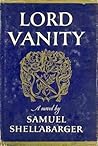
Lord VanityLord Vanity by Samuel Shellabarger
My rating: 5 of 5 stars

I bought this on kind of a fluke, and then I loved it. Start to finish. 5 stars.

Published in 1953, it falls in a dead spot historically for me. This isn't a book I would ever have read 40 years ago, or even looked at twice. As a child of the 60s, and becoming a reader in the 70s, I would choose new kids' books (like Charlie and the Chocolate factory) or new science fiction or fantasy (when I found out about those), and sometimes the odd book from another genre, like The Outsiders or something. Except for novels in school, I very rarely read books older than the early 60s. They didn't appeal. The Hobbit and the Lord of the Rings are exceptions, and I can't think of any others from childhood that broke through. And though I read in school, with *some* interest, Hemingway and Steinbeck and some other early 20th century stuff, I didn't like them enough to read for fun. (Still don't, actually.) And I honestly had no idea there would be any books from 1900-1950 that I would like. They were, to my mind, the ratty old books of another generation sitting on the shelves, all dusty and dry, meant to be passed over.

I wasn't surprised when I found I liked 19th century stuff, like Scott and Dumas and Austen, because I had no prejudice against those books. But I didn't think I'd ever want to read stuff from my parents' or older relatives' era. It's only lately that I've developed an interest in books from that time, an interest in hunting for things that I would like that I have never learned about before, or books I simply tuned out because they weren't for me.

All that is to say that I had no idea that this author existed, and I wouldn't care except that this was a really good book in a genre I really enjoy, an author that I should have been reading all my life. Many of the other titles sound great, and I don't want to count my chickens, but I suspect I'm gonna like a least a few of them.

Some spoilers: The story starts in Venice in the 1700s, with a talented young man trying to make his way in the world with just his wits and his talent. He is a musician and a writer and an actor, but he is also nobody special. His talents bring him to the attention of people who do matter, and he is sent off on a chaotic career. He falls in love with a dancer, a young unaffected woman that the reader is pretty much guaranteed to also fall in love with. He has setbacks--a time on the galleys as a convict, sent there on trumped-up charges--but he is redeemed and travels to England where he is recognized by his noble father, but his hopes for a future with the beautiful young dancer are destroyed by his father's wishes and his fear of falling once more into oblivion. He is a dandy; he is a soldier in Canada; he is a spy. He is an actor, and plays all his parts well.

And all of this is written about with tremendous skill. The love story is touching. The social life in Bath and then Paris, the dances and salons and card sharps and merciless lords and scheming ladies, is compelling. The battle scenes, telling the story of England's defeat of France at Quebec, is amazing, riveting. And the intrigue of Richard spying for England in Paris is very well done, almost too clever for me to follow. I loved the pacing and the layers and on-again-off-again love story. Terrific prose. Very satisfying ending.

It was such a great surprise to learn about this book, this author, this prejudice I had without even realizing it. A lot of new reading is possible that I didn't know about.

Highly recommended. I see other of his books have higher scores than this, and I have great hopes.

View all my reviews

Friday, April 11, 2025

Where Everyone's a Mess

Sacré BleuSacré Bleu by Christopher Moore
My rating: 3 of 5 stars

Not really my thing. And I like Christopher Moore.

I like the connections with all of the artists in Paris. It's cool seeing images of the artwork spread all around. And I enjoyed the last 50 pages or so.

Most of this, though, is just boring, and the plot doesn't work for me. It took me forever to finish the book. There's kind of a mystery--what exactly is going on with the Colorman, the woman connected to him, and the artists? Van Gogh has just died, and so it's a murder mystery, a little bit. (Spoiler: The two odd characters go way, way back, we learn, even to prehistory, and have been working among artists for all that time, inspiring and pushing them and, possessing them, and killing them...)

But the plot takes such a long time getting around to connecting any dots for the reader. Sheesh. Mostly, we follow obnoxious (slightly funny) artists around Paris as they talk about drinking, sex, and painting. The ending is a bit like a fantasy novel, which is good, and it moved faster there, but it barely redeems what is, for me, a slog of a novel.

I suspect that people who know more about art and artists, who have some notion of who these people are as individuals, will enjoy this more. I found it mostly tedious. If I didn't already like the author (which is one reason I gave it a 3), this would have been a DNF for me.

View all my reviews

Friday, April 23, 2021

Making me Root for the Bad Guy

Devil's Cub (Alastair-Audley, #2)Devil's Cub by Georgette Heyer
My rating: 4 of 5 stars

Whew. Heyer pulls this off, but just barely.

The Marquis of Vidal is a bad guy. For reals. He takes advantage of women (as long as they're ridiculous enough and low enough in social status); he gambles and drinks to excess; he gets into duels for stupid reasons, knowing that he will kill the man he's facing because he's done it before; he threatens women in his power; and it seems he really would do every terrible thing he says. (He tells Mary that he will CHOKE HER OUT and carry her if she doesn't do what he wants. I'm pretty sure that goes beyond "problematic.") He's like Darcy mixed with Wickham, if Darcy was also a pirate.

More or less.

But he's not really REALLY bad--at least not in the universe of the novel. He has his rules and he sticks to them. He is protective in his own way. And (spoiler) Mary falls in love with him as much as he falls in love with her, and she is able to curb his worst excesses.

Three quarters of the way through I was not going along with it. I wanted Mary to find a different solution for her problem. (Speaking of problem--the way Mary ends up *sort of* eloping with the marquis without really meaning to is a very clumsy way to get them to France with Mary relying on him and controlled by him. The series of decisions that led her to that point are out of character for her and quite silly. We have to overlook that and let the story unfold.) I hated him and wanted her to get away from a guy I consider dangerously misogynistic, even if my judgment is a touch anachronistic.

However, I'll admit, by the end she has pulled it off. Vidal is largely redeemed, Mary's love for him makes sense, and their HEA is best one the story could have produced.

It feels like someone bet the author that she couldn't successfully make an unlikeable blackguard like Vidal into a love interest, and she took the bet. And IMO whoever proposed the wager should have to pay up.

View all my reviews