Showing posts with label Tang poetry. Show all posts

Saturday, April 18, 2026

Where I Didn't Get It

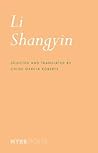
Li Shangyin (NYRB Poets)Li Shangyin by Li Shangyin
My rating: 3 of 5 stars

It was okay.

I generally really enjoy Chinese poetry, especially Tang-era poetry. I was psyched to get this book. But it's very hard to connect with.

A lot of Tang poetry is straightforward, at least on the surface, with concrete imagery and plain language, dealing with being separated from home, or enjoying wine and books, or working in one's garden, or visiting a neighbor, or saying goodbye at the river's edge. Generally comprehensible. And sometimes, often even, the poetry is filled with allusions that are completely unknown in the West, but are explained in extensive notes. (Red Pine does a really good job of this.) Both are absent here. Nothing is simple or readily comprehensible to a Western reader, and the many, many allusions are either left unexplained (most of the book) or are partly dealt with in endnotes (a few). So I struggled to understand or enjoy these poems.

I might succeed with a different collection and different translation and notes.

Like, look at these four lines (from a couplet in the original) and see if you get the author's intention:

Seablue, moonbeam,
Pearls hold tears.
Indigo fields, sun-warmth,
Jade begets smoke.


The book includes other translations of a few poems including this one, and one of those has two pages of notes for this 8-line poem. After working through that, I mostly understand it and can appreciate it some. Without it, I've got nothing but vibes, and I'm way off the mark on most of it.

My polite take on this book of poetry is that it is very challenging. I'm gonna look for a translation with more helps.

View all my reviews

Friday, November 21, 2025

Where Burton Watson Schools Us

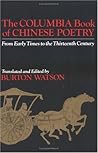
The Columbia Book of Chinese PoetryThe Columbia Book of Chinese Poetry by Burton Watson
My rating: 5 of 5 stars

This is a very nice collection of Chinese poetry, filled with wonderful literature from many time periods, but it is also a useful survey for students or others new to these works.

Much of the literature here is available in other collections, especially the poetry from the biggest Tang writers, but a lot of it was still new to me. And the introduction, chapter openings, and back matter were very useful, even for bits I'd read elsewhere. Burton Watson does an excellent job of explaining and teaching those of us in the West who are unfamiliar with the references and common symbols and the like or are still working out the differences between the various poetic forms. It's hard (but not impossible) to appreciate poetry in translation if you don't have some of these additional helps, and I appreciate how well Burton Watson supported us.

I still prefer books that are collections of works all by a single author--for the same reason that I prefer the original albums to "best of" albums, which are nice but lacking something--so I don't have quite the same feeling when I read collections like this, with examples from so many different authors. It feels somewhat artificial in a way I can't entirely defend. But it obviously has its uses, and this is a very good example of that type of collection. In addition to presenting some very fine poetry and educating me on it, a benefit of books like this one is tipping me off to "new" poets (from 1000 years ago or 800 years ago!) that may have whole books of just their work done by some helpful translator that I can now go look for. I have a few such names that I intend to follow up on.

In general, I love Chinese poetry for it's themes and simple clarity--so much is about loving the land, admiring a beautiful landscape, drinking wine with a neighbor, growing vegetables on a small plot, looking out over a river for a sail you recognize, and other romantic topics--and there's a bunch of that here. I'm aware that there can be many important messages buried in such simple-looking lines, which the editor sometimes clues us into, but even without that it's possible to love much of this literature. My favorites? Wang Wei, Li Po, and Tu Fu, out of the Tang era (who are so popular it is kind like saying you like Shakespeare, but it's true), and Su Tung-p'o, from the later Sung era. However, I'm now on the hunt for books focused on Lu Yu, Mei Yao-ch'en, and a few others. That alone makes it worth looking into this collection.

Wish me luck finding them.

New readers especially should take a look at this collection. Recommended.

View all my reviews

Monday, March 24, 2025

Where I Find Some Great New (to me) Poets

One Hundred Poems from the ChineseOne Hundred Poems from the Chinese by Kenneth Rexroth
My rating: 5 of 5 stars

This is a very nice collection, nicely translated and annotated. I enjoyed it a lot.

Tu Fu, with more than thirty poems in this collection, gets more coverage than any of the other poets, but with only two exceptions we get a good number of examples from every poet here. I like it that way, getting five or ten or more poems from the same poet. This gives the reader a chance to form an opinion of them, get a better idea of what they're like, and maybe follow up by finding collections devoted to each one. (That's what I intend to do, anyway.) Some collections like this have lots of poets with only one or two poems each, and I find that less interesting than the way it is here.

The topics and themes of the selections are pretty universal and generally comprehensible to someone not deeply familiar with culture-bound ideas. You don't need to know much about Chinese culture 1000 years ago to make sense of them or enjoy them. There are some helpful notes at the back (which I realized too late) but they aren't essential. I like it that way--just poetry up front, with background information at the back of the book. It's a nicer esthetic, IMO.

I liked the translations, and for probably half of them I liked the formatting as well. I had just an occasional "I wouldn't have done it that way" thought about how to arrange the lines on the page, but it wasn't enough to take me out of the poetry. In general, I found this a pleasure to read, and I think most readers will feel the same.

Recommended. I already hunted up the second volume, and I'm looking forward to it.

View all my reviews

Friday, April 26, 2024

Where My Review Doesn't Match the Stars

The Mountain Poems of Meng Hao-JanThe Mountain Poems of Meng Hao-Jan by Meng Hao-jan
My rating: 4 of 5 stars

[Please pardon my rant. I have some opinions about 1300-year-old poetry. :)]

The 4 stars are for the poems. (I wonder if it would be a 5 under different circumstances.)

3 for the translation. Barely.

I'm sure the translator is a lovely human, but I struggle to enjoy anything he's translated, at least out of the three books of his I've read so far. (Fool me three times...) One of those was an award-winning translation, so I'm likely an outlier--lots of people obviously thought it was awesome when I didn't. But I bet you money I could identify his translation of a random poem among a dozen others, and not because I love it. (I wouldn't even have to read it, tbh. A glance would serve. He always splits his 8-line poems into 4 pairs of lines. And they're almost always of near-equal length, even if he has to rearrange line breaks to do it.)

Grrr. I object.

(I am perfectly serious, though less impassioned than it might appear. It's fine. I'm fine.)

I like the tone and imagery of these poems. I like the topics. I appreciate the mountain and river locations found in them and the emotions they conjure. There are chunks of the poems here and there I love, and a couple poems work for me from start to finish.

Most don't, however, and that's what I always find with this translator. More than with any other translator of this kind of poetry, I find myself at the end of a poem, realizing I got nothing from any of the lines. I feel like I'm waiting for the verb that never arrives. ("The blue-lotus roof standing beside a pond,/ White-horse Creek tumbling through forests,// and my old friend some strange thing now." Wait what? Reread.)

I get it, the way Chinese poetry is elliptical and evocative, not necessarily grammatical or including complete thoughts. I'm used to that. But he removes most of the cues that a reader uses to parse Chinese poetry into meaningful chunks. He separates what should (IMO) be connected and connects what should (IMO) be kept separate.

Here, in a poem about oranges:

Clambering into branches, she plucks
treasures, opening hidden depths to view,

and touched at how they grow in pairs,
reflections, we feel this mind we share.


I feel like he could have helped us out a little more. I put a pause at the end of the line, after "she plucks." Oops. Nope. "She plucks *treasures*." Okay. Then she is touched... no. Who is touched? "We" are? Isn't that a dangling modifier? And what is "reflections" doing there, stuck in the middle? She's reflecting? She sees reflections? The poet is reflecting? Or is it more concrete than that? It's a noun all on its own. I don't get it.

There are a few notes in the back for some of the poems, and they help, but not too much.

For those who like their poetry to be like puzzles to work out, little riddles, this is probably a good choice. For those (me, I'm talking about) who like to read poetry and connect with the poet's thoughts without the language fighting back, this is a frustrating collection.

Don't rat me out to the author.

Finish on the positive

I still love many of the lines and several of the poems, and the paperback edition is actually very nice, very beautiful. Maybe I'll reread this in a year or two and take back all my ranting.

View all my reviews

Monday, November 20, 2023

The Best Translator for the Best Tang and Sung Poetry

Poems of the Masters: China's Classic Anthology of T'ang and Sung Dynasty Verse (Mandarin Chinese and English Edition)Poems of the Masters: China's Classic Anthology of T'ang and Sung Dynasty Verse by Red Pine
My rating: 5 of 5 stars

This is an amazing book and highly recommended.

Usually, I score based on the ridiculously subjective assessment of how fun was it to read? On that scale, I'll admit, this was about 3.5. But it's so well presented and so well broken down for the reader, I have to give it all the points.

This is a collection of 224 poems from Tang and Sung China, first collected in the 13th century and amended a bit afterwards. Part of what's interesting is seeing what contemporary readers (or readers who were at least several hundred years closer to their creation than we are) considered the most important poetry of those times. I'll admit, it's not what I would have chosen. But the original collectors would have taken into account the appropriateness of rhyme and meter and other effects of language that don't survive in translation, and of course I care nothing for that since I don't read Chinese. I prefer poetry with a lot of comprehensible imagery and easily accessed human emotion that one can still connect with. And there is some of that for sure.

But what there is plenty of is support for the English reader. Red Pine is (in my narrow, unsophisticated but unerring opinion) the absolute best at translating the poetry and supplying commentary making the poetry accessible. The fact that this poetry needs so much support is what makes it not my favorite, but having decided to read it, I can say that this is undoubtedly the best English version to get into it. Red Pine gives amazing biographical details, explicates oblique references to poetry we simply don't know, places the poetry in a specific historical context, and supplies all kinds of cultural knowledge that makes the poems make sense. It's a lot.

Ideally, I prefer to read poetry in books with nothing but the poems. You know? Just the words, just the lines. It's so much prettier to look at and more esthetic to experience. But that wouldn't work here at all, so the half-page or so of explanation for each poem is the next best thing.

There are lots of poems by familiar poets like Wang Wei or Tu Fu or Li Bai, but there are many, many more by poets I'd never heard of. Some of them, hopefully, will lead me to collections of their own.

Anyway, lots to enjoy and chew on here. Highly recommended for those making a study of Chinese poetry. Modestly recommended for casual readers like me.

View all my reviews

Friday, October 6, 2023

Red Pine and Cold Mountain FTW

The Collected Songs of Cold Mountain (Mandarin Chinese and English Edition)The Collected Songs of Cold Mountain by Hanshan
My rating: 5 of 5 stars

There is a great deal to recommend here.

If you like the poet Han-than ("Cold Mountain," named for the place where he hid himself away), or the translator Red Pine, or poetry based (mostly) on Buddhist thought, or poetry based (somewhat) on Taoist thought, you will almost certainly appreciate this book. It is a complete collection of Cold Mountain's poetry, with almost every single poem getting a paragraph of annotation. (For those who read Chinese, the original is included, on the facing page. Useful for some. For me, that's just nice art.) And I find Red Pine's translations, always, to be clear and comprehensible without glaring modernisms or strange archaisms. For this generation, IMO, speaking only as an ignorant reader, his translations can't be beat.

Here's a random selection:

Sitting alone I keep slipping away
far off with the cares of my heart
clouds wander by the mountainside
wind rushes out the valley
gibbons swing from the trees
birds call through the forest
time slips past my temples
yearend finds me old with regrets


You hear the poem in unadorned language, without gimmick. I like it.

As I am only academically interested in either Buddhism or Taoism, I'll admit I got my fill of those philosophies before I got to the end of the book. (Lots of verses like "The suffering of the Wheel is relentless/ back and forth stirring up the dust/ the ant patrol on its endless round/ the Six Paths are nothing but confusion...") I lean more towards the type of poem above, the ones that sound more like Wordsworth or something, with lots of nature imagery. But even without a deep interest, I was glad to learn quite a bit about religious thought during the Tang dynasty, just acquiring bits and pieces via the poetry and the notes.

Anyway, it was fine. No doubt others will find that aspect more to their taste.

The volume includes a few poems by two of Cold Mountain's associates. That's just the whipped cream on top.

Lots of people should be reading this. Maybe they are. Nobody has consulted me. But If you like any of the things mentioned above, this should be an easy choice.

View all my reviews

Tuesday, July 18, 2023

Scholar, Poet, and Servant of the People

In Such Hard Times: The Poetry of Wei Ying-wuIn Such Hard Times: The Poetry of Wei Ying-wu by Wei Ying-wu
My rating: 5 of 5 stars

First of all, this collection of poems is translated by Red Pine, who always does a great job.

Second, Wei Ying-wu writes some deeply affecting poetry that still works in English more than 1000 years later.

So--pretty awesome.

Most of this poetry is 2, 4, or 8 lines of 5 characters, though there are some 7-character lines and other less common formats. And most of the poems are either biographical or part of correspondence, so they reference actual people, places, and events in the poet's life. All pretty standard. What that means to a reader in English is that (as I prefer) we don't get the rhymes found in the original or any real sense of the feel of the language, and we might struggle to identify and understand references that have no meaning to a modern reader, but we do experience the ideas and feeling in these poems, and the translator has done an amazing job of providing context and background information and illuminating allusions that would otherwise remain opaque. We might lose the music, but we get the meaning, and most importantly we experience the humanity.

The poet lived through troubled times--thus the title--including the An Lushan rebellion (and continued troubles afterwards) which created so much chaos and disruption for the country. As a scholar and an official, with a career including many government jobs in many cities, Wei saw how the people lived and suffered all over the empire. "My pitiful fellow officials," he implores, "think of the hardships of those below us." He is referring to peasants who work all day long and can barely pay their taxes, and how families have to provide a worker each year to labor for free on giant projects: "The disaster of war has worn us all down/ there's no vacation from corvée [forced work] and taxes/ the downtrodden masses need help." While trying to enjoy personal downtime, relaxing at a lake, he says, "farmers this month are busy/ living in comfort I think of them toiling/ and wonder how they deal with the heat."

In "Jade Diggers Ballad," he writes:

The government drafts a common man
tells him to dig for Lan River jade
over the ridge, nights away from home,
he sleeps in thickets of thorns in the rain
his wife returns from taking him food
and sobs just south of their home.


In a poem about inspecting flooding along the Ching River, he writes, in part:

I could see the traces of disaster
perfectly good crops in the river...
once-happy homes in ruins...
whole hillsides were washed away...
meanwhile you gentlemen at court
gossip and laugh and think about parties.


It pains him that there is so much that they can't do to help, and even when there is something that might be done, they aren't allowed. One of his jobs was overlooking the corvée, which meant he had to make sure every family did its part in supplying labor for the government, and he was painfully aware of the difficulty of that sacrifice, giving up a good worker when they were most needed at home.

Many of his poems are about visiting with monks or spending time in monasteries, and he often laments not being able to retire to a life of contemplation. He always intends to, but can never quite walk away. "I love to follow trails to monastic retreats," he writes, "to an orchard of fruit trees after a rain.../ where green shade nurtures quiet days.../ my official duties have kept me so busy/ my footsteps have come here too seldom." Other poets and other officials walked away sooner, living more of their own life, but Wei kept taking new positions in the government, trying to do what he could for the people. He remains humble, claiming to be "inept," but you sense he feels like he is doing at least some good. When he's almost blind he finally retires and teaches farmers' children how to read, but by then most of his friends are gone and almost no one comes to visit him. Still, his last known poem is about a visit from a friend in that last year of his life:

You came with New Year's greetings
walking here alone in the bitter cold...
after starting a fire deep in my stove
and closing the door to my empty room
we shared a gourd full of wine
and didn't speak of all the things that went wrong.


Raise a glass to Wei Ying-wu. He really fucking tried.

View all my reviews

Thursday, June 15, 2023

Where the Poet Writes in Exile

Written in Exile: The Poetry of Liu Tsung-YuanWritten in Exile: The Poetry of Liu Tsung-Yuan by Liu Tsung-Yuan
My rating: 5 of 5 stars

I loved this book of Tang dynasty poetry.

In my mind, it is more of a book by the translator, Red Pine, than the poet, Liu Tsung-yuan. Normally, I'd be unhappy about this, but not in this case.

The poetry is amazing, first of all. Liu Tsung-yuan is known primarily as an essay writer in China (which I know from the preface, not from personal experience), though he has a few poems that achieved some popularity. The translator learned he had a lot more poems which had never been rendered in English, and this volume is the result. The poet was a brilliant scholar and civil servant in the Tang Dynasty, holding several important posts in his 20s (following a family tradition of excellence going back generations). Unfortunately, though he and some like-minded bureaucrats had the ear of the new emperor, trying to root out corruption with sensible reforms, the emperor was forced to abdicate by entrenched interests and all of the reformers were sent into exile.

Exile meant continuing to serve, just not anywhere near the capital. He was sent to south China, which was often deadly to those accustomed to the temperate north. After 2 years and after 5, the normal periods of review, he was kept in exile. Even when he was finally called back more than a decade later, he was sent right back to the south, where he continued to serve the emperor and the people.

And write.

Given here in unrhymed verse (thankfully), we have his thoughts and reflections, his feelings, his reactions to life's disappointments, and it's really fine poetry. Personally, as I read verse like this, I look for connections, for discussions of matters that resonate with me, for moments that sound like my life, and though I found some of those moments, and enjoyed them, most of this collection is made up of poetry and language that is absolutely specific to the poet. In the past, I might not have found that of much interest, but here I did. It was a lot like reading a biography in verse, and I liked it.

Like pretty much all Tang poetry, there's talk of nature, of mountains and trails, rivers and trees, rain and fog. As you would expect, we find hints of Taoist thought and Buddhist thought throughout, and poems about monasteries and monks. But not much of it is simply that. Most of the poems are for friends, or recalling specific moments with friends, or written in memory of those who have died. They're based on incidents and his recollection of moments that make them explicitly about the poet and his friends and family, too personal in most cases to feel immediate to a reader like me. (This is not a criticism. I'm only analyzing how I entered them differently than other poetry.) They're still universal in a way, as the life experience of a fellow human, but not in the sense that the words here could ever be mine. No, Liu Tsung-yuan is in every line. It's his voice you hear.

Like this:
Living in obscurity I've given up current affairs
I bow my head in silence and reflect on the sage kings
the highs and lows of the ancient past
the ups and downs of countless paths
I laugh to myself when I'm pleased
when I'm sad I simply sigh
I take my books from their cases
I go through from front to back
despite the affliction of tropical diseases
I feel different than in the past
while reading I suddenly understand
when I'm done my mind is a blank
who can I talk with at night
if not these texts on bamboo and silk


But as I said, this is the translator's book, to me. Every poem comes with notes, usually about half a page. In other collections, I have complained about such intrusion, but here it really worked. It's mostly biographical information giving context to the poems, and it's so complete that it's like reading a story of his life interspersed with illustrating poetry. I found it immersive and compelling.

It didn't work for other reviewers, I see, but I feel like this was probably the most complete and effective book of translated poetry I've ever read. I'm lining it up to read again after a suitable period, and I'm already looking for more books translated by the same person.

And the poet definitely deserves more modern readers. I hope others find their way to his verses.

View all my reviews
Sunday, May 14, 2023

Poetry by Han-shan

Cold Mountain: 100 Poems by the T'ang poet Han-ShanCold Mountain: 100 Poems by the T'ang poet Han-Shan by Hanshan
My rating: 5 of 5 stars

I enjoyed this volume of poetry a lot.

Han-than, a Tang era zen poet, is somewhat popular in China, but for some reason is one of the most popular poets in the West from that era. I'm not sure quite how that happens, but I can say that I really liked the poetry. I agree with the others that there's something important here.

I'm not sure I'd like the poet himself. He talks about the wife he left to go live on Cold Mountain (the English translation of the name he also calls himself) and I don't understand him. I guess he just bailed on her. I only hope it wasn't as bad as it sounds.

But his poetry, filled with nature imagery, ruminations on the pointlessness of ambition, and laments about growing old, makes a lot of sense. It's easy to connect with him on a human level. This collection, translated by Burton Watson, is written in natural language with a hint of poetic language, just the way I most like it. He doesn't try to make it rhyme, and he supplies enough of the missing articles and verbs that it scans well in English. Good stuff.

Here is a representative sample of both the poetry and the translation:

I sit alone in constant fret,
Pressed by endless thoughts and feelings.
Clouds hang about the waist of the mountain,
Wind moans in the valley mouth.
Monkeys come, shaking the branches;
A bird flies into the wood with shrill cries.
Seasons pass and my hair grows ragged and grey;
Year's end finds me old and desolate.

You can hear the poet's voice. You can see the wild natural setting where he has hidden himself. You can feel his loneliness. I think it's just about perfect.

Recommended.

View all my reviews