Showing posts with label science fiction. Show all posts

Sunday, May 31, 2026

Where Bruno Can't Be Left in Peace on his Private Planet

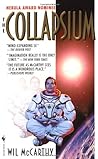
The Collapsium (The Queendom of Sol #1)The Collapsium by Wil McCarthy
My rating: 4 of 5 stars

This is a clever and entertaining SF novel. 4 stars.

The science is hard, or where it isn't really, it looks like it is, because it's realistic-sounding for a non-scientist. (Me thinking: is that how that would work? That would erase inertia? Why wouldn't everything crash together? I don't get it. I guess that's possible...) :) Lots of really big ideas here about how to use mini-black holes in a matrix to achieve pretty much anything you can imagine.

The characters are interesting and, in places, surprisingly well-developed, though the book has a very narrow cast of characters. That made it feel a little underbaked, but also makes it read in a very breezy way, so I guess I prefer it to novels that are overwritten and too long. It's episodic, and really is constructed like three short stories (or two short stories and a novella) stitched together. In each episode, our heroic and brilliant main character is called in when a partially-built invention is being sabotaged in a way that would imperil the sun itself, meaning that he has to solve the problem quickly or humanity is doomed. That's fun. And thematically, that is a very traditional SF kind of story, where we look at the tension between the wonder of new technologies and the damage they might or do cause. He makes it work.

The pacing is great, and the story is cool, but I found the tone a little odd. Some readers talk about how witty and funny it is, but it just seemed a bit off-kilter to me. I love humorous SF, like John Scalzi, but this hit more like a work of pulp fiction or a comic book in tone. That's okay; I like those things. I found it strangely whimsical, I guess, except where it took on a serious tone.

YMMV.

So--pretty fun to read, and successful enough overall to encourage me seek out other books by the author. Nice.

Sure, recommended.

View all my reviews

Wednesday, April 29, 2026

Where It's Nine Hibiscus's Story

A Desolation Called Peace (Teixcalaan, #2)A Desolation Called Peace by Arkady Martine
My rating: 4 of 5 stars

This is a good book, in a lot of ways, which I was expecting; the first book was really great. But even though I mostly enjoyed reading this, the flaws and bad decisions (as always, in my opinion) nearly overshadowed everything else. This was a four, but a disappointing four, which is my rarest score...

Arkady Martine is a wonderful writer of prose. Sentence by sentence, paragraph by paragraph, cool idea by cool idea, she is great writer. Her style is brisk and entertaining, even when little is happening, and that kept me coming back.

But.

Okay, for one thing: Eight antidote, the little kid who will be the next emperor, is just a really boring character. Every time the POV switched to him, the book slowed to a crawl. At the very end, the author gave him something cool to do, an interesting bit of action, and that almost redeems the long, dull pages filled with trivial nothings. Except no, it doesn't. Almost every page devoted to him, except the last handful, could have been simply cut to improve the pacing a ton without losing anything.

Worse, Mahit Dzmare is supposedly the main character, but she's entirely forgettable and pointless in this novel. She's there for a lot of the action, like a fly on the wall or a purse under someone's arm, but she contributes almost nothing. She's spoken of and treated like she's brilliant and special and remarkable, but the author gives her nothing brilliant or remarkable to do. Three Seagrass drags her along on this war adventure, and everything they accomplish could have been done by Three Seagrass alone. Except for their love scenes, obviously. I wanted the Mahit we had in the first book, and she just wasn't here.

The real main character is Nine Hibiscus, the fleet commander, and she is interesting. If the book had been just about her, leaving Mahit out of it entirely, it would have made more sense. She makes a sort of Jean Luc Picard series of decisions, and that was the best part of the book.

If you want an action story with movement and brisk pacing, it's a bit hit-or-miss. If you were looking for spectacle, which an interstellar war promises, you'll get very little, hardly more than a few scattered pages. If you want to see your favorite MC be awesome, you'll have to squint, because it's kinda there, but it's more suggested than shown. But if you read the book for fine prose, or for ideas on language and identity, or for themes such as sacrifice and nationality and cultural hegemony, you'll probably be rewarded.

View all my reviews

Sunday, April 5, 2026

Where Humans Kinda Fade Away

Space (Manifold, #2)Space by Stephen Baxter
My rating: 3 of 5 stars

I found this a hard read.

Almost DNF'ed a bunch of times.

I'm glad I finished it--but now I'm done. It wasn't much fun to read and I won't look for others by this author. I will give him credit, though, for very big ideas, for creating something worth thinking about. Is that a fair trade for my time and effort? Some people would probably say yes. I'm not sold.

This story, as entertainment, is disappointing, despite its constant promise to get good and be really cool. I'd say the last 45 pages do that. I liked that part. The first 400+ were frustrating. And here's my main objection: the main characters do almost nothing. There's an alien invasion and nobody mobilizes; nobody plans; nobody fights back. The whole book reads like a dream where you try to run and can't, and though you keep finding yourself in a new setting it's the same problem--you're passing through like a wraith, having no effect on the story. The characters are sleepwalking through Armageddon.

Nemoto does some stuff, and on page 444 she accomplishes something important on the planet Mercury. That's enough of a spoiler, and I won't give more, but that was the first time for me, the reader, that I thought "Yay! They're doing something!" For all of the rest of the book, until the very end, the main characters are just observers, looking at a small part of history, reporting an incomprehensible piece of the galactic tale. The author lays them out for us like sticks on the beach, and for most of the story it doesn't add up to anything. You (I) think that maybe you're getting the big picture, but nope. That's not it. It's not until the last handful of pages that anything is made clear.

(Have you ever heard one of those jokes that is spun out to ten or fifteen minutes before you finally get the punch line, and it's a joke that could have been told in about a minute? That's how the story and its much-delayed ending felt here--there's a little burst of sense after hundreds of frustrating pages of random weirdness. And in those jokes, remember, the punchline isn't the point. The joke is on the listener.)

In my opinion.

Malenfant and Madeline and others travel here and there, hitching a ride with the incommunicative Gaijin robots, surviving improbably long, pushed into the future by thousands of years by their interstellar travel, seeing the dwindling and scattering human race stumbling into oblivion. Why they're dwindling is just hinted at. There is no story about how nations tried to push back against alien invasion. There is no organized effort to survive. Minor actions are taken on earth's moon, on other moons, on Mercury, where humans are trying to hang on, but these are all chaotic fragments of stories that don't add up to anything. And the Gaijin robots won't talk, won't explain anything, won't interact in any way that matters until the very end of the novel.

I found it frustrating and unsatisfying.

Five for big ideas. Two for being a slog to read. Let's call it a 3.

YMMV

View all my reviews

Friday, March 27, 2026

Where He's Invisible and a Narcissistic Sociopath

The Invisible ManThe Invisible Man by H.G. Wells
My rating: 3 of 5 stars

You know what? It's not great.

I found it mildly interesting, but he could have made a much better story. The first third of this book is the MC tediously trying to reverse his invisibility. The second third is him recounting the dull story of how he became invisible. And the last third is an action and chase sequence that has the book's only fun scenes. It feels like a missed opportunity.

Imagine you're the first person to think of writing a story about an invisible man. Wouldn't you have your character *do* something with this ability, for good or ill, and make the story about that? Make him a hero or a villain, but have him use his ability for something: solve a mystery, track a criminal, rob banks, get intelligence on foreign spies, something cool.

Or if you're just gonna do what H.G. Wells did, make it a short story. This was so thin it didn't demand even 150 pages. It reminds me of Verne's 20,000 Leagues Under the Sea, where nothing interesting (to me) happens; all he did was show us the marvels of this pretend invention, traveling to amazing places underwater. It's as if both authors expected to wow readers with amazing visuals and unusual settings rather than write a very engaging plot. It is still quite short, as novels go, but longer than it needed to be.

IMO, always.

I found a few things to interest me, especially the final confrontations, and I still want to read other famous titles by the author that I have some curiosity about. But my expectations are lower than they used to be. Maybe he'll surprise me. Fingers crossed.

View all my reviews

Sunday, January 4, 2026

Where Charlie Gets Friggin Dolphins

Starter VillainStarter Villain by John Scalzi
My rating: 4 of 5 stars

Very entertaining book.

I always like John Scalzi. It feels like he's using straightforward, plain language, but nobody makes me laugh more. The dialogue, the tone, the clever, smart-ass quips--never jokes--kill me. Scalzi taps into the zeitgeist in a way nobody else quite does, and he makes it work for him.

I almost gave this a 5, and still could, but it feels a little smaller than some of his other books. Lots of fun still, but I wish he gave his MC more to do. He's a good character, but his role could have been played by almost anyone. Except for a few good scenes with the other villains and some stuff with the dolphins (I won't give more spoilers than that) he doesn't contribute a lot.

That's alright. It still works.

I kinda wonder what genre this really is. I read it like SF, but it's not really. Speculative fiction still, I guess. Satire, for sure. Closer to a James Bond novel than SF, though. And again--that's alright. He can write in any genre and I'll read it.

A regular dude getting tossed into the role of a super-villain, having to face other rich villains, is a clever idea, a novel-worthy idea. Giving him friggin dolphins and friggin smart cats is just too funny.

If you like Scalzi, or if you like SF (is it SF?) that also makes you laugh, this is your book. And he's got others.

View all my reviews

Sunday, December 28, 2025

Where the Robots are Tired

The Liberation (The Alchemy Wars, #3)The Liberation by Ian Tregillis
My rating: 4 of 5 stars

In some ways this novel (and series) didn't exactly work for me. It left some stuff out that I wanted, and it wasn't organized the way I like my stories organized. But it's so creative, thought-provoking, profound, and terrifying that it's still pretty damn awesome. I accomodate those contradictions with a 4/5, and I'll kinda explain.

The setup and world building are topnotch. The Dutch invented unstoppable robot servants in the 1600s, and used them to become the greatest world empire. The French, their only remaining enemy, use advanced chemistry to fight back, to hold, to barely survive, though they are forced to move all of government and the Catholic Church to the New World, our Quebec and Ontario, mostly. (The Dutch have the southern colonies.)

The central question of the series, concluding here, is whether the "Clakkers" are sentient beings with a right to free will, something they are denied by the various sciences used by their creators and masters, particularly alchemy. The robots are tightly controlled and are unable to do anything other than what they are told to do. We follow from book one a robot named Daniel who has accidentally gained freedom and escaped to the New World. But we learn he's not the only free robot, and by the third book many have been freed and are rampaging on both sides of the ocean, trampling their oppressors--who never believed they were sentient or capable of thought, and never knew they were committing horrible crimes against thinking beings.

There are many fantastic and horrible characters, brutal and cruel opponents among both the humans and robots, and it's the many factions and points of view that make the story less focused than I would like. The main conflict for humans, in a general sense, is very clear--survive the onslaught of emancipated and angry robots who are much, much faster and stronger than humans. That's cool. But when you try to narrow that down to a more specific goal, to something actionable, it's not there. There's no clear through-line of action; the main human characters are mostly just getting pushed around and chased and scattered. This is foxes and chickens, and I wanted the chickens to come up with something. I wanted to see a coherent plan of action, a coming-together of human factions much earlier, a dramatic push-back with explainable goals. Instead, we get a lot of muddling about, a lot of chaotic movement without purpose, before we reach a quick resolution with a lot of loose ends.

Still great. Very good prose. Lots of big ideas. I had fun reading the whole series, which is awesome in many ways, and for sure there's a lot to chew on. It's definitely worth investigating if you like fantasy.

View all my reviews

Wednesday, November 5, 2025

Where Some People Do Some Stuff in a Place

DecipherDecipher by Stel Pavlou
My rating: 3 of 5 stars

It was okay.

There are a thousand ideas in this book, from ancient civilizations to gravity wave science, from corporate greed to international diplomacy, from golems to ghosts, but they don't hold together all that well. Even though I happily read lots of fantasy and science fiction and pulp, I found the suspension of disbelief while reading this increasingly hard to maintain. Bunches of it--the parts under the pyramids in Giza and under the ice in Antarctica especially--seem a lot like the monumental ancient history stuff out of H.P. Lovecraft stories, and it just never really seems to work.

It's reasonably fun to read. It breezes along pretty well, not hard to digest, though there's just way too many scenes with people sitting around and talking about stuff they know about ancient civilizations and weird things in science, piecing together what's happening all over the world like Robert Langdon figuring out the Da Vinci code. It's meant to be useful exposition, but it's mostly nonsensical. They translate 12,000 year old writing by assuming it's Sumerian, and it works. That's kinda silly. In the end, I found it impossible to care very much about anyone in the story. I learned literally zero of the names involved. I just read what they said and did and didn't worry who was saying it, because it didn't really matter.

This sounds like a 2-star review, and that's slightly unfair. I gave it 3, because it had enough movement and "what's gonna happen?" interest for me to finish it. It was okay. It aimed for big ideas like Jurassic Park and fell short, IMO, but some readers will enjoy it.

View all my reviews

Sunday, September 7, 2025

Where Star Trek Fails to Dazzle

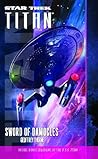
Star Trek: Titan #4: Sword of Damocles: Titan 4 Sword of DemocleStar Trek: Titan #4: Sword of Damocles: Titan 4 Sword of Democle by Geoffrey Thorne
My rating: 3 of 5 stars

This was okay. I enjoyed parts, just enough to finish and give it a 3.

But I was leaning 2 or DNF for a lot of it.

This is the fourth book in a spin-off of Star Trek: the Next Generation, with Riker and Troi as familiar characters, and I hoped to enjoy it. It didn't really work for me. I would probably have enjoyed it more if I had read the first books, but this is the one I found in the used bookstore, so....

I found the action very slow, based almost entirely on characters talking about what they were doing or talking about how far along they were on doing it, with almost nothing heroic or exciting taking place. Most of the action was repairing broken technology or adapting technology, but in a very static way. Titan was trapped by strange waves similar to warp technology, and a shuttle sent to the planet surface was lost (actually split up across time, somehow) and Riker believes Troi has died. On the planet and on the ship, the crew members fight to get free of the phenomenon. Bad things happen. Good guys do their best. Not everybody makes it.

If more of the characters had been familiar to me, maybe I would have cared about them, and maybe it would have been more fun. I dunno. I might try others in the series, maybe hunt up the first ones. Not feeling it right now.

View all my reviews

Tuesday, May 13, 2025

Where Humanity Faces Extinction

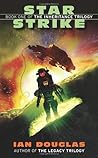
Star Strike (Inheritance Trilogy, #1)Star Strike by Ian Douglas
My rating: 3 of 5 stars

Parts of this novel were awesome. Super fun. It's got a great premise, with humans trying to survive in a universe where the Xul, a very advanced, ancient alien race, wipes out intelligent, technologically advanced species whenever they find them. Humans barely survived coming into contact with them centuries before, and it seems that the Xul have luckily lost track of them. However, they're about to come back into contact.

Great stuff. There's lots of cool technology, much of it based on good hard science, and the rest based on fun impossibilities (like faster than light travel) that make this type of novel work. If it had been all about that, I think this would be a 5 for me. But huge chunks of the novel are given up to a pointlessly drawn-out marine boot camp and a bunch of other military life throat-clearing passages that get super dull. We would go from edge of your seat action to a complete stop, with a couple of people chatting about stuff the author seems to care about. There are long conversations about politics, usually lamenting the way regular people don't understand what it is the marines are doing for them and how ridiculous the public is. You could have pictured Col. Jessup delivering a lot of these lectures.

Then we'd get a little action again. Then stop to have a long chat. I can put up with long technobabble passages in a novel like this, with all the weapons being described and given goofy alphanumeric names, and the origin of the FTL drives explained, and the like. I wish it was only that.

I almost never do this, but I skipped a bunch of it. Skimmed many pages. It didn't matter a bit to the story. And that, of course, was my problem with it. The readers digest version of this story would be great. All the action and none of the dreary, pointless, editorializing conversations.

I wonder if I'm being too hard on this, giving only a 3 and some harsh criticism. Then I ask myself, do I want to read the sequels? Or related series? I don't. And there's a bunch of them, so that's a bummer.

View all my reviews

Sunday, March 30, 2025

Where the Heroes Punch Above Their Weight

The Shattered Skies (The Cruel Stars, #2)The Shattered Skies by John Birmingham
My rating: 5 of 5 stars

I loved the first book in this trilogy, and the second is just as good. Maybe better.

This is a very rich, well imagined universe that is profoundly real in the best science fiction way possible. It is weird and complex and beautiful and ugly, filled with extrapolations from the present that sure seem possible.

The story is a space opera staple, with star-traveling empires competing for survival in an all-out war, but like the best novels it's told from the perspective of about a half-dozen really engaging, well-developed characters with unique voices. They're all brilliant in their own ways, and hilarious, and super fun to follow.

The bad guys, who are clearly fascist and terrifying, are not entirely wrong, and the good guys, who emerge from somewhat freer societies that also include horrible slavers and noblemen and oligarchs who are crushing the common people, are obviously pretty horrible. There's hope, and there are many people fighting for better lives for people, but there's a lot that's pretty bleak. And I feel like this could represent exactly where we'll be someday--where the rich have infinite lifetimes and the poor are completely shackled by their superior tech.

This book ends with a nice conclusion, as did the first book, but it's the larger arc that brings me back, and I'm bummed that the final part was supposed to be out already and still isn't schedule a year later. I can wait, I guess, but I'm ready for it.

In many ways, this has a fantasy feel, with action and stakes like maybe Joe Abercrombie or someone like that, blended with a bunch of John Scalzi dialogue and humor. Highly recommended.

View all my reviews

Thursday, February 20, 2025

Where It's More Science than Fiction

From the Earth to the MoonFrom the Earth to the Moon by Jules Verne
My rating: 2 of 5 stars

This is not a very good book. In fact, I would argue it's not really a novel.

Not because it's short. It is a little short, but it's longer than many pulp novels.

It's that it doesn't contain many of the attributes of a novel. The characters are almost dispensed with for about half of the book--we are instead given calculations and science as if it's textbook.

[skim or skip, by all means]:

But, in order that the moon should reach the zenith of a given place, it is necessary that the place should not exceed in latitude the declination of the luminary; in other words, it must be comprised within the degrees 0º and 28° of lat. N. or S. In every other spot the fire must necessarily be oblique, which would seriously militate against the success of the experiment.

As to the sixth question, "What place will the moon occupy in the heavens at the moment of the projectile's departure?"
Answer.— At the moment when the projectile shall be discharged into space, the moon, which travels daily forward 13° 10' 35", will be distant from the zenith point by four times that quantity, i.e. by 52° 41' 20", a space which corresponds to the path which she will describe during the entire journey of the projectile. But, inasmuch as it is equally necessary to take into account the deviation which the rotary motion of the earth will impart to the shot, and as the shot cannot reach the moon until after a deviation equal to 16 radii of the earth, which, calculated upon the moon's orbit, are equal to...

There are pages and pages like this, describing the motion of the moon, the stresses put on the cannon, the type of gunpowder needed to create a certain kind of explosion, the kind of explosion necessary to move an object of a particular size, the size necessary to make it big enough to see it with a telescope, and the kind of telescope that would needed to do the job... and so on. The text fetishizes numbers and calculations, reveling in them, as if inundating the reader with math and jargon would make us forget how foolish it all is. That's fine. But he forgot a plot. Really, the plot is just planning it and building it and firing it, and much of that happens in a remote way, by unseen hands, and there's virtually no tension or interest anywhere.

The characters are rudimentary and given almost nothing to do except narrate like professors. (There's a tiny bit of personal conflict between the MC and his rival, but that fizzles.) The story reads more like a documentary, or maybe an HGTV renovation show, where it just shows how a job gets done. Except those shows have more humanity in them than this book.

The conflict--"we must build a giant cannon to shoot something to the moon"--is a legitimate conflict, potentially, but it's not given to humans to solve; it's given to physics. The only real obstacle was solving for x. There was a tiny bit of fundraising, but it also amounted to nothing.

Really, this book is what you get when a documentary and a physics textbook love each other very, very much.

And no conclusion, really. The cannon is shot, so you can claim it as a sort of climax, but we know nothing of the three men inside the projectile. Do they survive the initial firing? Does their science work well enough to provide air while they're in there? Do they fight? Are they scared? If he had told the story from their perspective, it would be a lot closer to a novel. Instead, like the crowd gathered to watch the projectile launched into space, we see it fired from the cannon and then... we just wander off, none too sure what, if anything, has been accomplished.

This could have been a very cool short story, and still could be, if we chopped about 80% of it.

Anyway, I didn't hate it, despite my rant. It was interesting as an example of the origins of science fiction. He was aiming for hard science, like Robert Heinlein or Arthur C. Clarke, Liu Cixin or Andy Weir, and it needed to start somewhere. It reminded me of Robinson Crusoe, the way that book also focused on specific, tiny, scientific details--building a home with poor tools, husbanding crops, solving all the problems of survival alone on a desert island--and the through-line from Robinson Crusoe to this to The Martian is pretty clear. I found it worth reading even if just for those insights.

Not much recommended. But who knows? You might like it.

View all my reviews
Sunday, January 26, 2025

Awesome Galaxy-Spanning Space Opera

Infinite Stars: Dark FrontiersInfinite Stars: Dark Frontiers by Bryan Thomas Schmidt
My rating: 5 of 5 stars

This is fantastic and I highly recommend it.

The end.

Seriously, I loved this collection. I found it at the dollar store (the fate of overlooked good books every day) and it really didn't deserve to end up there. Although I haven't read many galaxy-spanning space operas in years, I used to love them. I used to read them in preference to fantasy or mystery, which are my go-to genres now. But this collection makes me want to get back into it, and it gives me a bunch of names and series and titles to go hunt up.

This is a mix of reprints and new stories, though it's leaning towards new. A few of these are quite old, golden age stuff, including stories by Arthur C. Clark, Robert Heinlein, C.L. Moore, and E.E. Doc Smith. Some are from the years between, like stories by James Blish and George R.R. Martin. Then there's a scattering from the 90s and 2000s. But there's a bunch from around 2019, when the anthology came out, including several that tie in to series that are already popular, maybe filling a gap between novels. I think that's cool. It's a good balance, and I generally liked the older ones about the same as the new ones.

In fact, there are only two or three stories here that I didn't really love. All the rest were fun, and a few were awesome. IMO. But I was surprised by that.

TBH, when I have tried in the last decade or two to read SF short stories in magazines, I feel like I'm being tricked, because I almost never like them. They always feel incomplete, or only bad things happen in them, and they're not fun. YMMV, obviously. But I've given up on the magazines; they're clearly for a different kind of reader. But I thought that mean I didn't like SF short stories at all. If this book hadn't been a dollar, I doubt I'd have ever picked it up. Then it knocked it out of the park for me. The Lost Fleet series by Jack Campbell sounds great. I'm intrigued by the Wayfarers Universe of Becky Chambers. Tanya Huff I already knew, but now I'm curious about her SF series. Mike Shepherd's Kris Longknife series looks very cool. And on and on. Lots of tips for future reading.

That is kinda the point of an anthology, though, isn't it? Yes, you want it to be a success all on its own. But then you want to point the reader to a bunch of other good stuff that they've been missing out on. And it sure worked that way for me.

5 stars. If you like SF, especially space opera (and maybe military SF, too) you should enjoy this as much as I did. Recommended.

View all my reviews

Thursday, July 4, 2024

Where Humans Are the New Kids on the Block

Sundiver (The Uplift Saga, #1)Sundiver by David Brin
My rating: 4 of 5 stars

(This is a reread.)

I like David Brin a lot, and this is the first thing I read by him about 40 years ago. I thought I loved this book a little more on the first read than I probably did. I forgot that it's sluggish at times and has a couple problems, as far as I'm concerned. But it's still fun to read, mostly, and deserves a 4 at least for ideas.

The ideas:

The idea of a ship that can survive the heat and turbulence and gravity of the sun long enough to visit the surface to do science is very cool. The idea of long-lived beings existing on the surface of our sun is also very cool. The idea of a galaxy-spanning library is very cool. And the coolest idea behind the novel, that every sentient race in the universe was uplifted sometime in the past by another race (except maybe humans), is super cool. Younger races are clients of older races, and on earth, chimps and dolphins are being lifted to sentience in a similar way. That uplifting is the basis of the rest of the series, and it's the one that makes this SF setting so exciting. However, it's not the main idea here. The uplift stuff *matters* in this book, but it simmers in the background more than I remembered.

The ending is also a bit off for me. It's okay; I like how the characters come out pretty well. But some of the action amounts to a crime that needs to solved, and the solution doesn't really make sense, and has to be explained to us like Sherlock working through the details for Watson and Scotland Yard. It's clunky, IMO. It's as if he wrote the book, racking his brains till the end for a reason certain characters would do certain inexplicable things...

Anyway, the book is still a good read with interesting ideas. Maybe a 3.5, if you give half-points and don't wanna round up. But it kicks off a series that is better than that, and I'm glad after so long to be getting into it again. I traded all the books in long ago, but that's okay--part of the fun is hunting them all down again.

Recommended for hard science readers. David Brin knows his physics. And he's astute about politics. Worth it just for that.

View all my reviews

Saturday, August 26, 2023

Where Olgo's Fighting for the Workers This Time

COLD RISING: A Cold Rush NovellaCOLD RISING: A Cold Rush Novella by Rohan O'Duill
My rating: 4 of 5 stars

This is a smart, brisk novel set in a realistic but gritty future, most of it taking place deep in the mines and awkward workplaces of Mars. It's dark in bits but not too dark. I liked it.

Olgo and his fellow agents are fixers for a giant corporation out of Geneva, and though they have leave to be brutal (and even have their emotions suppressed because of the pain of some unspecified trauma), Olgo is still compassionate and sympathetic. As direct representatives of the company's owners, they (Olgo and his assistants) travel to Mars to oversee compliance with worker protections--something that is clearly not being taken seriously to that point.

The story of twelve-year-old Suong, a worker in a deep pit of Mars, shows the horrors of life for millions of people. The conditions reminded me of workers in Red Rising or The Expanse, though the world-building is unique and rolled out to the reader in a nicely organic way. (There are some resemblances to Murderbot as well, in both story elements and reading time.) The arrival of Olgo and the other agents gives people hope, igniting a storm of demonstrations by the workers and violence in response. Suong survives a riot, and along with Olgo has to find a way to fight back against the uncooperative companies on Mars.

The story reads briskly with good pace from the start, though I found the action and plot of the second half the most engaging. The author does a good job of keeping it human, especially with the evolution of Olgo as a person. The value of individuals specifically and humanity in general is a nice theme worked throughout the story, and it makes a bright contrast to the darkness of the setting.

I enjoyed the novella and look forward to other stories by the author.

(I received an ARC of the novella in return for an honest review.)

View all my reviews

Wednesday, July 5, 2023

Where Scalzi Amuses Non-Curmudgeons

The Kaiju Preservation SocietyThe Kaiju Preservation Society by John Scalzi
My rating: 5 of 5 stars

Come on. You can tell. Just from the title (and the author) you can tell that this is gonna be awesome.

And it is.

John Scalzi has a knack for telling real science fiction stories that have an entertaining plot and characters easy to root for while still managing laugh out loud killer dialogue. Funny. Pitch perfect (it's in the book) modern voices.

Smart people (who also like each other) messing with each other.

It's my favorite.

Another thing I like about Scalzi books, beyond the way they entertain me and make me laugh, is the social critique layered in there. I'm sure it triggers sad puppies (look it up) and others of that sort, but that's a bonus. His books are heavy on diversity and light on talking about it. He has as many great female characters as male. It's just how he puts his stories together. It's a Star Trek universe way of seeing the world, and while he can still have lots of dark stuff, with bad guys and painful events, that sense of hope remains and is key.

If you know Music and Lyrics, you'll get the reference, but even without you'll understand: this book is dessert, but it's also dinner.

5 stars. No notes.

View all my reviews

Tuesday, June 27, 2023

Where the Ideas Are Better Than the Story

Ancillary Justice (Imperial Radch, #1)Ancillary Justice by Ann Leckie
My rating: 3 of 5 stars

This book is filled with some amazing ideas. Tons of clever ways of looking at a possible, strange future. Some of the science stuff was fun to contemplate. But the story was almost uniformly uneventful and slow. Add to that all the impediments to comprehension that one encounters in the novel and it just wasn't all that fun to read--even though I really thought it was going to be, and I was psyched for it.

I don't mind when SF and F novels are filled with invented science, strange names, and made up nouns, like we find here. I like it, in fact. But I need more helping filling in the meanings than we tended to get. Patience isn't always rewarded, as we're meant to infer a great deal, and piece together so many hints of how things work. I still don't know, at the end, the differences or relative sizes of the "swords" as opposed to the ships called "mercies." I don't know whether the ancillaries of a ship all look different or the same. If different, how are they recognized? Same with the versions of Anaander Mianaai. Were the ships ever humans, or are they entirely artificial? I don't understand what happened with the Presger or Garseddai very well. I can't picture a lot of the settings, or how the parts of the empire fit together.

And the central idea, the long-running secret conflict with the emperor (avoiding the spoiler), is still vague to me, and that's what all the action in the last third is really about. I have a sort-of idea, and I kept waiting for the author to make it plain, but she never does. I don't understand the ramifications of the Anaander Mianaai succeeding in quashing that one bit of information.

What we get a lot of is a whole bunch of time in a small town on Ors, where nothing happens for too long. Then there's a bit of local violence that seems utterly trivial to an interstellar empire, but somehow has implications I couldn't make sense of. Then we spend way too long on a snowy planet where Breq runs into Seivarden and wastes a bunch of pages sitting in a house.

I kept believing that something exciting and important and revelatory was about to happen, but it's just a long slow buildup to a confusing fight at the end with stakes I still don't really understand. It's like an exciting-looking firework with a long fuse that just goes "pop" at the end.

Anyway, the creative bits are interesting, and I bet one could set some really exciting stories in this universe. I bet I'd get a bunch of my questions answered in such stories. I'm just not sure I trust this author enough with doing any of that to read the sequels.

As for a recommendation, I dunno. Hugo and Nebula say the book is amazing, and I don't. I'm probably outgunned.

View all my reviews

Friday, April 7, 2023

Where Sherlock Fights the Martians. For Reals

The Further Adventures of Sherlock Holmes - The Martian MenaceThe Further Adventures of Sherlock Holmes - The Martian Menace by Eric Brown
My rating: 4 of 5 stars

This is a fun Sherlock/War of the Worlds crossover, and I really enjoyed it. It's a couple decades after the first failed invasion, and supposedly the Martians are trying to make up for their ill-advised attack. The truth, though, is they are still at it (which is kind of a spoiler except that it's in the title) and they want to remove Sherlock (older here) from the picture. It's silly, of course; the science fiction part, with a thriving civilization on Mars, is impossible, as we know, but the story still works, IMO.

Watson and Sherlock are still the men we know, and so this is still sufficiently plausible in their world to make the plot hold together. We get only a couple new minor characters and a couple call-backs from vintage stories, but it's enough, with the action plot, to make it a fun read. In fact, I almost gave it all 5 stars (which for me means "enjoyed reading," not necessarily "our grandchildren will read this book"), except there are a couple slower parts that dragged it down just a bit. Overall, though, it's clever and entertaining, and the conclusion is satisfying. I would definitely look for other books penned by this author.

I wouldn't recommend this for Sherlock readers who prefer traditional stories, as they'd likely find it too silly to enjoy. Honestly, they're not likely to read past the title anyway. But Sherlock readers who are intrigued by the premise and enjoy pulp fiction would probably find a lot to like here.

View all my reviews

Monday, October 3, 2022

Where I Enjoy an Author I Have Long Overlooked

Eight Fantasms and MagicsEight Fantasms and Magics by Jack Vance
My rating: 4 of 5 stars

This is another cast-off book I picked up from the school library years ago. I left it on my shelf for a long time--in class and at home--before I opened it up, and it turns out it's pretty good. A very even collection.

Vance has kind of a dark view of our future, both for earth and for people, and some of the stories are kinda sad and dreary for that reason, though I still found them satisfying and interesting. Others are a tad more hopeful and just very cool. All of them are deeply original and creative.

My favorite is the one called "Telek," set in a future where a fraction of humanity develops telekinesis to the point that they become wealthy rulers--able to bring back treasures from anywhere in the universe--and they live in a cloud city from which they control the entire population. It kinda reminds me of humans and fairies, but it still feels more like science fiction than fantasy. Told from the perspective of downtrodden common humans trying to take back some control over their lives, plotting a one-shot-at-this-thing uprising, it is compelling and engaging and a little frightening. It has a great ending, too. I recommend hunting this one up. (It's found in several other collections, so it's not that obscure.)

"The New Prime" starts out like a series of dream stories, especially with the first scene being a man waking up naked in a wedding, trying to figure out how he got there and how to proceed. It slides into the story of a platoon of soldiers going up against a hive of giant aliens, then slips into a search through a long-abandoned ruins in the desert, then leads us into a disorienting art competition, with contestants creating images and movies on giant screens for an audience using only their minds, before taking the reader to another kind of battle with the first person protagonist being captured and tortured without end. All of these vignettes make sense in the final portion of the story, when we see how they were all the same person, somehow, and his performance has a score attached. Wildly inventive.

I have never read Jack Vance, though I've seen his books all over for decades. Having enjoyed his short stories, guess it's time I try some of his greatest hits. I'll gladly accept recommendations.

This is a fun collection. Still exists on eBay, for those who enjoy SF of the 50s and 60s.

View all my reviews

Wednesday, June 8, 2022

Where I Take a Sip From a Near-Forgotten Well

Creatures of the Cosmos (Pern (Publication Order) #4.5)Creatures of the Cosmos (Pern by Catherine Crook de Camp
My rating: 4 of 5 stars

This is one of those books I never would have owned if it had not been set out at the high school where I taught, left for the taking as a discard. It lived briefly in my classroom library then came home with me forever--

--where it sat for a long time until recently when I opened it on a whim.

What I forget about many such collections is that they are pretty fun to read, and that they're designed to be the right length to read at a single sitting. That's what I found here. The stories are aimed sort of at young people, and there is nothing technical or sophisticated about any of these stories, but that doesn't mean they're not interesting or have no impact. On the contrary.

"The Bear Who Saved the World" is an uplift story told from the bear's point of view. "Old Man Henderson" gives us a near future where the kind, elderly hero of moon landings is treated as a bore by younger generations who have grown up accustomed to the wonder of space travel. "The Million Dollar Pup" is the story of a handy young girl and an elderly mentor inventing a robotic pet where dogs and cats are outlawed. "The Smallest Dragonboy," the most fantasy-like of the collection, is the story of a bullied underdog coming up big. "The Large Ant" is a first-contact story where we find that humanity's first instinct is violence. "Dead Man's Chest" tells about following a treasure map to a Lovecraftian horror. "Socrates" is the melancholy story of a sweet dog born with human intelligence. And "The Horse Show" tells about a nerdy boy learning confidence from the horse-like creature he brings back from a distant planet.

TL;DR--All of the stories center on an animal or pet or creature, though the character of the creatures and the tone and vibe of every story was quite different.

These stories are all simple, in a way. Quick reads. Limited characters. But they all have surprising depth, leaving the reader to ponder the nature of other intelligences--bears, alien ants, alien horses--and whether they might not be kinder and more generous than we are. They cause one to consider the significance of pets and why we want to lavish our love on them, as well as wonder whether those animals, on the whole, are better or worse off for that attention. They make one think about how small man is compared to the universe. And so on.

On another level, this collection makes me think about all the stories written over the years, the ones showing up in magazines and Hugo-winners collections, where they are read by a few people and then forgotten. Most of the stories are from the 50's and 60's, and one comes from 1938, so that even when the collection was published in 1977, they were being brought back from oblivion. It's nobody's job to keep them alive, I suppose, but it still makes me kinda sad to imagine them languishing in silence on increasingly obscure bookshelves...

I won't try to make the case that there's anything essential here, and this exact book is probably of limited interest to most readers. It's a little dated, obviously. (The words "rocket ship" are used unironically by the authors. It's like that.) This is just one collection, like a hundred or thousand others, which have been mostly forgotten. Any of them might be worthy of opening up if you happen on it, but are not really worth hunting down. However, I wouldn't mind someone else reading these 60-, 70-, 80-year-old stories and comparing their thoughts with mine.

That would be welcome.

View all my reviews

Wednesday, October 27, 2021

Where I Still Liked It After All These Years

Dune (Dune Chronicles, #1)Dune by Frank Herbert
My rating: 5 of 5 stars

I read this in junior high or high school--can't quite pin it down--but I remember it was over a Christmas vacation when I had lots of time just to read, and I really liked it. With the new movie out, I wanted to re-read it and was worried how it would hold up. IMO--it held up very well, and I'm glad for that.

The language is a little different than more recent books. It's odd to find omniscient viewpoint after not seeing it for so long, but there's no difficulty in getting used to it again. I was surprised, though, and how distinctly I remembered most of the scenes; it was very familiar, reading it once more, even though 40 years have passed. Some bits I understood better, paid better attention to, and that helped me like it even more.

Lots of discourse about the book and newest movie, but I don't care to rehash any of it here.

What I like most about the novel is the scope. It reminds me of Foundation, dealing with vast times and distances as well as big ideas. There's something about that which, in addition to engaging my interest and my emotion, engages my curiosity, my sense of wonder, and that's a valuable thing.

Recommended for most.

View all my reviews