Showing posts with label Italy. Show all posts

Tuesday, July 22, 2025

Where Ruggiero Loves Beatrice

The Children of the King A Tale of Southern ItalyThe Children of the King A Tale of Southern Italy by F. Marion Crawford
My rating: 3 of 5 stars

I wish we had half stars. This is better than some books I've called 3-star reads, but I couldn't quite give it a 4. Alas.

But I still liked it, finding it interesting and entertaining for a number of reasons. First of all, it's written in a very smooth, glib way, with unornamented prose that feels more modern than it really is. It was published in 1885, but sounds (to my ear) at least 50 years more recent. Also, it makes Italy of 150 years ago or so very real, and very much a character in the novel. I found that enlightening, and learning often feels fun to me.

The main characters, at least the rich ones, seem like characters in a early 20th century British mystery novel, enjoying a long summer of ease on the Italian coast. The Marchesa, especially, is always lounging, always doing things in a languid manner, never showing too much emotion, and her dutiful daughter is a lot like her, but seems to be half waking up as she is being courted and pressured into an arrangement with a titled but poorer man who she realizes is a bad man too late. If someone had died on page 20, I might have thought I'd wandered into an Agatha Christie novel.

The two young Italian sailors, here called the Children of the King, are interesting in a different way. They are trustworthy but rough; principled; hard-working; and noble in spirit, though thoroughly working class. They man the ships that the wealthy elites lounge on all summer, and they have to watch without comment as their social betters play out their moneyed dramas. The commentary works both ways in the novel, with the rich Beatrice noting with interest the deep convictions and strong spirit of the sailors, though she has no emotional interest in them, while the poor servants (sailors, maids, and so on) watch and inwardly judge but outwardly obey the privileged and pampered elites who, to them, live in a different world. It's easy to see which side the author favored, though he's not too unfair to Beatrice, IMO. And I come down on the side of the servants, who are the more admirable characters here.

Another thing that interested me is how I never could quite decide what genre this book belonged to. Before I opened it, I expected it to be romance in the style of Dumas or Scott, and later I thought it might turn into a romance in the style of Nora Roberts, but in the end it's more like a Henry James novel, or E.M. Forster, or even Hemingway. That is to say, the genre is just... novel, I guess. With a tiny bit of adventure in a warm climate. A tad of romance. A bit of "novel of manners," too. Which all adds up to just novel.

I don't read that very often. It's alright.

Anyway, I like the author's style, and I'll happily pick up another book (off the shelf right beside it where I have 3 more) and the next one might be closer to my type. But this was still pretty good, and since it reads briskly, I think a lot of people who've never tried the author might enjoy it.

View all my reviews

Tuesday, December 10, 2024

Where Fox and Willa Cross Italy

The Last True Templar (Tales of the Lawless Land #2)The Last True Templar by Boyd Morrison
My rating: 4 of 5 stars

This second book in the series, another collaboration between brother and sister Boyd and Beth Morrison, is a lot of fun and a solid historical mystery/adventure. Four stars. Maybe 4.5.

It's another take on the lost and hidden Templar treasure, but it feels fresh just the same. The characters are likable (which I care about, yes) and the conflict is something that feels like it matters, making me eager to see Willa and Gerard reach the place and do the thing. Their happiness and the happiness of people around them is important enough to care about and root for.

Beth Morrison is an actual historian, which makes the details of the times not just accurate but compelling, helping sell the world-building to immerse the reader. And Boyd Morrison is an amazing story-teller, one who knows how to keep on-the-edge-of-your-seat tension going throughout the novel. There is no letup, no relaxing. They are metaphorically chased up the tree and attacked with rocks until the last page of the story.

In fact, that's my only criticism of anything beyond quibbles. Keeping the pressure on the MC's, making it so they are never, for one moment, able to take a free breath makes you keep reading. Ya gotta know if they get through it. But it also stresses me out. I need a breather here and there.

That's just me. It's not an actual flaw in the book, at least not how most people see it.

Anyway, I get a breather at the end of the novel, and it's a satisfying end, leaving me eager for the third book.

Recommended.

View all my reviews

Sunday, June 9, 2024

Where the Narrator Is Just. The. Worst. But Interesting

The DwarfThe Dwarf by Pär Lagerkvist
My rating: 4 of 5 stars

I found this book intriguing and kinda fascinating, and I don't know why. Gimme a minute.

[It's from the 40s, translated into English in the 70s--so the title is very uncomfortable. Forgive me if I just leave that aside for now.]

The story is told from the perspective of Piccoline, a little person in the court of a prince during the Renaissance. It's clearly meant to be a fictional version of Florence, with a fictional version of Leonardo da Vinci as a minor character, but most of the plot is invented. Piccoline is a horrible, misanthropic character, clearly a narcissist and probably a sociopath, although the novel obviously doesn't say anything like that. He delights in war and ugly things, is cruel to people, and doesn't have any concept of empathy, so he's hard to follow, in a way. You'd never want to know him. Nevertheless, the story, as it's told in his voice, is compelling.

[As a personal note, I am one of those "won't read books with unlikable characters" people, but I've read three things lately with very unlikable sociopathic or narcissistic characters, yet the books worked for me. I'm still working out why as I type.]

He believes he is not human, but a race apart, so he watches humans with interest but no compassion. He accompanies the prince to war, and never stops loving the violence. When they have to make a peace treaty, he is horrified, but the prince uses him to poison his enemies, which makes him very happy. Really, he just wants to lash out, like the prince's bad angel tempting him to foolish acts. Then they are besieged, and he's annoyed at the peasants taking refuge in the city:

The refugees are more and more disliked, being regarded, and rightly so, as the cause of the food shortage. They are a burden to the citizens. Most unpopular of all are their whining dirty children who go begging all over the place... They are stupid like all peasants, and spend most of their time sitting and staring.


His reflections are always this way, showing no comprehension, no compassion, no humanity. When plague starts to kill the people, he's glad just to see there be fewer peasants left in the city. When the prince's young daughter falls in love with his enemy's son, like Romeo and Juliet, [serious spoilers here] Piccoline discovers the boy in her room, tells the prince, and is super happy to be there when they kill him. He doesn't care that the girl loved him and later kills herself.

He's the same way with the princess, who he probably loves in a toxic way. She hasn't always been nice to him, but she has always trusted him with her secrets, including her lovers, which causes him so much jealousy. He is happy to include her most recent lover in the poisoning, which brings her to a crisis of conscience, where she feels that she has caused all the suffering in the city and can never be saved. She begs him to help her, but he says that she cannot be helped and will go to hell. He never relents on this and never shows her the slightest kindness.

So... he's horrible. But the whole time, it feels like he's serving some purpose, that the author has created him to be the incarnation of cruelty or spite or something, or the representation of all hurt, and trying to puzzle that out is a big part of the reading experience.

That's not my usual thing, either. But the story is stuffed with the narrator's observations on life, and they're all so toxic and ugly that it's almost unbearable, but they're not unique to him. He is speaking like the voice of human intolerance and cruelty, and it's interesting to hear, like a truth unearthed.

[Nothing but spoilers ahead.] The story ends with the siege ended by plague, the princess dead by starvation and negligence, and the narrator in the dungeon for his cruelty to her. The people who survived return to their lives.

I picked this up on a discard pile years ago. I only recommend it to other readers because I want them to get back to me after they're done to tell me WTF they think happened in this book. And why did I kinda like it?

View all my reviews

Thursday, August 29, 2019

Where the Story's Too Damn Real, but I Like It

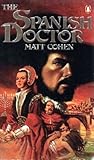
The Spanish DoctorThe Spanish Doctor by Matt Cohen
My rating: 5 of 5 stars

This is a hard book, a painful book, but a good one. Well written. Affecting. Not what I expected, frankly, but that's on me.

This is the story of a Jewish man in 14th Century Spain who becomes a successful doctor, much in demand, but finds that doesn't protect him from his enemies. As much as anything, it is a biography, following him across Europe and across the decades of his life. But in a broader sense, it is the story of the violence against Jews at that time in Spain and France and Italy and elsewhere in Europe, and the intolerable choice they were given--convert, giving up your identity, or face extermination at the hands of the mob, which was fully supported by the church. And, if you convert, be ready to be hated and attacked anyway.

There was one more choice: move away, losing everything, but still face the same violence in another country, sooner or later.

It is suffocating and horrifying to read about Avram Halevi and how he tried to navigate a world that hated him from birth. Before birth, really, as he was conceived when a Christian rioter raped his mother. This theme continued throughout. There were no right choices for him or for his people. There was no "Just leave us alone" option. There was no hiding. There was only murder and destruction, followed by the survivors rebuilding and moving on.

This novel is more literary than I expected; I took it for more of a genre novel, historical fiction with a triumphant hero sort of thing, but it's not that. As a result, the pacing is different than I looked for, the story and conflict broader. But I liked it, despite my scant appreciation, usually, for literary novels. The writing is spectacular, the canvas is wide, the history is engrossing, and I'm glad I gave it a chance.

Some of it is ugly. Some is brutal. Some is tragic. But some is beautiful and even hopeful. I'm gonna hold on to those bits.

Recommended, especially for those who lean toward literary fiction.

View all my reviews